When Arlington’s remodeled and upgraded Fire Station 8 at the corner of Langston Boulevard and North Culpeper Street held its grand opening in April, it was the culmination of nearly a decade of advocacy by, among others, the Old Dominion Citizens Association.
The neighborhood, which was established in 1907 but traces its roots to the mid-1850s, builds bonds through fighting for community causes — all while seeking to preserve connections with the past amid the area’s steady push to expand and modernize.
Richard Lolich, a resident of Old Dominion since 1983 and past president of the citizens association, recalled the proposal in 2015 to move the historic fire station to a new location within neighborhood boundaries and expand it to become a large emergency response center. While the idea concerned residents of Old Dominion who worried it would disturb the neighborhood, it also bothered neighbors in the historically Black Highview Park, also known as Hall’s Hill, who didn’t want to lose the station.
Leaders of both neighborhoods collaborated to voice objections and work with Arlington County to develop a new plan.
“It took months and months of work by a lot of dedicated people in the neighborhood, and it also enabled us to reach out and work with our fellow neighborhood, over in Highview Park, which we had not done before,” Lolich recalled. “And so it solidified those ties, and to this day, people in both neighborhoods remember that and are thankful that we did that … and to be able to rebuild and enlarge the fire station.”
For Rana Bortot, the current president of the citizen’s association, the next objective is clear: see through the long-standing work to fund and install a neighborhood park in Old Dominion. After about 30 years of requests and debate, they’re getting close, she said. The park proposal is now in the Arlington County Capital Improvement Plan, and she expects to see funds for a feasibility study allocated in 2028.
“We are the only civic association in all of Arlington County that doesn’t have a park,” she said.
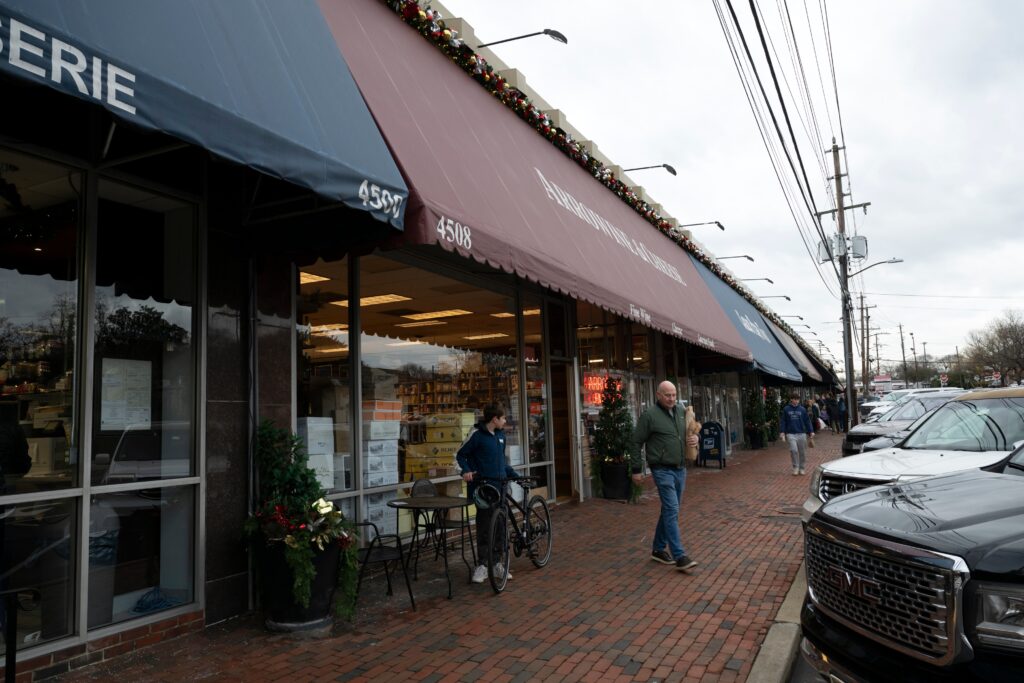
While that work continues, Old Dominion offers easy access to just about everything else residents could want. Bisected by two parallel thoroughfares, Old Dominion Drive and North Glebe Road, it provides a smooth and straightforward commute into D.C. Just outside neighborhood boundaries, the Lee Heights shops showcase beloved small businesses, including Pastries by Randolph, Arrowine, and the French bistro Cafe Colline, one of the area’s hottest reservations.
The neighborhood abuts the quiet Marymount University campus and includes Missionhurst, an 80-year-old Catholic mission encompassing a serene green space where locals love to walk their dogs.
Dog walking, further aided by neighborhood access to Arlington’s Custis Trail, is a key source of social connection in the neighborhood, Bortot said.
“Most of the neighbors, I know them by their dogs more than anything,” she said, adding that, with a daughter newly in college, she’d recently gotten a new puppy herself.
Developed from farmland just after the turn of the century, Old Dominion is notable for its smaller-than-typical lot sizes, about 6,000 square feet on average, said Christine Morgan, a longtime Old Dominion resident and associate broker with Sotheby’s International Realty. But that, she said, has actually helped preserve the original feel of the neighborhood, limiting the teardown and new-build projects common elsewhere in north Arlington.
Unlike many area neighborhoods, Old Dominion also encompasses a small townhouse community, The Birches, with 24 units.
While the architecture is diverse, most older homes are Cape Cods or Colonials, Morgan said. With prices for large new Arlington houses reaching into the millions, the smaller original houses of Old Dominion have a particular appeal, she said.
“Any of the houses that are decent, that have been maintained — even if they need some updates — those are going to go, probably, to a young family. Or sometimes we’re seeing down-sizers, people who still want to live close, but don’t want to take care of a huge house anymore,” she said.
Still, turnover is relatively rare, and bargains are relative. In the last year, Morgan said, 13 houses sold, ranging from an updated Cape dating to 1937 for $875,000 to a seven-bedroom new build with luxury touches and an accessory dwelling unit for $2.6 million. One home is currently on the market: a modest but thoroughly renovated Cape from 1950 for $899,000.
Lolich, who continues to play an active role in the civic association and, like Bortot, is committed to seeing a park built in the neighborhood, said Old Dominion to him is like “living in a city, without the city problems.”
And, he said, the transfer of houses in recent years from longtime owners to young families has given the neighborhood new life. A landmark annual event is the neighborhood’s July 4 celebration, including a kids’ bike parade and — appropriately enough — an escort from Fire Station 8.
“It’s a very vibrant group,” Lolich said.
Boundaries: Old Dominion is bounded by North 26th Street to the north; Wakefield Street to the east; Langston Boulevard to the south; and Columbus Street to the west.
Public schools: Discovery Elementary; Taylor Elementary; Escuela Key Elementary (Immersion); Williamsburg Middle; Dorothy Hamm Middle; Yorktown High.
Transportation: The Ballston-Marymount University Metro station, on the Orange and Silver lines, is less than two miles away. The 72 and A70 Metro buses stop along North Glebe Road.
The post In Arlington, Va.’s Old Dominion, neighbors bond over local causes appeared first on Washington Post.