My father died two years ago, at the age of 81. But the grief only really hit me this year, in a very particular form: For months, all I wanted to listen to was Neil Diamond, my father’s favorite artist. I’d put on “Holly Holy” or “Shilo” and I’d be transported to the rear seat of a wood-paneled Grand Marquis, looking at the back of my father’s blow-dried hair while “Love at the Greek” spooled along the 8-track.
So of course I was eager to see the new movie “Song Sung Blue,” a kind of jukebox tear-jerker loosely based on the story of a real-life husband-and-wife Neil Diamond tribute act and its rise through the working-class bars and stages of Milwaukee.
“Song Sung Blue” is not technically about Diamond, though it is about the world’s love for and connection with him. I did not expect it to capture the very specific way my father experienced this love and connection. His Diamond was not the Everyman’s Diamond; the relationship was much more personal. It wasn’t simply that my father looked like Diamond, spoke like Diamond, had three marriages like Diamond and came into his adult prime during the same open-shirted era. Both were the sons or grandsons of Jewish immigrants, Ashkenazic introverts playing an American extrovert’s glamorous game, shaking off generations of persecution and fear, rising from nearly nothing. That my father became a Canadian lawyer and Diamond a global superstar is beside the point. In the 1960s and ’70s, Diamond was just one in a wave of artists who suddenly could and did fully display their Jewish identity to mainstream audiences: Barbra Streisand and Leonard Bernstein, Joan Rivers and Woody Allen, Neil Simon and Mel Brooks, Philip Roth and Saul Bellow. It felt like a golden era of outness — of Jewishness not as something to hide but as a story to be shared.
This was not, for the record, some hidden subtext in Diamond’s work; it completely suffused his stardom. He was a Jewish artist of intense specificity, in the same way that Marvin Gaye was a Black artist. He could not swing a chicken without landing on some nigun–derived melody or Song of Songs reference. He topped charts alongside the Rolling Stones and Creedence Clearwater Revival, but there was nothing cool or countercultural about him; his cuff-linked shirts and faintly sebaceous shimmy carried the striving of Tin Pan Alley, where, like so many Jewish songwriters before him, his career began. Those were showbiz trousers, and being called the Jewish Elvis didn’t mitigate the vibe. If anything, Diamond leaned into it. He didn’t just record the mournful Yom Kippur recitation “Kol Nidre”; he did it for a 1980 remake of the “The Jazz Singer,” in which he plays a cantor with dreams of secular stardom. His song “I Am … I Said” echoes a phrase from the Book of Genesis, spoken by both Abraham and Isaac: Hineni. Here I am.
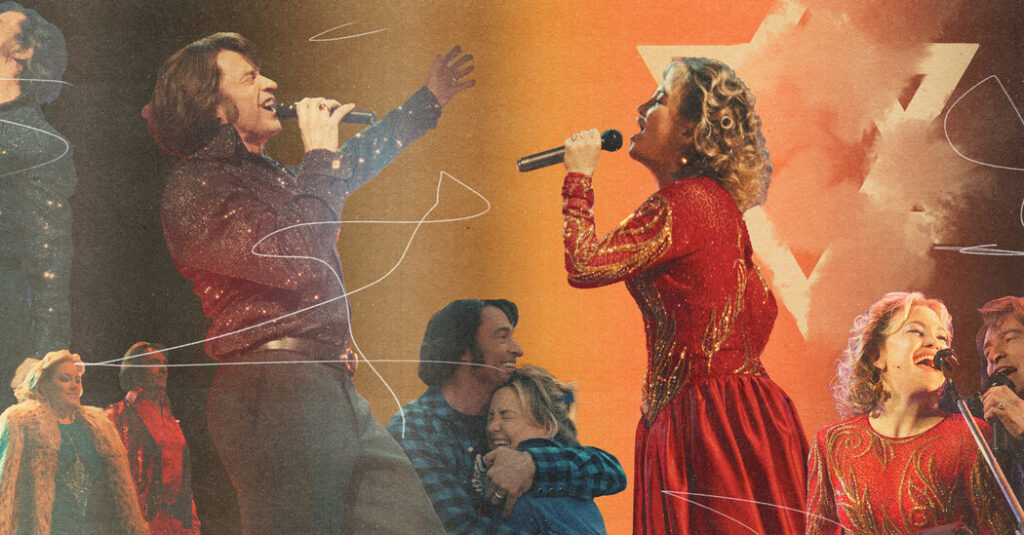
“Song Sung Blue” contains none of this. It is a heart-rending ode to love and gumption and the power of Diamond’s music, and it is in fact a very good movie. It places Hugh Jackman and Kate Hudson in a pitch-perfect early-90s Milwaukee, yet manages to pass so much of America before viewers’ eyes — a whole tapestry of people, many of them connected or beguiled or uplifted by Diamond’s golden songbook. There are Asian Americans, Italian Americans, African Americans, white bikers of the Hell’s Angels ilk. Even Eddie Vedder, of Pearl Jam, hops onstage for a rousing rendition of “Forever in Blue Jeans.” It’s a textured portrait of the Midwest that produced and inspired a Diamond impersonator, just as Brooklyn once produced Diamond himself.
The stories are about us, but we’re not in them.
But in the movie, one type of American is not visible, unless you count a split-second image of the Fran Drescher sitcom “The Nanny” playing on a TV set in the background. There’s no reference to Diamond’s heritage, not even a sidelong hint; no Jews seem to be present. This absence might not be on the level of, say, a movie about white musicians trying to become the world’s best James Brown cover act without ever acknowledging race. But of course a movie like that would at least address the topic — as in 1991’s “The Commitments,” about a Dublin soul band.
Lately this feels like a pattern with Jewish stories. I got an odd feeling watching 2023’s “Oppenheimer,” a film that seems uninterested in the fact that its protagonist — leading the Manhattan Project in 1942, at the height of Nazi control of Europe — came from a Jewish German family. I got the same feeling watching Timothée Chalamet as Bob Dylan in 2024’s “A Complete Unknown,” a film that skirts not just Dylan’s origins but also the Jewishness of the Greenwich Village folk scene. I got it while watching Bradley Cooper play the muscularly Jewish Leonard Bernstein in 2023’s “Maestro,” with an absurd prosthetic nose substituting for Jewish interiority. I definitely got it watching Helen Mirren as the Israeli prime minister Golda Meir, with yet more nose prosthetics, in the film “Golda,” which turns the Yom Kippur War into an almost ethnically neutral war-room flick. In each movie, some bid for universality trumps the representation of Jewish experience, leaving behind a peculiar Jew-shaped hole: The stories are about us, but we’re not in them.
I would hate to think that this is because we have, in recent years, been deemed too problematic, too difficult to relate to or hard to like, for mainstream consumption. You could, of course, make a case that what we’re seeing is precisely the opposite — that this erasure actually represents some triumph of assimilation and acceptance. What followed that midcentury efflorescence of Jewish visibility, after all, was a period during which parts of the Jewish experience were absorbed into the mainstream, until millions of Americans could watch TV shows steeped in Jewish humor and sensibilities, like “Seinfeld,” and think of them only as New Yorkers Being Very New York. Somewhere along the path from “Goodbye, Columbus” and “The Odd Couple” to Judy Blume and “An American Tail,” from “Dirty Dancing” to Jon Stewart’s “The Daily Show” to “The Marvelous Mrs. Maisel,” the Jewish experience became capable of blending, sometimes invisibly, into the broader American one.
But this is part of why it’s so strange when this experience feels obviously excised. Yes, Diamond reached a level of fame so enormous that his background could seem immaterial. He morphed from an American-dreaming boychik in the hood to an avatar of the American dream; he made a multiplatinum Christmas record, an all-time secular wedding banger (“Sweet Caroline”) and even a song that would end up as a reggae staple (“Red Red Wine”); his song “America” channeled the immigrant identities of millions. But like a lot of great art, the universal appeal was rooted in the artist’s particular experience: So much of what “everyone” loves about Diamond is, in the end, his distinctness — that he was a man with a specific background and identity, one he drew on constantly.
I cried throughout “Song Sung Blue,” because it is a real tear-jerker, and also because here were all my dad’s favorite songs, and also, several times, because the movie’s sense of Diamond no longer seemed to contain my father’s sense of Diamond. When I was 8, my dad took me to see “The Jazz Singer” in a Montreal movie theater, and I still remember how the opening scene — the strains of “America” playing over shots of teeming New York sidewalks — made me gasp at the variety and industry and excitement of it all, the grand American project of everyone allowed. That giant hineni feels over, now so often replaced by vicious battles over belonging. I imagined taking my father to “Song Sung Blue,” maybe on its Christmas Day premiere, and seeing him sit there bewildered. “I don’t think this guy is really doing Neil Diamond,” he would say. “I think he’s doing something else.”
Mireille Silcoff is an author and a cultural critic who lives in Montreal. She last wrote for the magazine about the sex lives of Gen X women.
Source photographs for illustration above: Focus Features; Sarah Shatz/Focus Features.
The post There’s Something Missing in Films About Jewish Cultural Figures appeared first on New York Times.