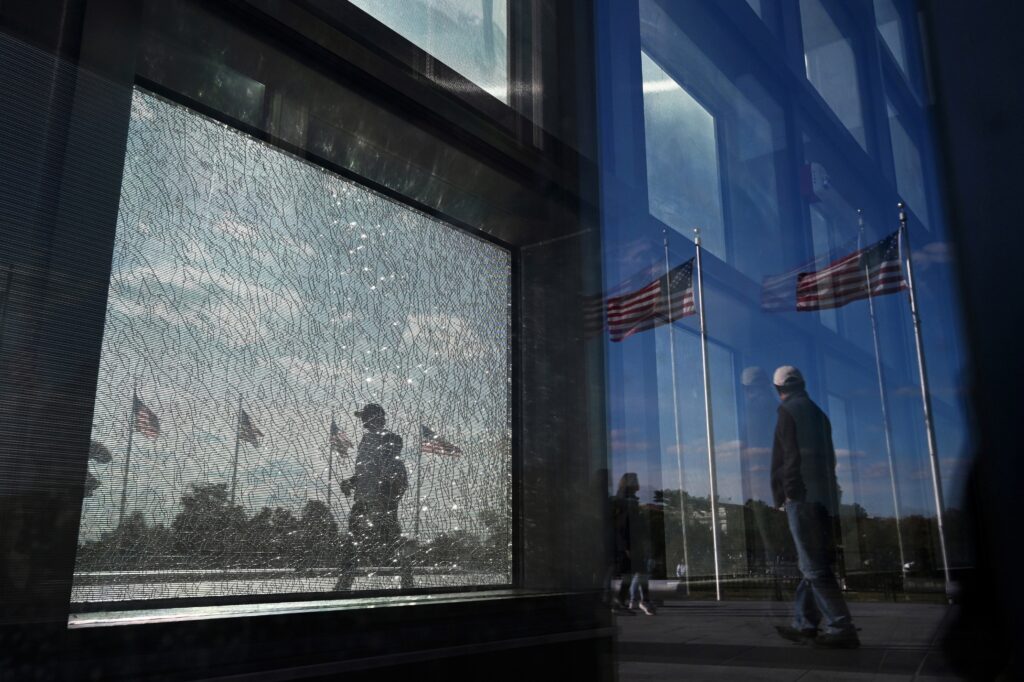
Heading into the new year, the nation’s capital is gripped by economic gloom that may permanently alter the shape of the city as the forces that long underpinned its growth weaken all at once.
Unemployment rose steadily through the summer, climbing above levels last seen in 2021 to reach nearly 7 percent by early fall, a reflection of the private sector struggling to absorb thousands of laid-off federal workers who fell victim to the Trump administration’s slashing of the bureaucracy. Consumer spending fell sharply in late summer after holding up earlier in the year. The longest government shutdown in history closed top sightseeing attractions, further fueling the woes of declining tourism.
Those pressures are already reshaping daily economic life in Washington and the city’s surrounding suburbs, showing up most visibly in empty offices, struggling restaurants and softer demand across retail and hospitality.
The D.C. region saw the largest increase in home sale listings of any major metro area, according to the Brookings Institution, raising concerns about people being pushed from their homes due to increased economic instability or lured to other parts of the country for stronger job prospects — or both.
By the second quarter of 2025, the District had come within a whisker of a recession, with three months of declining GDP followed by another three months of flat growth.
“Death by a thousand cuts,” said Yesim Sayin, executive director of the D.C. Policy Center, a local think-tank. The significance of 2025, she said, lies less in any single data point and more in the earthquake it has delivered to the very bedrock of the city’s long-term outlook.
“This isn’t just a blip,” Sayin said. “What this year has done is change the trajectory of the District’s economy.”
D.C.’s government has begun to register the shift. Its most recent financial plan, submitted to Congress in October, struck a notably cautious tone, framing priorities around affordability and maintaining services rather than expansion. On Monday, city officials released a revenue report showing weakening tax collections: November receipts, reflecting October activity, showed hotel tax revenue down 16 percent, restaurant tax revenue down 3.4 percent, retail sales taxes down 0.9 percent and income tax withholding down 1.5 percent.
Analysis by Brookings found that consumer spending in the District held up through the first half of the year before dropping sharply in August and September, a decline far steeper than in the surrounding region. “The last two months have been the worst,” said Tracy Hadden Loh, a fellow at Brookings.
Federal jobs are down 5.6 percent year over year, compared to a 3.1 percent decline nationwide, according to a joint analysis published in early December by Brookings and the Metropolitan Washington Council of Governments, a nonprofit association of jurisdictions in the region.
Meanwhile, private-sector job growth has slumped. While the country as a whole experiences a decrease in unemployment rate, it is up by 0.65 percent in the D.C. region, with rates of unemployed workers growing the most in Virginia counties.
Commercial real estate experts said many companies are continuing to shed office space locally, extending a shift that began during the pandemic and driving up the vacancy rate.
Another change this year has been the pace at which office buildings are disappearing altogether. In 2025, 3.7 million square feet of office space was torn down in the D.C. region, up from 2.8 million the year before, said Melina Duggal, senior director of market analytics for the D.C. and Baltimore regions for CoStar Group which tracks commercial real estate trends.
Those trends long predate 2025, but federal job cuts have added new pressure to an already fragile market, said Phil Mobley, CoStar’s national director of office analytics. “The federal government’s personnel reductions are certainly a drag,” Mobley said. “So far, it has probably outweighed the renewed focus on in-office work.”
The effects are spilling beyond office towers and into the city’s consumer economy, where the slowdown has been sharper and more sudden.
For many restaurateurs, this year has been especially tough, marked by what they describe as multiple punches: inflation, changes to D.C’s wage policy, job cuts that have led to consumers spending less, Trump’s temporary police takeover and fears of ICE raids.
As a result, Shawn Townsend — president and chief executive of the Restaurant Association of Metropolitan Washington — said he’s heard from many of his 1,500 members in the region as they navigate higher costs while demand softens. Some are closing, others are cutting down on staff and adjusting their menus to keep them simple.
“The margins continue to be razor thin,” he said.
Eric Heidenberger, partner at DC Restaurant Group, said the economic changes have hit his business. His company owns several restaurants in D.C., including Prost, Madhatter and Shaw’s Tavern and employs 250 people.
“We’re in a heavy-bout fight,” Heidenberger said.
Some of his D.C. locations have seen sales drop 20 to 30 percent over the last four years compared with pre-pandemic levels. “We’re trying to be resourceful and make ends meet so we wouldn’t have to cut labor,” he said.
Diane Gross, co-owner of Cork Wine Bar in Logan Circle, said the dampened demand coupled with increased prices for wine and food due to inflation and tariffs has made business tough. Sales have been down between 10 and 30 percent over the course of this year, she said. She used to be able to absorb some of the cost increases, Gross said, but lately some prices have jumped so much that she can’t afford to.
Due to job losses in the region, she and other restaurateurs said they’re noticing that when people do go out to eat or drink they’re spending less.
“They’re cutting out appetizers,” she said. “You notice less steaks being ordered and more flatbreads. Less duck confit and more orders of fried calamari.”
Now, she has servers take on more tables and has cut back employees’ hours. She let three people go and has a manager — instead of a host — seat people on nights business is slow. For the holiday season, she’s noticed consumers held smaller parties and she received fewer orders for gift baskets.
“We keep plugging along,” she said, “because even though it’s difficult we always think what else would we do? We’re a neighborhood spot and it brings us so much joy.”
The post D.C. region heads into 2026 with an economy teetering toward recession appeared first on Washington Post.