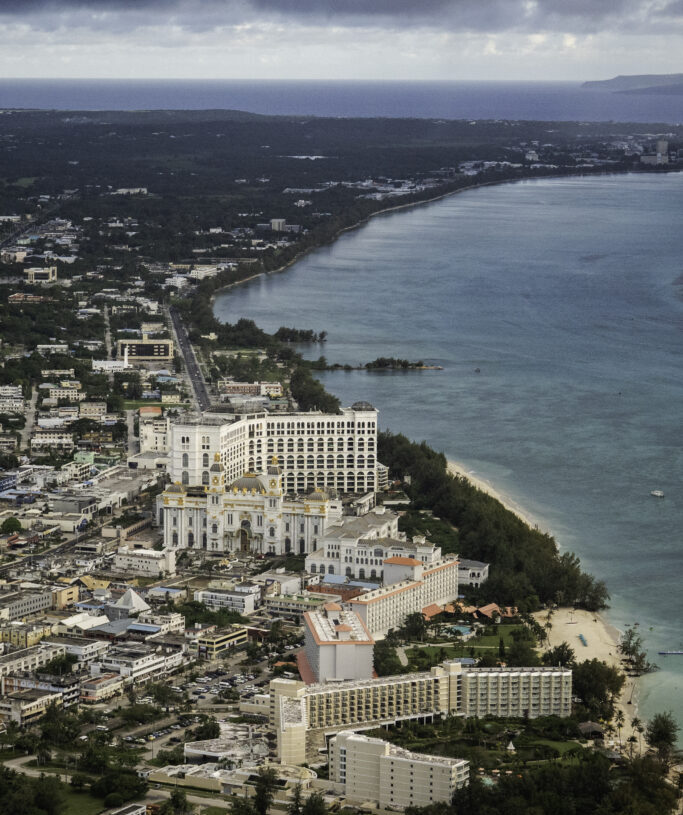
SAIPAN, Northern Mariana Islands — The beachfront casino built here by a Chinese mother-and-son duo a decade ago was billed as a $2 billion investment, a resort bigger than the Casino de Monte-Carlo in Monaco. The giant, gilded Imperial Palace would transform this tiny American island’s economy, the venture’s investors said.
Instead, it ended up drawing multiple U.S. investigations and a litany of lawsuits, and its operators abandoned it half-built, with hundreds of millions of dollars still owed to the local government. The original owners also left behind accusations against them of massive money laundering and corruption, and a half-finished building with peeling gold-leaf accents, mildewed carpets, unplugged slot machines and hollow arches where the windows should be. The Chinese gambling scion who spearheaded and oversaw the casino venture is now wanted in Beijing, where he was named as the head of an organized criminal syndicate.
In August, a new investor bought the rat-infested complex, promising to finish and reopen it, while bringing jobs and tourists to Saipan’s depressed economy.
The buyer presented himself to local authorities as Hiroshi Kaneko, a Japanese businessman who claimed to have a track record of raising capital and overseeing successful real estate developments. In a 2023 email to the U.S. territory’s governor, as Kaneko began to broach taking over the casino, he vowed to build on the “rich experiences” of the casino’s original Chinese operators and to spend at least $300 million to finish the resort, repeating promises that it could be the centerpiece of Saipan’s tourist economy.
There was much Kaneko left out, however.
Rather than representing a break from the Saipan casino’s troubled past, Kaneko and the company he founded to acquire the casino, Team King Investment, have long-standing ties to its original operators — Cui Lijie, 67, and her son, Ji Xiaobo, who is believed to be in his early 40s — according to corporate records, court documents, internal emails, and cryptocurrency wallets and other financial records related to both the original Chinese casino developers and the new owner, which were obtained in a months-long investigation by The Washington Post.
Kaneko was born in China as Jin Song, a name he still goes by in Hong Kong, where he spends much of his time, and only later became a Japanese citizen. Key people in the companies he controls in Hong Kong are active in pro-Beijing circles, records show.
A director of several of these companies, for instance, is a member of Shandong province’s branch of the Chinese People’s Political Consultative Conference, the highest-ranking body in China’s “United Front” system that analysts say spearheads Beijing’s influence operations abroad. A separate investor who acquired a Hong Kong-listed investment firm and later transferred shares to Kaneko and his Japanese business partner is a permanent member of the CPPCC of Jiangmen city, and is also involved in various pro-Beijing bodies in Hong Kong, records show.
Kaneko’s arrival in Saipan has renewed concerns about corruption in one of America’s most isolated, economically vulnerable and strategically important territories, and again raised the specter of Chinese influence peddling that first helped drive the project under, according to federal agents and former government officials familiar with the investigations into the casino.
The FBI, IRS and the Treasury Department’s Financial Crimes Enforcement Network have all had open investigations against the casino and its original owners, according to people familiar with the matter who spoke on the condition of anonymity to discuss sensitive information. But these probes have not led to indictments on the most serious allegations surrounding the facility, including corruption and money laundering. Investigators and former U.S. and local officials involved said the probes lacked federal resources and attention from Washington.
“It is shocking that we haven’t seen any real prosecution, after everything,” said Edwin Propst, an independent turned Democrat who formerly served in the U.S. territory’s House of Representatives, who said he was interviewed by the FBI as a witness to corruption as part of its investigation. “People have reached a point where they feel let down.”
Spokespeople for the FBI, IRS and U.S. attorney’s office in Guam — which oversees the Commonwealth of the Northern Mariana Islands, the Pacific archipelago that includes Saipan — said they could not comment on the status of the investigations.
Meanwhile, the Japanese company that Kaneko led as chief executive officer and with whom he launched his bid for the Saipan casino, Kyosei Bank, is facing deepening financial and legal problems in Tokyo, where more than 1,000 retail investors are suing for more than $70 million in claims, according to lawmakers and plaintiffs’ lawyers. The company is still a partner in the casino project, according to internal corporate records and Kaneko’s lawyer.
The Northern Marianas is the closest American soil to mainland China, and is increasingly important to U.S. military strategy in the Pacific, former and current military leaders say.
In a measure of the islands’ growing significance, the territory recently helped host the largest U.S. war games exercise in the Pacific since the Cold War. On the island of Tinian, just 10 miles from Saipan and part of the commonwealth, the U.S. Air Force is spending $800 million to repair and expand an airfield that has sat dormant since its runways were used by the American bombers that dropped atomic weapons on Japan’s Hiroshima and Nagasaki in 1945.
That has added national security fears to the debate here about the wisdom of proceeding with the casino project. When Ji and Cui first established their casino on Saipan, they were seen by U.S. officials as part of a wave of Chinese businesspeople, some with clear ties to Beijing, who gained footholds across several Pacific island states — a cluster of small territories where China has sought to expand its interests while undercutting the influence of Western powers.
Though Ji is now wanted in Beijing, individuals like him “know Beijing will conveniently overlook their illegal activities if they are seen to be in service of the larger goals in the region,” said Kathryn Paik, a senior fellow with the Australia chair at the Center for Strategic and International Studies who was the director for Southeast Asia and the Pacific on the U.S. National Security Council from 2021 to 2023.
Kaneko did not respond to multiple emailed requests for interviews and detailed written questions. In brief comments, when a reporter working for The Post approached him at one of his offices in Hong Kong, he said that he “serve[s] the interest of Japan” and its government and that “what the media writes is all wrong” and he is “not at all interested in China.” The lawyer representing him in Saipan, Louie Yanza, declined to answer detailed questions but said in an email to The Post that Kaneko’s company, Team King Investment, which now owns the casino assets, “has no relationship or affiliation” with Cui and Ji’s company Imperial Pacific International, and is a “good faith buyer.”
A lawyer who represented Ji in a lawsuit in Hong Kong did not respond to multiple emails. Cui could not be reached and did not respond to detailed questions sent to her husband, Howyo Chi, who is also the local director in Saipan of the now-bankrupt Imperial Pacific International. Chi, who paid to incorporate Kaneko’s local company in Saipan, also declined detailed requests for comment.
Billions on baccarat
Before Cui and Ji set their sights on Saipan, they were among the biggest operators of “junket” excursions that ferried high rollers from China to the Asian gambling capital of Macao, according to U.S. and U.N. investigators. The junkets, the investigators said, helped wealthy Chinese who wanted to move money out of the country and get around Beijing’s capital controls. By converting Chinese money into chips, and then into foreign currency that skirted strict capital controls, junket operators “effectively [became] bankers for organized crime,” according to a 2024 report from the U.N. Office on Drugs and Crime (UNODC).
Cui and Ji “ran one of the most profitable junkets in Macao’s history,” said John Wojcik, a former UNODC analyst who investigated the company. Wojcik, now a senior threat researcher at Infoblox, a California-based IT security company, said the pair created “a family business that was founded on facilitating informal cross-border money transfers on behalf of criminals and anyone else who needed this service,” including Chinese elites.
The business model came under pressure, however, when Chinese leader Xi Jinping launched a campaign in 2012 against corruption, raising the risk for elites who wanted to move money out of China. As revenue began to dip, Cui took control of a failing frozen-food company listed on the Hong Kong Stock Exchange, renamed it Imperial Pacific International and set out to create a miniature Macao on Saipan, according to company filings and court records.
For years, the population of Saipan had rejected casino gaming. But Cui and Ji began working to overturn the ban as early as 2013, cultivating local officials by sponsoring trips to Hong Kong, Macao and Singapore on private jets, according to U.S. government filings in civil forfeiture proceedings in Saipan. Some of those local officials had repeatedly voted against casino gambling, but changed their position soon after the trips, records show. The territory’s Senate, without prior public consultation, according to lawmakers, passed a bill legalizing casino gambling in 2014.
Even before breaking ground on the resort in 2015, Imperial Pacific set up a temporary casino in a shopping mall. Across just a few baccarat and other gaming tables, it was reporting upward of $25 billion in VIP bets in the first half of 2017, according to its own corporate filings, numbers that several casino analysts believe could not have been generated legally.
“The numbers couldn’t have been true; it just wasn’t physically possible,” said Shaun McCamley, a gaming consultant with four decades of experience in the casino industry. Even now, there’s “no business model for a casino of that size [in Saipan] in real terms and no business plan that would work,” he said.
Still, the partially operational resort brought in a record number of Chinese visitors, who until 2019 could enter on a visa-free arrangement for up to 45 days. Until the pandemic, they accounted for more than 40 percent of the islands’ arrivals. More than 240,000 Chinese travelers visited the commonwealth between October 2017 and September 2018, a number that had dropped to 11,000 over the same period ending in September of this year.
“It was really pouring money,” said Remedio Mafnas, the commonwealth’s commerce secretary. The perception was that “China created that,” she added.
Soon, however, Imperial Pacific started missing construction deadlines on a project that was supposed to encompass a 14-story resort with 340 rooms, 15 villas and more than 200 gaming tables. Some workers said they were being made to work for 13 hours a day for below minimum wage, and that they had been defrauded into working on the casino.
In 2018, a Bloomberg Businessweek article reported on the death of a worker who fell from the resort’s construction site, and it found that the families of local officials were profiting from Imperial Pacific’s land acquisitions. The next year, the FBI raided the offices of Imperial Pacific, the sitting Republican governor, Ralph Torres, and other businesses in Saipan, including a consultancy working for Imperial Pacific. All put out statements at the time denying wrongdoing. The raids, investigators said, were part of their probe into alleged wire fraud and money laundering.
The federal agencies seized more than $310,000 from the consultancy and its sole owner, Alfred Yue, which he has sought to reclaim in an ongoing civil forfeiture case. As part of that case, which is scheduled to go to trial in 2026, FBI and IRS agents laid out in a complaint that they found what they believed was evidence that Imperial Pacific was providing a “stream of benefits” to Saipan officials, including campaign contributions and upward of $300,000 in rounds of golf, meals and other perks. The complaint does not name the officials.
Yue, through his lawyer, said he had no comment. Torres, when approached in Saipan, declined to speak to The Post. His lawyer, Matthew Holley, in an emailed response to questions from The Post reiterated that no charges have been filed against Torres in connection with the federal probe, and said the former governor has “always conducted himself with integrity and remains committed to doing what is right for the community.”
Torres announced this month that he would run for governor again in elections next year.
Under pressure from the probes and the covid-19 pandemic, the casino closed its doors in 2020. Later that year, the U.S. attorney for Guam unsealed an indictment against casino executives over federal labor violations. The indictment named two entities, Imperial Pacific International and its construction partner, MCC International Saipan, which is a subsidiary of a Chinese state-owned company, as well as three executives, one of them Taiwanese and the other two Chinese citizens. By then, all had left U.S. jurisdiction.
Cui and Ji were not named. The indictment referred to several other co-conspirators who were senior executives at the companies.
Millions in unpaid debts
Ji and Cui’s family also began facing pressure back in China. After prosecuting Macao’s biggest junket operator, a Chinese court in November 2023 went after Ji, naming him a head of a criminal syndicate and charging him with crimes including smuggling Chinese migrants and illegally establishing gaming operations. Cui Limei, Ji’s aunt and Cui’s sister, was charged in the same case alongside 14 others, and sentenced to 8½ years in prison.
By the time he was named as a criminal in Beijing, however, where he faced the near certainty of being convicted and imprisoned, Ji had settled in Japan, which does not have an extradition treaty with China. Corporate records, obtained by The Post, show he registered two business entities there, one in November and the other in December of 2023.
Cui Lijie remains in Saipan, where she is rarely seen, according to more than a dozen people interviewed by The Post.
It is unclear how Ji met Kaneko, but the two, according to multiple associates in both Hong Kong and Japan, have maintained a business relationship for years. In recent years, Kaneko, who obtained a PhD from the University of Tokyo on China’s water policy, served as an executive director of a Japanese company called Kyosei Bank, working closely with the company’s founder, Kenichi Yanase, in managing and identifying ventures for the group. In a presentation to the commonwealth’s government as part of his bid for the casino, Kaneko identified himself as the group’s chief executive officer.
Kyosei Bank said he stepped down from that role in January 2025.
Yanza, Kaneko’s lawyer, said in an email that Kaneko retired from Kyosei to focus on the Saipan casino, but maintains a “collaborative relationship” with the company.
“With the backing of Kyosei Bank, the resort will undoubtedly reopen as promised by both Kyosei Bank and Mr. Kaneko to the Saipan government,” Yanza said.
Despite having the word “bank” in its name, Kyosei is not a registered financial institution in Japan and is involved mostly in real estate, according to an analysis of its projects and lawmakers who have investigated the company. Both the Tokyo and Osaka local governments in 2024 issued a directive for the company to halt part of its business for 30 days, and they issued an advisory against the company again in October of this year for failing to provide a clear explanation to investors about its investment strategy.
In November, the Narita International Airport Corp., which leased 40 percent of the land to Kyosei Bank for the bank’s planned multibillion-dollar development next to the airport, said it would be canceling that agreement, citing “financial issues” at Kyosei Bank. Japanese lawmakers have called for investigations into the company.
In an emailed response to questions from The Post, Toshi-Souken Invest Fund Inc., the fund under Kyosei Bank that manages capital raised for its real estate projects, said the company has suffered “substantial reputation damage” from “false public opinions fomented by the media.”
Kaneko launched his bid for the casino in summer 2023, a few months after the commonwealth elected a new governor, Arnold Palacios, a former Republican who had defeated Torres as an independent after running on an anti-corruption platform. The casino by then had been abandoned for over three years, and trading of its parent company’s shares on the Hong Kong Stock Exchange had been suspended since 2022, as creditors — including the commonwealth’s government — brought multiple civil court cases to reclaim millions in unpaid debts and fees from the Chinese company.
Palacios spoke of the need to wean the islands off their dependence on China. People close to him said the experience with the casino’s original operators left him skeptical of its merits.
Kaneko seemed to tailor his proposals to Palacios’s positions, saying he would seek to attract Japanese rather than Chinese tourists, writing in an August 2023 email that gaming should be “the most powerful engine and tool for the development” of Saipan’s economy.
Kaneko did not reveal Kyosei Bank’s or his own ties to Ji, who had received two separate payments totaling $20 million from Toshi-Souken Invest Fund, under Kyosei Bank, shortly before the email to Palacios, according to transaction records.
Imperial Pacific filed for bankruptcy in Saipan on April 19, 2024, and was delisted in Hong Kong several months later. It requested to delay that delisting, telling a Hong Kong court that an “independent investor, Kyosei Bank Co. Ltd,” had agreed in January 2024 to purchase more than $100 million of its shares and restructure the company, according to a copy of the judgment denying the request.
Kaneko emerged as the only serious bidder for its assets. A lawyer representing the commonwealth dug into Kaneko’s companies and found that a director for Imperial Pacific was one of Kaneko’s directors at Team King Investment, the local company he formed to buy the casino assets.
In addition, the person who paid the incorporation fees for Kaneko’s Saipan company was Howyo Chi, according to a receipt of fees. Chi was Imperial Pacific’s local director until its bankruptcy. He married Cui Lijie last year, according to marriage records reviewed by The Post. None of these links, nor the transactions between Ji and Kaneko, nor Kyosei Bank’s agreement to buy Imperial Pacific’s shares, were made public to the court, which they should have been, according to stipulations in the bidding procedures, reviewed by The Post.
Both Imperial Pacific and Kaneko’s company are “run by the same insiders, working together to ensure their debts are erased without making anyone they harmed … whole,” lawyers representing the Saipan creditors in the bankruptcy proceedings initially argued, according to court filings.
Faced with the prospect of finding no other bidder, however, they withdrew those objections in April. Creditors “just wanted to get their paychecks,” one of the lawyers involved said.
The bankruptcy court approved Kaneko’s bid in August. His company paid $12.95 million for the property and the casino license — effectively clearing Imperial Pacific of its $169 million in liabilities.
The China narrative
Though he now owns the resort, Kaneko will still need permits, regulatory approval and the backing of the commonwealth’s government to finish and reopen it to gamblers. The prospect that he would face any real opposition seemed to evaporate in July, when Palacios died suddenly after what his office described as a medical incident.
Many in the business and political elite, who argue that the United States has neglected the commonwealth, say Chinese money is a lifeline, and favor bolstering economic ties with China. Palacios, however, believed that money posed a risk both to national security and clean government.
Days after Palacios was buried in a state funeral on Aug. 3, Kaneko arrived in Saipan, one of several recent trips to finalize the casino sale. He has been met with enthusiasm by local officials, including Dennis Mendiola, the lieutenant governor, who assumed his role after Palacios’s deputy became governor. After a meeting with Kaneko in September, Mendiola posted on his Facebook page encouraging the government to “streamline the process” of reopening the resort.
“That means providing support with permitting and regulatory requirements, ensuring full compliance with the law,” Mendiola wrote. “It’s our responsibility to help see it through to completion.”
In a response several weeks later, in October, to questions from The Post, including on Kaneko’s connections with the original Chinese operators and the legal and financial issues faced by Kyosei Bank, Mendiola was more circumspect.
“My office or the administration … cannot guarantee outcomes for any private project,” he wrote. “We remain committed to transparency, lawful process, and protecting the public interest.”
In November, Mendiola met with representatives from the U.S. Interior Department, which oversees the commonwealth, to discuss the casino’s revival.
In that meeting, he described Kaneko and the casino’s new owners as a “Japanese company” that would help “get rid of the China narrative” around the project, according to people familiar with the discussions.
Mendiola’s office did not respond to a follow-up request for comment.
Chie Tanaka in Tokyo, Selina Cheng in Hong Kong, and Katrina Northrop and Pei-lin Wu in Taipei, Taiwan, contributed to this report. Graphics by Adrián Blanco Ramos.
The post A tiny U.S. territory in the Pacific doubles down on a giant Chinese casino appeared first on Washington Post.