ISTANBUL — Anti-government demonstrations erupted in Iran this week, with initial protests by shop owners in the capital Tehran over the plummeting value of the Iranian currency spreading by Wednesday to students, workers and other elements of society across the country.
Iranians have struggled for years with raging inflation, anemic economic growth and international isolation, largely because of mismanagement, corruption and sanctions imposed by the United States and other countries over Iran’s nuclear program. Official figures show inflation reaching 50 percent this year and the overall economy shrinking slightly. But in recent days, the situation has grown acute, with the Iranian rial’s value falling sharply, repeatedly reaching record lows.
Simmering discontent turned to open protest on Sunday, when videos shared on social media showed shopkeepers in some of Tehran’s commercial centers closing their stores. Demonstrators chanted, “Don’t be afraid, don’t be afraid! We are all together,” and called for others to shutter their stores in solidarity.
It was a rare instance in the history of Iran’s Islamic government, established in 1979, that protests had been sparked by the country’s “bazaari” merchant class. In initiating the demonstrations, shop owners and other merchants signaled that severe economic distress had spread beyond the poor and to those relatively better off, said Mahdi Ghodsi, an economist at the Vienna Institute for International Economic Studies. Past rounds of economic protest in Iran, particularly in 2017, were driven by poorer segments of society, such as workers or farmers.
“Even the people that are making money, even they cannot make money anymore,” Ghodsi said.
One of the early protests broke out among mobile phone vendors in a complex in central Tehran, not far from where demonstrations have often centered in the past. Mobile phone vendors are particularly vulnerable to depreciation of the rial because they sell imported goods, Ghodsi said. In recent weeks, these businesses had become largely unviable, as the rial fell to 1.38 million to the dollar on Saturday, then 1.44 million to the dollar on Sunday.
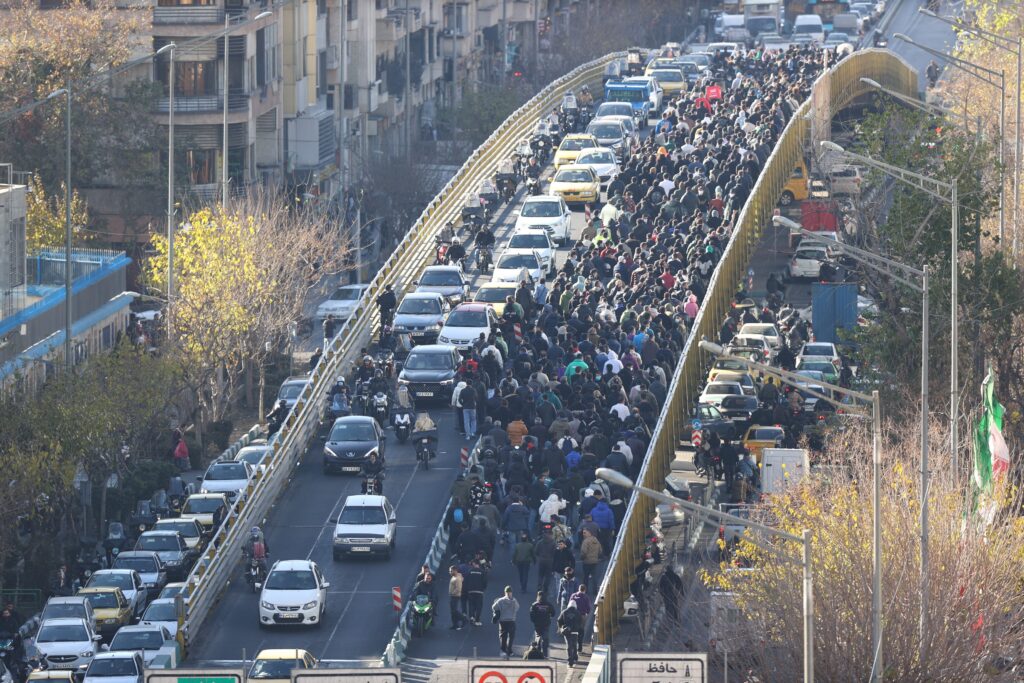
From the Sunday spark, the protests grew quickly in size and spread widely. Videos from Monday showed large crowds marching through central Tehran and depicted protests well outside the capital, including on the Persian Gulf island of Qeshm and in the western cities of Zanjan and Hamedan. And on Tuesday, videos showed that protests had spread to other major cities, including Kermanshah, Shiraz, Yazd and Isfahan.
Yaser, a Tehran resident, recalled that he was in the city’s main bazaar on business on Monday afternoon when shopkeepers in a section occupied by clothes sellers began closing up, chanting slogans and marching, he said. The crowd grew to about 150 people, and they urged other shopkeepers to close. If they declined, the crowd cursed them, and if they agreed, people cheered, Yaser said. Like others interviewed for this article, he spoke on the condition that only his first name be used to avoid government scrutiny.
The bulk of the protesting shopkeepers, especially those leading the crowd, were relatively young with fledgling businesses, he said. Richer, more established merchants were nowhere to be found. The vast majority of protesters were men.
The protesters’ slogans soon moved beyond economic issues to take aim at the overall ruling system. Videos from a Tehran indoor mall on Monday showed people chanting “Death to the dictator,” and in some videos, street crowds chanted slogans praising Iran’s deposed monarchy, which the current Islamic system replaced. By Monday evening, university students, a key driver behind past protests, had joined in. The guild representing Iranian truckers put out a statement in support of the bazaar protests but stopped short of announcing its own strike.
A wave of Iranian businesses posted on social media on Tuesday that they would close in solidarity with protesters. They included retailers, doctors’ offices, car salesmen, cafes and restaurants.
The protests are the first significant ones in Iran since Israel attacked the country in June, in what was dubbed the 12-day war, and the most serious since autumn 2022, when the killing of a woman detained by police over her dress prompted widespread demonstrations that lasted months. Before that, Iran had seen serious demonstrations in 2017 and 2019 arising from economic discontent.
The authorities respond
As protests mounted, the government deployed security forces on motorcycles in Tehran on Monday, and some videos showed the use of tear gas and had the sound of gunshots. So far, no casualties have been reported, though a video showed a chaotic confrontation between security forces and protesters in Hamedan.
One image stood out — a lone man sitting cross-legged in the middle of a Tehran street before a line of about two dozen uniformed officers on motorcycles. His head hung down, and at one point he pulled his jacket over his head so as to hide his face. The image drew instant comparisons online to the “Tank Man” of China’s 1989 Tiananmen Square demonstrations.
Despite the official show of force, state-affiliated media so far have refrained from labeling the protesters as “rioters,” which they were often called during past unrest. Instead, a state television report described the protesters as “tradesmen,” while Fars News, affiliated with Iran’s Islamic Revolutionary Guard Corps, in a Monday report similarly described the protesters in relatively neutral terms.
In a post on X early Tuesday, President Masoud Pezeshkian wrote that “The people’s livelihood is my daily concern” and that the government was pursuing “fundamental steps” to reform Iran’s monetary and banking system. He said he had tasked the interior minister with holding discussions with the protesters’ representatives, to hear their “legitimate demands.”
But there also have been more ominous warnings. The IRGC, which takes the lead in suppressing domestic unrest, warned Iran’s “enemies” that it would stand “against any sedition, unrest, cognitive warfare, security threat, or territorial aggression.” Iranian authorities often have used the term “sedition” to describe internal dissent.
The government also announced broad business and government office closures in Tehran and across the country on Wednesday, citing a cold snap and the need to conserve energy, though the announcement was widely interpreted as an effort to tamp down on public presence in the streets.
Ayatollah Ali Khamenei, the supreme leader who holds ultimate power in Iran’s theocratic system, so far has remained silent on the demonstrations.
The boiling point
Signs had been accumulating for several weeks that the country’s economy was reaching a critical condition. Pezeshkian’s administration had proposed a budget for the upcoming Iranian fiscal year that would reduce government workers’ salaries in real terms and increase the tax burden on consumers. The government also had recently cut gasoline subsidies, raising prices.
Pezeshkian cast blame for the problems on a long line of politicians during an impassioned speech before parliament on Sunday. “Some people have problems of livelihood, life, health, they’re facing a thousand problems. This is because of the decisions that administrations, parliaments, we and policymakers have taken,” he said. “They say you tax too much, okay we tax too much. And then they say increase the salaries. Someone tell me, where am I supposed to find money?”
Nonetheless, parliament quickly rejected the proposed budget, citing economic pressures on Iranians and other factors.
In a letter to parliament published on Tuesday, Pezeshkian said he agreed with the need to restructure the budget bill and said those reforms would include salary increases for government employees and an increase in subsidies. But it was unclear how those changes would be paid for. A spokesman for Pezeshkian also announced that Iran’s central bank governor, Mohammad Reza Farzin, would be replaced by the current minister of the economy, Abdolnasser Hemmati.
Parsa, a 23-year-old university student and barista living in Kermanshah, in western Iran, recounted in an interview the pressures his generation faces. He said he makes about 100 million rials a month at his cafe job, or the equivalent of about $70 at current rates. On a recent evening out with a friend, their bill for a pizza, salad and two sodas came to 10.5 million rials, or about a half-week’s pay. He said he remembers a time when he could buy a PlayStation video game console for 10 million rials.
Parsa recalled a recent argument with a professor, who was puzzled as to why young people were so upset over the economy. “We wake up at 7 a.m., check the price of the dollar, and it ruins our day,” Parsa recounted telling his professor. “I told him, ‘Professor, your generation screwed us over.’”
The post Iranian protests sparked by economic woes quickly spread across country appeared first on Washington Post.