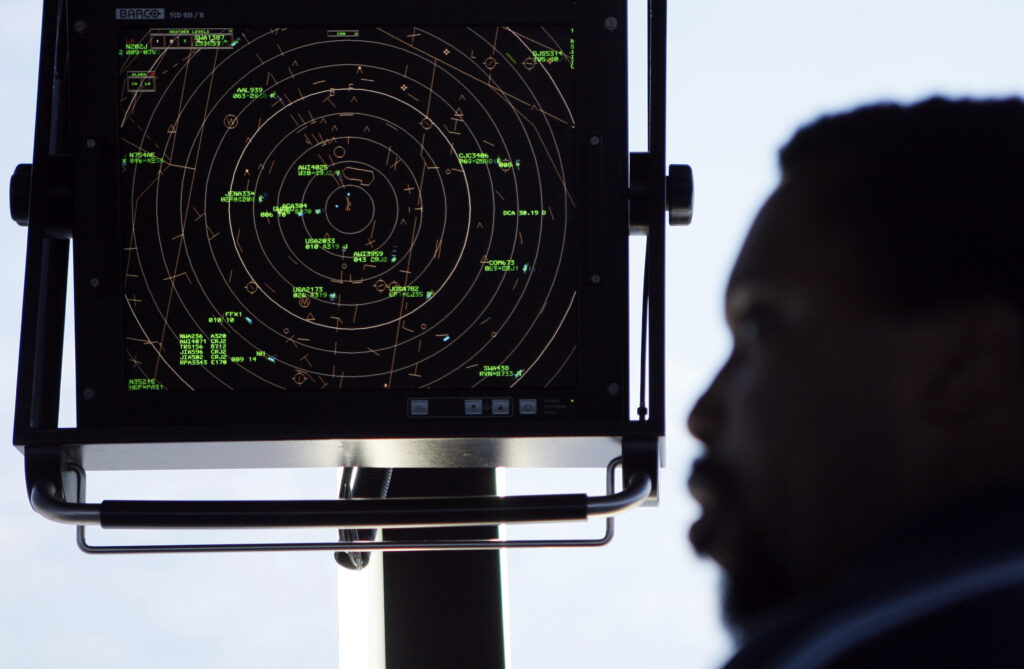
The pilots flying into Denver International Airport could tell something was wrong. In urgent calls to air traffic controllers, they reported that the Global Positioning System they used to navigate was going haywire, forcing them to rely on backup systems for more than a day. The Federal Aviation Administration issued a warning to air traffic in the area.
Eight months later, in October 2022, it happened again — this time at Dallas-Fort Worth International Airport, which shut down a runway as pilots and air traffic controllers scrambled over two days without GPS to guide them. Federal officials have not said who was responsible for interfering with the systems or why it took so long to get them back online, though they’ve said the Denver incident was unintentional.
But the disruptions stoked fear about the security vulnerabilities of GPS, a satellite network relied on daily by 6 billion people, businesses and governments.
Over the past two years, interference with the U.S. Global Positioning System has grown dramatically, threatening a network that is highly vulnerable to attack in a conflict. The danger could be posed by enemy or rogue nation-states — or even just hobbyists with commercially available equipment. Efforts by the Pentagon to upgrade GPS have been delayed by years and have cost billions, as adversaries are developing increasingly sophisticated ways to jam and trick the system with false signals that make it think it is somewhere it isn’t.
And it’s not just civilian airline traffic at risk. The underpinnings of modern life and entire economies could be disrupted by a broad attack on the fragile satellite system — power grids, financial systems, cellphone networks — raising the prospect of catastrophe in an era of increasing electronic warfare.
“You really can’t overstate how economically and militarily dependent we are on GPS,” said Todd Harrison, a senior fellow at the American Enterprise Institute. “The system was not originally designed to be this critical, and it was not originally designed to be protected against the wide range of threats it faces today.”
A widespread outage, he said, “would take us back to a World World II-era economy and military.”
GPS is perhaps best known as the little blue dot on phones, allowing millions to use apps like Google Maps, Uber and DoorDash. But it’s also an invisible, space-based timing system vital to synchronizing systems in the digital age. Power companies use it to distribute power to homes during peak usage periods. Cell towers use it to send data to phones at the right time, so it doesn’t pile up. Financial institutions use the GPS network to record precise transaction times.
One study found that in 2019, GPS, known as the “silent utility,” enabled $1.4 trillion in economic activity in the United States alone. While the Pentagon operates GPS for military purposes, for more than three decades the U.S. government has allowed the system to deploy a separate signal for civilian use.
For years, officials have warned about the vulnerabilities of the system. Last year, the Department of Homeland Security issued a warning to what it deemed “critical infrastructure,” from the financial services industry to the energy and communications sectors, urging them to understand the risks of GPS outages and to develop backups.
GPS is just one of several satellite “position, navigation and timing” systems that are used around the world. Europe operates its own, and so do Russia and China, which now has more of its BeiDou satellites in orbit than any other country and reached global coverage in 2020.
Like GPS, China’s BeiDou system was designed largely for military applications, such as precision bombing, but also as a boon to its economy. Designed to be a rival to GPS, BeiDou has become a symbol of China’s “ascent into the ranks of the world’s great powers,” according to a report from Harvard’s Belfer Center for Science and International Affairs.
The U.S. Space Force operates 31 GPS satellites, which orbit Earth at 12,550 miles. From that distance, the signal is weak when it gets to Earth. That makes the system’s signal easy to jam or trick into issuing false coordinates — or spoof, as the tactic is known.
When GPS became fully operational in the early 1990s, space was largely regarded as a peaceful domain, and concerns about its vulnerability weren’t as acute as they are today. During the 1991 Gulf War, also known as the world’s first “space war,” the Pentagon relied on GPS precision-guided munitions for the first time. China, Russia and other nations took notice of the technology’s military use, which continues today.
During Operation Midnight Hammer earlier this year, when U.S. B-2 bombers attacked three nuclear sites in Iran, “those precision strikes were 100 percent enabled by GPS,” Space Force Lt. Gen. Philip Garrant said in an interview.
Brian Weeden, the director of civil and commercial policy at the Aerospace Corporation, a federally funded research center, said, “The military has had a sustained effort over the last few decades to integrate GPS into nearly every tank, ship, plane, bomb and soldier on the battlefield because it has such value in military operations.”
He added, “GPS jamming and spoofing in general is becoming much more prevalent these days, and that’s largely due to the growing recognition that denying access to position and navigation technology is an important part of warfare.”
As the wars in Ukraine and Gaza intensified, jamming and spoofing became so widespread that they thwarted missile and drone attacks, which rely on GPS to hit their targets. But there are also wider, civilian consequences — most notably how hundreds, if not thousands, of commercial airline flights are affected each day, particularly across Eastern Europe, into Russia, down to the Black Sea and the Middle East. It’s so routine that websites such as GPSjam.org display where it is happening in real time.
A report last year by the OpsGroup, an organization of international airline operators, found that in January 2024, about 300 flights per day were affected by GPS interference. By late last year, that number had grown to 1,500 flights per day as conflicts in Eastern Europe and the Middle East continued. And in a one-month period, between July and August last year, some 41,000 flights were affected.
“While GPS interference is not a new phenomenon, the scale and effects of the current wave of spoofing are unprecedented,” the report found.
Incidents of GPS interference have “ballooned” across the globe, said Steve Jangelis, the safety chair of the Air Line Pilots Association, and as a result, “it’s become a forefront topic in our safety discussions, in our security discussions.”
It’s particularly concerning, he said, because a pilot might not know that the system is being spoofed and “you could be off course as much as many miles.”
“It’s really an insidious risk because there’s no warning,” he said. “There’s no light that comes on, there’s no alarm, there’s no nothing. It may be hidden completely from the crew.”
Though more prevalent today, GPS jamming has been around for years. In 2013, a truck driver who didn’t want his employer tracking him used a jammer to block the signal. But as he drove along Interstate 95, it interfered with Newark Liberty International Airport’s GPS system, crippling one of the busiest airports in the country.
It wasn’t the only U.S. airport to suffer a major disruption. Nearly a decade later, the airports in Denver and Dallas did, too. In Denver, the cause of the interference was “an emitter unintentionally transmitting a signal” that interfered with the GPS signal, according to a report issued by the Cybersecurity and Infrastructure Security Agency. But it did not say who was responsible for the emitter or why it took officials 33 hours to fix a problem that affected a 50-mile radius and up to about 36,000 feet in the air. In addition to causing chaos in air traffic control, it also affected nearby cell towers and the railroad system.
In the Dallas case, officials never revealed publicly what caused the disruption, which lasted nearly two days, forcing the Federal Aviation Administration to issue a warning: “ATTN ALL AIRCRAFT GPS REPORTED UNRELIABLE WITHIN 40NM [nautical miles] OF DFW.”
Todd Walter, who directs the GPS Lab at Stanford University and has studied the outages at Denver and Dallas, said both were caused by outside interference. The Dallas incident in particular “was very concerning,” he said, because the interference seemed to come from different locations. “It was a wake-up call for the FAA.”
In response to questions from The Post, the FAA said 86 aircraft were affected in Denver and 256 in Dallas-Fort Worth but did not provide any more detail about the cause of the disruptions.
Well aware of how easy GPS is to jam, the Pentagon has been working to upgrade the system for more than two decades by building satellites and ground stations that would use a more “jam-resistant, encrypted, military-specific signal” offering more efficiency “in the face of adversary threats,” according to the Government Accountability Office. But the government watchdog has long criticized the Pentagon’s modernization efforts, which have been plagued by severe cost overruns and years-long delays.
The Pentagon has launched eight of its next-generation GPS III satellites, which broadcast the military-grade signal that is more resistant to jamming and spoofing. Lockheed Martin, the contractor building the satellites, is also developing a next-generation spacecraft, which would have the ability to emit an even stronger “spot beam” directly to areas used by U.S. forces, making it even more difficult to jam.
But the ground systems needed to help operate those encrypted signals are still not online.
More than a decade ago, Gen. John Hyten, who was then commander of Air Force Space Command, called the ground station program “a disaster” and lamented that “it’s embarrassing to have to stand in front of people and try to defend it, so I won’t.” Since then, the delays and cost overruns have only continued, and now the ground system alone is expected to cost $8 billion, according to the GAO.
In July, the Pentagon said it was accepting the new ground station program from the contractor, Raytheon, but recently Space Force officials said it was still in the testing phase and there was no timeline yet of when it would come online.
Even when it does, the new system will not eliminate the threat of jamming but rather “mitigate it,” said Space Force Col. Stephen Hobbs, the commander of the units responsible for “satellite control and navigation warfare,” in an interview. “It doesn’t necessarily get rid of it.”
Representatives from other industries, including banking, health care and the electrical grid, did not respond to requests for comment about developing backups to GPS.
In addition to protecting critical bases and infrastructure, interference is also a way to protect high-ranking officials, such as Russian President Vladimir Putin, as they move about. A report by C4ADS, a nonprofit focused on illicit networks, found that much of that activity in Russia “took place over brief time periods in isolated locations” and that Russian forces were probably using mobile spoofing systems “to create local areas of effect.”
In 2018, there were reports from taxi drivers in Moscow that the GPS showed them in the Atlantic Ocean off the coast of West Africa.
U.S. officials say most of the interference focuses on the signals reaching the ground and not on the satellites themselves. Weeden said that although “it is possible to have some sort of physical attack against the satellites, that’s very unlikely” given the fact that an adversary would have to take out a large number of satellites to have an effect.
“It’s much easier to go after them from an electronic warfare standpoint than a physical standpoint,” he said.
But last year, U.S. officials said Russia was developing a nuclear weapon that could be deployed in space — a weapon that could, in theory, wipe out constellations of satellites. And as the U.S. has grown more dependent on space, there is growing fear that the fleet of satellites operated by the Space Force could be targeted to devastating effect.
Speaking at a meeting of the National Space Council in 2017, Michael Griffin, a former NASA administrator and a top Pentagon official, warned of the consequences.
“To what extent do we believe that we have defended ourselves if an adversary can bring our economic system near collapse?” he said.
Articles in this series
Stories by Christian Davenport about the militarization of space.
- Inside the Space Force as it prepares for a new kind of war
- Inside Trump’s Golden Dome: High-stakes debate over missile-defense shield
- Why U.S. and Chinese satellites are ‘dogfighting’ in orbit
The post GPS is key to the global economy. It’s also surprisingly easy to attack. appeared first on Washington Post.