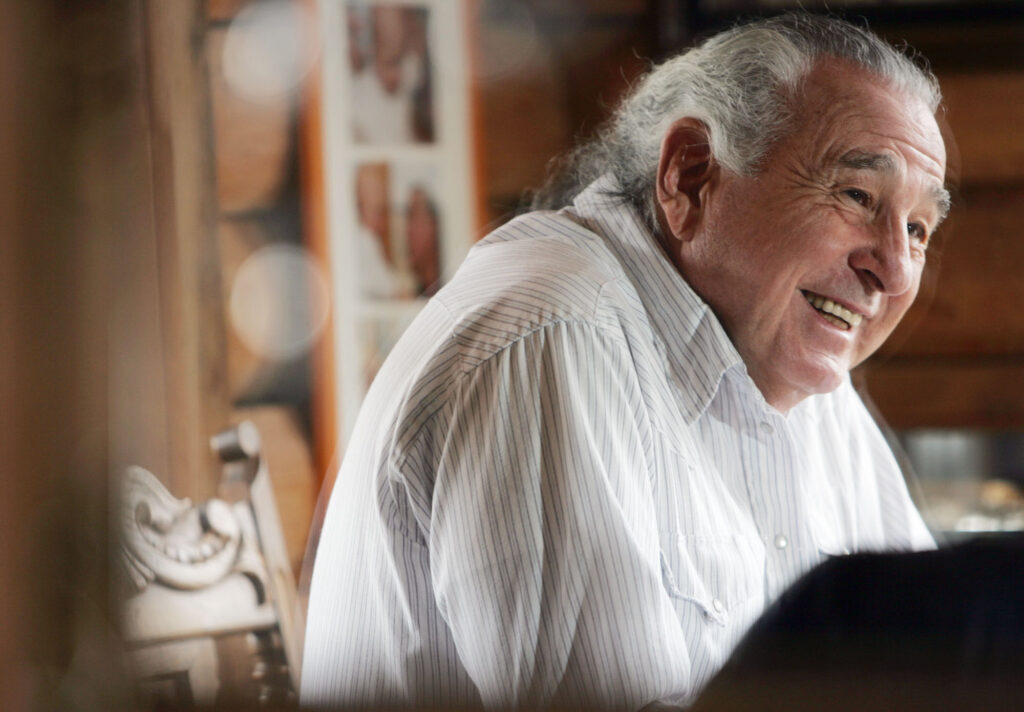
Former U.S. senator Ben Nighthorse Campbell of Colorado, who overcame a hardscrabble childhood to become the first Native American chairman of the Senate Committee on Indian Affairs and a leader of the effort to build the National Museum of the American Indian in Washington, died Dec. 30. He was 92.
Campbell died surrounded by his family, his daughter, Shanan Campbell, told the Associated Press. A cause of death was not provided.
Mr. Campbell, a member of the Northern Cheyenne tribe, represented the western slope of Colorado for three terms in the U.S. House, starting in 1987, and served two terms in the Senate beginning in 1993. In each chamber, he was the only American Indian in office at the time. He immersed himself in public lands, water and mining issues but made Indian causes the centerpiece of his legislative career.
In the button-down environs of Capitol Hill, Mr. Campbell stood out by arriving at work on a motorcycle, wearing a ponytail and a bolo tie with a handmade silver and turquoise clasp. His unusual résumé further set him apart from the many former lawyers in Congress.
In his youth, Mr. Campbell was a member of the first U.S. Olympic judo team. He became a Teamsters union truck driver, an Air Force military police officer, a trainer of champion quarter horses and a successful jewelry designer before entering public service, by his account, on a whim.
A fiscal conservative and social liberal, Mr. Campbell was elected first as a Democrat and made a high-profile switch to the Republican Party in 1995. He joined the Republicans, in part, he said, to protest Senate Democrats’ defeat of a GOP-backed proposed constitutional amendment to balance the budget.
He continued to support abortion rights and opposed attempts by some Republicans to cut spending for the federal school lunch program. The program sometimes accounted for “the only meal I got when I was a kid,” he said, recalling a childhood that also included years in an orphanage during the Depression.
Republicans had recently taken control of the Senate when Mr. Campbell joined their caucus, and they rewarded him with a seat on the Appropriations Committee, which controls government spending. In 1997, he was selected to chair the Indian Affairs Committee.
His involvement with the Smithsonian Institution’s National Museum of the American Indian dated to 1989, when he was a sponsor of legislation that authorized construction of a building on the National Mall and that required the Smithsonian to identify Indian remains and sacred objects in its vast collection and repatriate them to tribes requesting their return. The museum opened in 2004.
Unlike federal laws regarding water rights or tribal boundaries for Native Americans, the museum legislation “was about respecting their humanity,” said Kristen Carpenter, director of the American Indian Law Program at the University of Colorado.
John Echohawk, executive director of the Native American Rights Fund, a Colorado-based public interest law firm that has worked for decades to secure the return of Indian remains and sacred objects, said the legislation was a “key part of the process of educating” the public about Indian rights and sovereignty.
Fascination with judo
Benny Marshall Campbell was born in Placer County, California, northeast of Sacramento, on April 13, 1933.
His father, who dabbled in jewelry-making and ran a country store, tried to hide his Cheyenne Indian heritage in an era of rampant discrimination. “My father insisted we keep our Indian background a secret,” Mr. Campbell told his biographer, Herman J. Viola. “Don’t worry about it, we were told. Just keep your mouth shut. It doesn’t mean anything; don’t have anything to do with it.”
His mother, a Portuguese immigrant, suffered from tuberculosis and was in and out of health care facilities for much of his childhood. She struggled to look after Benny and his sister while their father, an alcoholic, spent long periods away on drinking sprees.
“It was all she could do, sick and weak herself, to take care of her little family,” Mr. Campbell recalled to Viola. Sometimes the only food in the house was a can of vegetables. “I remember one day, in fact, when my mother opened a can of peas and gave half of them to my sister and half to me,” he said. “All she kept for herself was the juice in the can.”
Mr. Campbell was 6 when his mother placed her children in an orphanage in Sacramento, an act that he said he never held against her, given the family’s struggles. They occasionally returned to her care when their father was home.
At roughly age 12, Mr. Campbell began packing fruit at the many farms in the area. He worked alongside laborers of Japanese heritage and, in one heated moment, found himself in a fight with a young man Mr. Campbell assumed he could easily knock to the ground.
Instead, to his shock, the man put him on the floor with a judo maneuver — and Mr. Campbell became a “convert” to the sport, he said. He joined a judo club established by Japanese residents in Placer County, and the sport became an obsession.
He left high school in 1950, during his junior year, to enlist in the Air Force at the start of the Korean War. He chose to be a military police officer, in part, because the training included judo lessons.
He completed his high school equivalency diploma in the Air Force and, after he left the service, used the GI Bill to enroll at San José State College (now university), partly because of its winning judo team. His biographer wrote that Mr. Campbell’s first marriage, which was annulled within months, and his second, to Elaine Morgan, ended, in part, because he “put judo first.”
After graduating in 1957 with degrees in physical education and fine arts, Mr. Campbell taught art and industrial arts at an elementary school near San Jose. When he learned in 1960 that judo would be introduced in the 1964 Tokyo Olympic Games, he quit his job, sold his house and car and moved to Japan to enroll in a renowned judo program at Meiji University.
To support himself in Tokyo, he taught English and landed bit parts in Japanese movies. He won a gold medal at the 1963 Pan American Games in São Paulo, Brazil.
The next year, Mr. Campbell was part of a four-man U.S. Olympic team, but a knee injury forced him to drop out during the competition. Stunned and in pain, Mr. Campbell wept openly when he had to forfeit the match, according to his biographer.
Returning to California, he took a job as a high school physical education teacher near Sacramento.
In 1966, he married Linda Price, and they had two children, Colin and Shanan. A complete list of survivors was not immediately available.
Entering politics
In the late 1960s, a period of protest and cultural resurgence among American Indians, Mr. Campbell joined thousands of Native American young people searching for their roots. He located relatives in the Northern Cheyenne tribe in Montana, became a member of the tribe and took the name Nighthorse.
Soon, Mr. Campbell moved his family to a ranch in Southwest Colorado and began raising champion show-ring quarter horses. He also made award-winning jewelry with Indian themes, using skills he learned from his father, who taught him how to carve wood and bone and shape metal from coins and tobacco tins.
With a thriving jewelry business, Mr. Campbell acquired a pilot’s license and purchased a single-engine plane to ease travel to jewelry shows and competitions around the country. One day in 1982, he found himself grounded by weather in Durango, Colo., and met up with a friend who was attending a Democratic Party gathering to nominate a candidate for the state House of Representatives.
Mr. Campbell, who had not been active in politics, volunteered when no one else agreed to run. He won election that November, with 54 percent of the vote, and served two terms before narrowly unseating one-term incumbent U.S. Rep. Mike Strang (R) in 1986 in a congressional district that included the cities of Pueblo, Grand Junction and Durango.
In the U.S. House, Mr. Campbell successfully co-sponsored legislation to rename the Custer Battlefield National Monument in Montana, which became the Little Bighorn Battlefield National Monument. The change, according to the National Park Service, was intended “to recognize indigenous perspectives” on the American Indian victory over Lt. Col. George A. Custer and his 7th Cavalry in June 1876. The legislation also authorized a prominent memorial to the warriors who died there.
In 1987, Mr. Campbell generated support to remove from the House Interior Committee hearing room a century-old painting, titled “Death Whoop” and depicting an Indian holding a bloody knife in one hand and a settler’s scalp in the other.
“It’s out of touch with the sensitivity of Indians,” Mr. Campbell told the Associated Press at the time. “It plays on the prejudice of man.”
After three terms in the House, Mr. Campbell ran in 1992 for an open Senate seat and won the general election with support from organized labor, energy interests, ranchers and Hispanic voters.
He did not seek reelection in 2004, citing poor health. He had been treated for prostate cancer the previous year.
Yet it was his vigor that most colleagues recalled.
On one occasion, he chased down a mugger who had accosted him. In 1995, when he was 62, he used his martial arts skills to help subdue a homeless man who had shoved 92-year-old Sen. Strom Thurmond (R-South Carolina) and then attacked a Capitol Police officer.
Alluding to his colleague’s physical prowess, Sen. Mitch McConnell (R-Kentucky) wryly observed when Mr. Campbell retired that “many Senators became a little more inclined to vote for his amendments after that.”
The post Ben Nighthorse Campbell, Native American senator, dies at 92 appeared first on Washington Post.