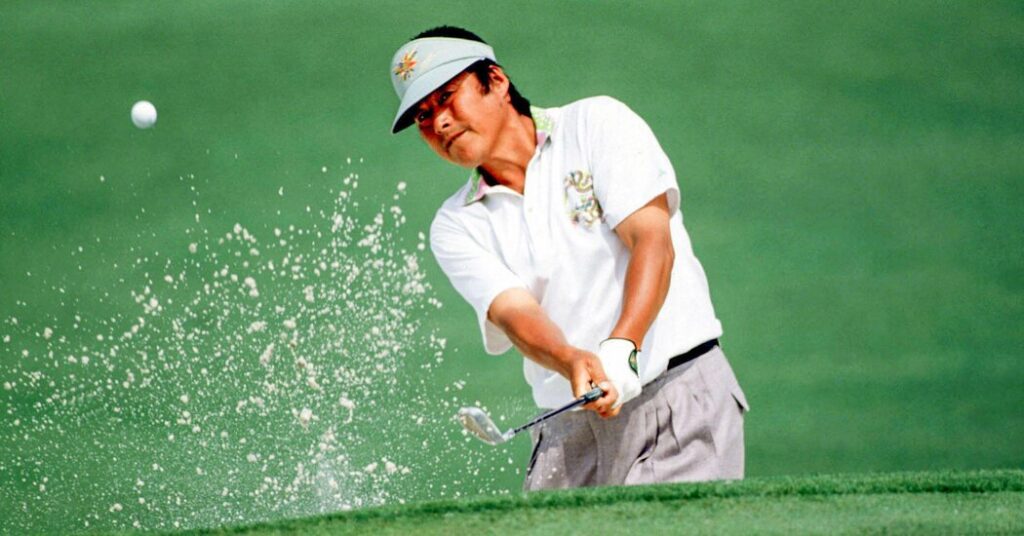
Masashi Ozaki, who had a brief professional baseball career in Japan before converting his powerful, free-swinging approach to golf and becoming the country’s most successful champion and a Hall of Famer with 113 victories, died on Dec. 23. He was 78.
He was diagnosed with terminal colon cancer about a year ago, his son, Tomoharu Ozaki, said in a statement posted on the Japan Golf Tour’s website. He gave no other details.
Nicknamed Jumbo because of his long-hitting golf swing, attacking style of play and charismatic personality — as a guitar-playing singer, he had three songs on the Japanese charts in the 1980s — Ozaki was sometimes compared in his home country to Arnold Palmer and Jack Nicklaus as a popularizer of golf.
“Mr. Ozaki’s unparalleled driving distance and delicate short game transcended traditional wisdom and opened up new horizons for golf in Japan,” Masashige Ikeya, the chairman of the Japan Golf Association, said in a statement.
Ozaki, who could drive his tee shots more than 300 yards in his prime, showed up at the 1990 Masters Tournament in Augusta, Ga. — a major he played 19 times — with what the columnist Dave Anderson of The New York Times called a “mysterious magical driver.” It had a graphite shaft and a metal head and was embossed with the words “Professional Weapon.”
Nicklaus, who had used the so-called Jumbo Driver to unload a 350-yard tee shot a week earlier at a Senior PGA Tour event, told Anderson that he didn’t know what Ozaki’s driver was made of but added, speaking as part owner of the MacGregor Sporting Goods Company, “we’re trying to copy it as fast as we can.”
While accumulating his 113 professional victories, a record for a Japanese golfer, Ozaki won 94 tournaments on the Japan Golf Tour. By contrast, the record for most wins on the more competitive PGA Tour is 82, shared by Tiger Woods and Sam Snead. Gary Player of South Africa retired with more than 160 professional victories worldwide, according to the World Golf Hall of Fame. Ozaki was inducted into the Hall in 2011.
Though he never won a major tournament and collected his lone victory outside Japan at the New Zealand PGA Championship in 1972, Ozaki ascended to No. 5 in the world rankings in 1996 at age 49. Favoring silk shirts and baggy pants, he competed in 49 majors, bringing along a sushi chef to make his entourage feel at home outside Japan, according to The Associated Press.
A fan wrote in a tribute on Instagram that he “had never seen that much silk on a golf course” until he saw Ozaki play at the 1992 U.S. Open, at Pebble Beach, Calif.
His best result in a major came at the 1989 U.S. Open, at Oak Hill Country Club, outside Rochester, N.Y., where he finished tied for sixth, three strokes behind the winner, Curtis Strange. He had top-10 finishes at the Masters (tied for eighth in 1973), and the British Open (tied for 10th in 1979), at Royal Lytham & St Annes Golf Club in Lancashire, England.
In winning the Japan PGA Championship six times and the Japan Open five times, Ozaki led the Japan Golf Tour money list 12 times, including five years in a row from 1994 to 1998.
Still, he experienced financial difficulties late in his career. In November 2005, he declared bankruptcy with debts totaling 1.6 billion yen (roughly $14.5 million at the time), according to The Japan Times.
Masashi Ozaki was born on Jan. 24, 1947, in Tokushima Prefecture, an agricultural region on the island of Shikoku in southern Japan. Baseball, introduced to Japan in the late 1800s, was severely disrupted during World War II, but it was revived during the postwar Allied Occupation. Ozaki excelled at the sport as a teenager, becoming the star pitcher for Kainan High School in Tokushima and leading the team to the national high school championship in 1964.
The next year, he joined the Nishitetsu Lions professional baseball team, now known as the Saitama Seibu Lions, as a pitcher but made few appearances over two seasons. He became an outfielder in 1967, but in one last season he went 2 for 42 at the plate, with 24 strikeouts.
An .048 batting average was far from sufficient to sustain a baseball career, but if Ozaki often whiffed as a batter, he struck a golf ball more assuredly when he took up the sport at age 21 the following year. He turned pro at 23 in 1970, and in 1971 won his first significant title, the Japan PGA Championship.
Ozaki taught the sport to two younger brothers, Tateo and Naomichi, both of whom became multiple-time winners on the Japan Golf Tour. At the 1999 Japan Pro Tournament, the brothers took the first three places. They are among the all-time top-30 money winners on the Japan Tour.
Complete information on survivors was not immediately available.
“He teed the ball up about three inches, as high as anybody I’ve ever seen, took a big, big backswing and swung at it as hard as he could,” Jerry Pate, winner of the 1976 U.S. Open, said in a 2011 video tribute to Ozaki. “That’s why they called him Jumbo.”
Jeré Longman is a Times reporter on the Obituaries desk who writes the occasional sports-related story.
The post Masashi Ozaki, Japan’s Dominant Golfer Known as ‘Jumbo,’ Dies at 78 appeared first on New York Times.