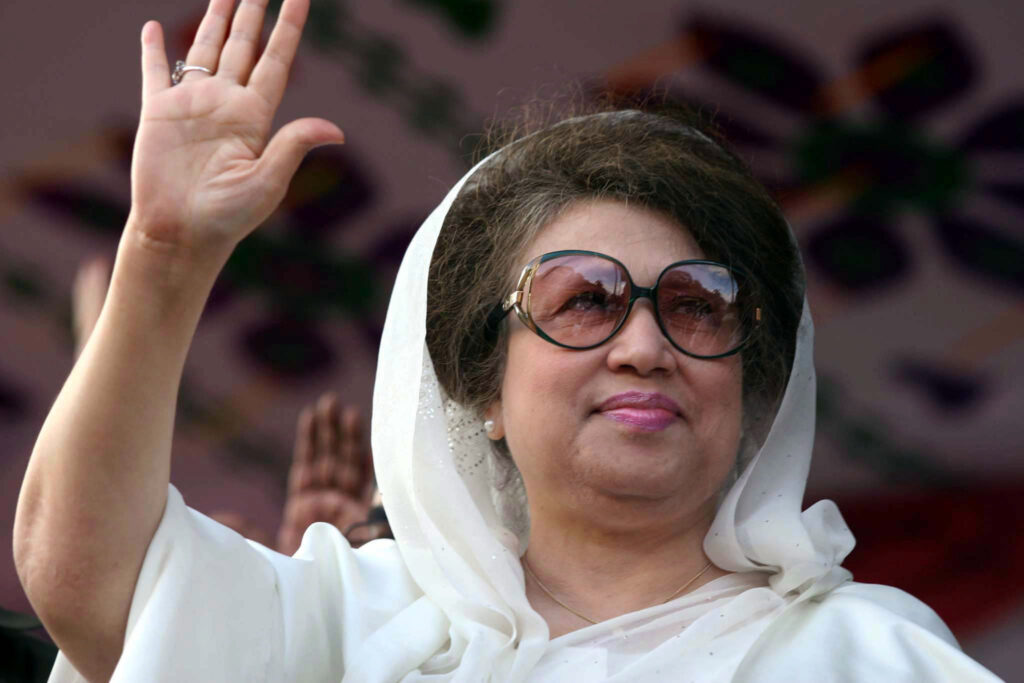
Khaleda Zia, the first female prime minister of Bangladesh, died Dec. 30, her Bangladesh Nationalist Party said.
The BNP said she died at a hospital in the capital, Dhaka, with her son and other family members present. The statement did not provide a cause of death but said that she suffered from multiple health problems, including cirrhosis, arthritis and diabetes, and that she was admitted in November with infections in her heart and lungs.
She was 80, according to the statement, though her age was contested in Bangladesh, and the BNP in her biography listed her date of birth as Aug. 15, 1946. It did not immediately respond to a request for clarification.
Ms. Zia was first elected in 1991 and served as prime minister of Bangladesh until 1996. She was reelected that year but stepped down the following month because of an opposition boycott, which meant 90 percent of voters had abstained from participating in the election. She was elected again in 2001 and governed until 2006.
Ms. Zia was the first woman to lead the country and the second woman to govern a Muslim-majority country, the first being Pakistan’s Benazir Bhutto.
Muhammad Yunus, the chief adviser of Bangladesh’s interim government, said in a statement shared on social media that Ms. Zia was a “symbol of the democratic movement.”
“Her role in the struggle to establish democracy, a multi-party political culture, and the rights of the people in Bangladesh will be remembered forever,” he said, adding, “The nation will remember her contributions to the country and its people with respect.”
Ms. Zia became the leader of the BNP in 1984, three years after her husband, Ziaur Rahman, the former leader and the founder of the party, was killed in an attempted military coup. She became an outspoken advocate for democracy and was voted prime minister in elections found to be free and fair by international observers.
She was imprisoned multiple times throughout her long political career, including in 2018 on corruption charges. She was also put under house arrest by the military regime that ruled before she became prime minister.
Ms. Zia spent the first part of her life as a quiet, high-school-educated wife of the relatively popular general, The Washington Post reported in 1991. But the events of her life transformed her into a key political figure in Bangladeshi politics.
She was the longtime rival of Sheikh Hasina, Bangladesh’s second female prime minister, who was ousted by protesters last year and fled to India after ruling the country for 15 years. Ms. Zia’s and Hasina’s parties — the latter called the Awami League — have been the two main political groups in Bangladesh since 1991.
Ms. Zia was freed from house arrest last year after protesters took control of the country. Her party had long dismissed the charges against her — among them, that she had embezzled tens of thousands of dollars in donations meant for an orphanage trust — as false and politically motivated.
The U.S. State Department said in a 2023 report on human rights in Bangladesh that “international and domestic legal experts noted the lack of evidence to support the conviction and suggested a political ploy to remove the leader of the opposition from the electoral process.”
Ms. Zia was born before the partition of India at the end of the British colonial period and grew up in what was then East Pakistan, an entity split from the western portion of the country by a thousand miles of Indian territory.
East and West Pakistan shared a majority religion, Islam, but were ethnically and culturally distinct. The eastern part was majority Bengali, while the western part — where the national government and military leadership were located — was majority Punjabi.
In 1960, Ms. Zia married Rahman, who would become a military commander during Bangladesh’s war for independence from West Pakistan in 1971. Rahman read out Bangladesh’s declaration of independence on a radio broadcast in March of that year, an important moment in the conflict.
Hundreds of thousands — up to 3 million, by some estimates — of Bengalis died during the war, as West Pakistan fought to prevent its eastern portion from breaking away.
Rahman founded the Bangladesh Nationalist Party and was the country’s sixth president, ruling from 1977 until he was assassinated while in office in 1981.
The couple had two children, Tarique and Arafat. Arafat Rahman died of cardiac arrest in Malaysia in 2015, according to Bangladeshi media. Tarique Rahman, 60, the current BNP acting chairperson, returned to Bangladesh this month after 17 years in exile, ahead of elections scheduled for February.
The post Khaleda Zia, first female prime minister of Bangladesh, dies appeared first on Washington Post.