Federal Reserve officials are grappling with two fundamental questions as they confront both rising unemployment and elevated inflation. How much more should they lower borrowing costs, and when should they deliver that relief?
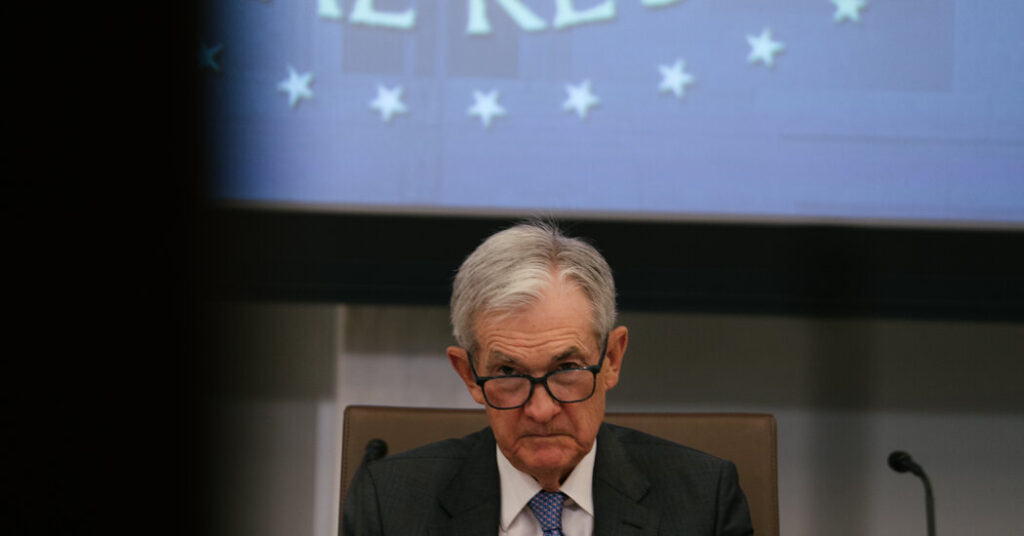
Minutes from the Fed’s final gathering of 2025 in December, released on Tuesday, underscore the difficult task facing Jerome H. Powell, the chair, as he tries to forge a consensus among policymakers after a series of increasingly contentious interest rate reductions.
The record of the December meeting showed that officials remained at odds over the outlook for inflation and the labor market and whether the risk of sticky price pressures or rising joblessness posed the greater threat. They also appeared unsure about just how much they are restraining the economy with interest rates at a range of 3.5 percent to 3.75 percent — a level that Mr. Powell said left the Fed “well positioned to wait to see how the economy evolves.”
Most officials thought that further interest rate cuts would most likely be appropriate as long as inflation continued to decline, the minutes said. A majority argued that cuts would help “forestall the possibility of a major deterioration in labor market conditions,” especially when there was less concern that President Trump’s tariffs would stoke a persistent inflation problem.
But the minutes also indicated that officials appeared less certain about the magnitude and timing of those cuts. Some indicated a preference for holding interest rates steady “for some time” after December’s reduction. They said that would allow the central bank to better understand the impact of the Fed’s policy actions on overall economic activity, “while also giving policymakers time to acquire more confidence about inflation returning to 2 percent.”
The minutes captured the debate ahead of the Fed’s 9-to-3 vote in favor of a quarter-point reduction, the third straight move of that size since September and the most fractured one of the year.
Austan D. Goolsbee, president of the Federal Reserve Bank of Chicago, and Jeffrey R. Schmid of the Kansas City Fed dissented against the cut in favor of standing pat, while four other policymakers indicated their opposition in the form of a “soft” dissent. That entailed their submitting a forecast for interest rates to end the year at the previous level of 3.75 percent to 4 percent.
Those in this camp appeared to be chiefly concerned about inflation that has stayed above the central bank’s 2 percent target for nearly five years. They worried that the full effects of Mr. Trump’s tariffs have not yet materialized, and that coupled with a resilient economy, price pressures could resurface in a much more worrisome way.
Stephen I. Miran, who joined the Fed’s Board of Governors in September after Mr. Trump nominated him, voted for a larger, half-point cut, as he had done at the previous two meetings.
Mr. Miran and others in favor of cutting interest rates are anxious about the labor market, which has shed momentum this year even though layoffs overall remain low. They fear that the unemployment rate will start to rise quickly, risking more economic pain than necessary given their expectation that inflation will eventually ebb more substantially.
Trump Administration: Live Updates
Updated
- A federal judge blocks the deportations of a group of South Sudanese migrants.
- A judge rules that the White House cannot let a consumer bureau’s funding lapse.
- Crew members paint a Russian flag on a tanker being pursued by the U.S. Coast Guard.
The minutes indicated that a few of the officials who supported December’s quarter-point cut could have also supported holding rates steady, describing the decision as “finely balanced.” Several officials also flagged the risk that cutting rates against the backdrop of elevated inflation “could be misinterpreted as implying diminished policymaker commitment to the 2 percent inflation objective.”
Policymakers had only a partial view of how the economy was faring before their December meeting because of the government shutdown, which delayed critical data releases until after the central bank convened.
The subsequent reports, which were distorted by technical quirks related to the shutdown, showed the unemployment rate rising despite decent jobs growth in November. Retail sales were solid, but wage growth slowed. And inflation cooled more than expected but remained high.
By the Fed’s next meeting at the end of January, officials will have another round of data in hand, which could help tip the balance on interest rate cuts in either direction. Already, however, there are signs that the central bank will proceed cautiously.
In addition to Mr. Powell’s saying the Fed was “well positioned” to determine its next policy steps, the central bank amended its policy statement in December to say it would assess the incoming economic data, the evolving outlook and the balance of risks “in considering the extent and timing of additional adjustments.”
According to projections released alongside the December interest rate decision, seven of the 19 policymakers penciled in no reductions at all next year, while eight wanted at least two reductions. One official, likely Mr. Miran, given his three dissents in favor of bigger cuts, penciled in interest rates falling closer to 2 percent over the next year.
Limited cuts next year would keep the Fed in the cross hairs of Mr. Trump, who has criticized its reluctance to lower borrowing costs aggressively. The president is selecting a new chair to replace Mr. Powell when his term ends in May. He has said he will pick someone who supports cutting interest rates, a criterion that many across Wall Street and Washington say creates a credibility problem that will be difficult to overcome.
Top contenders include Kevin A. Hassett, a longtime loyalist and economic adviser to Mr. Trump; Kevin M. Warsh, a former Fed official; and Christopher J. Waller, a current governor.
Mr. Waller recently said that while there was scope for the Fed to cut rates further, there was “no rush” to do so.
Colby Smith covers the Federal Reserve and the U.S. economy for The Times.
The post Deep Divide Inside Fed Raises Questions About Timing of Further Rate Cuts appeared first on New York Times.