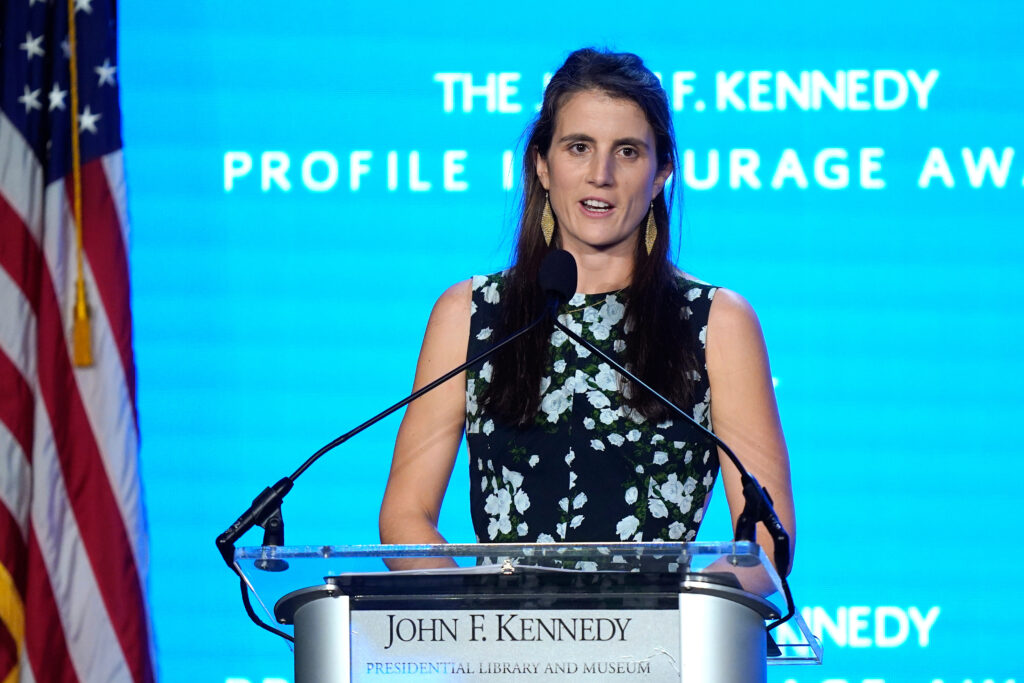
Tatiana Schlossberg, a journalist who told stories of the changing climate and the ways humans can help protect the environment, and whose terminal illness and position in the Kennedy family thrust her into the national spotlight late in life, died Dec. 30. She was 35.
Her family announced the death in a social media postshared by the John F. Kennedy Library Foundation. The post did not say where she died.
Ms. Schlossberg published a New Yorker essay in November revealing that she had been diagnosed with a rare form of acute myeloid leukemia, a cancer of the blood and bone marrow. Between reflections on her family and mortality, she harshly criticized her cousin Robert F. Kennedy Jr., the secretary of health and human services, for his opposition to government-funded medical research and vaccines.
As an environmental journalist, Ms. Schlossberg was drawn to stories that humanized sprawling and complicated policy issues — often while offering her a chance to participate in the action herself.
While chronicling the impact of climate change, she jumped in a cranberry bog in Massachusetts. She later spent nearly eight hours skiing the Birkebeiner, a cross-country race in Wisconsin threatened by warm weather and a lack of snow.
“On the lake, my cross-country skis began to skate in a rhythm, something that had eluded me for much of the day,” she wrote in a dispatch for Outside magazine. “I felt like I was flying.”
Ms. Schlossberg studied at Yale and Oxford before launching her journalism career at the Record newspaper in North Jersey, covering crime and local affairs. She joined the New York Times in 2014 as an intern and was named a staff writer on the paper’s Metro desk before moving to the science section, where colleagues regarded her as a curious, hardworking reporter who wore her privilege lightly.
A granddaughter of President John F. Kennedy and first lady Jacqueline Kennedy Onassis, Ms. Schlossberg was the second child of Caroline Kennedy, a former U.S. ambassador to Australia and Japan, and Edwin Schlossberg, an artist and designer.
“She was a total delight,” said Henry Fountain, a longtime climate and science reporter at the Times. Ms. Schlossberg “just researched her butt off on stories,” he added.
After leaving the Times in 2017, Ms. Schlossberg began freelancing and, in 2019, published “Inconspicuous Consumption: The Environmental Impact You Don’t Know You Have.” The book examined the hidden costs of everyday activities — streaming videos, buying jeans, eating burgers — and was honored by the Society of Environmental Journalists.
“Using history, science and a personal narrative, Schlossberg provides a better understanding of both individual and systemic drivers of ecological destruction,” the judges said in awarding her the Rachel Carson book prize. “Readers will find solace, humor and a route to feeling empowered with possibilities for positive change, rather than drained by an accumulation of bad news.”
Ms. Schlossberg had been planning to write a second book, on the oceans, when she was found to have cancer in May 2024, while in the hospital for the birth of her second child.
In her New Yorker essay, she wrote of her shock at getting the diagnosis — “This could not be my life” — and of the turbulent 18 months that followed, in which she received stem cell donations from her sister as well as a stranger in the Pacific Northwest; underwent chemotherapy; and participated in a clinical trial, testing a new type of immunotherapy.
In recounting her experience, Ms. Schlossberg implicitly acknowledged that her family, and her mother in particular, had dealt with years of grief. Her mother was only 5 when her father, President Kennedy, was assassinated in Dallas in 1963. She was 10 when the same fate befell her uncle, Robert F. Kennedy, while he was campaigning for president in Los Angeles. Her younger brother, John Jr., died in a plane crash in 1999.
“For my whole life, I have tried to be good, to be a good student and a good sister and a good daughter, and to protect my mother and never make her upset or angry,” Ms. Schlossberg wrote. “Now I have added a new tragedy to her life, to our family’s life, and there’s nothing I can do to stop it.”
Ms. Schlossberg recalled that she was in her hospital bed when her cousin “Bobby, in the face of logic and common sense, was confirmed” as health and human services secretary, “despite never having worked in medicine, public health, or the government.”
Kennedy had previously run for president as an independent, in what Ms. Schlossberg called “an embarrassment to me and the rest of my immediate family.” He faced blowback when he acknowledged that he had placed a dead bear in Central Park a decade earlier, a bizarre episode that — in an odd twist of fate — Ms. Schlossberg had reported on for the Times, writing in 2014 that state investigators concluded that the bear had died after being struck by a car but did not know how it ended up in the park.
“Like law enforcement, I had no idea who was responsible for this when I wrote the story,” Ms. Schlossberg told the Times last year.
In her New Yorker essay, Ms. Schlossberg wrote that her cousin’s health policy decisions threatened her own survival, and that of “millions of cancer survivors, small children, and the elderly.”
“I watched as Bobby cut nearly half a billion dollars for research into mRNA vaccines, technology that could be used against certain cancers; slashed billions in funding from the National Institutes of Health, the world’s largest sponsor of medical research; and threatened to oust the panel of medical experts charged with recommending preventive cancer screenings,” she wrote.
She also noted that the drug misoprostol, which she received to stop a postpartum hemorrhage that nearly killed her, was “part of medication abortion, which, at Bobby’s urging, is currently ‘under review’ by the Food and Drug Administration.”
“I freeze when I think about what would have happened if it had not been immediately available to me and to millions of other women who need it to save their lives or to get the care they deserve.”
‘I was not just a sick person’
Tatiana Celia Kennedy Schlossberg was born in Manhattan on May 5, 1990. She was raised on the Upper East Side with her older sister, artist and filmmaker Rose Schlossberg, and her younger brother, Jack Schlossberg, who is now running for Congress in New York.
Ms. Schlossberg studied history at Yale University, where she received a bachelor’s degree in 2012 and served as editor in chief of the weekly Yale Herald. She later earned a master’s in American history from the University of Oxford.
As a freelance journalist, Ms. Schlossberg contributed to publications including The Washington Post, the Atlantic and Vanity Fair. She wrote a weekly newsletter, News From a Changing Planet, until 2024.
Juliet Eilperin, The Post’s deputy Futures editor, called her “one of the least pretentious journalists I have ever dealt with.”
“Tatiana had an intense desire to be out in the field, immersing herself in nature and talking with scientists,” Eilperin said. “She was meticulous and exhaustive in her research, scrutinizing environmental problems and what might be done to fix them.”
In 2017, Ms. Schlossberg married George Moran at her family’s home on Martha’s Vineyard, in a ceremony officiated by former Massachusetts governor Deval Patrick. Moran, a urologist, was a resident at Columbia-Presbyterian when Ms. Schlossberg was diagnosed with cancer at the hospital.
“He did everything for me that he possibly could,” she wrote in her essay. “He talked to all the doctors and insurance people that I didn’t want to talk to; he slept on the floor of the hospital; he didn’t get mad when I was raging on steroids and yelled at him that I did not like Schweppes ginger ale, only Canada Dry.”
In addition to her husband, survivors include their two children; her parents; and her brother and sister.
While battling cancer, Ms. Schlossberg held her profession up as a point of pride. “My son knows that I am a writer and that I write about our planet,” she wrote. “Since I’ve been sick, I remind him a lot, so that he will know that I was not just a sick person.”
The post Tatiana Schlossberg, journalist and granddaughter of JFK, dies at 35 appeared first on Washington Post.