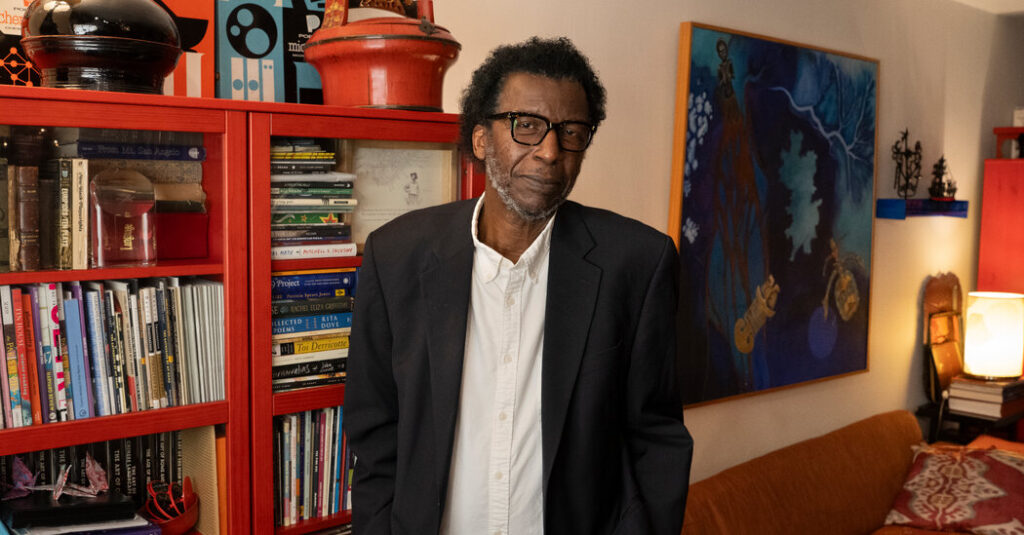
The email arrived unsolicited, with an offer so out of the blue that the recipient, Cornelius Eady, pondered whether it might be a phishing attempt.
Was Mayor-elect Zohran Mamdani’s transition team really asking if he would consider writing and delivering an original poem at Mr. Mamdani’s New Year’s Day swearing-in at City Hall?
Mr. Eady, an acclaimed poet, had never met or spoken to the mayor-elect, but had written proudly on social media that he had voted for him. He concluded that the email was not a fake, but was ambivalent about accepting the offer.
His first impulse, he said, was to instead suggest one of the many poets he had mentored through the decades as the co-founder of Cave Canem, a nonprofit focused on developing Black poets that has nurtured a host of future MacArthur “genius” grantees, Pulitzer Prize winners and National Book Award recipients.
But as a progressive Democrat who shares Mr. Mamdani’s values, Mr. Eady said he was compelled by the gravity and honor of writing an original poem to mark the beginning of what could be one of New York City’s most significant mayoralties.
“People are seeing themselves reflected in him and in his energy, and that’s just like medicine to them,” Mr. Eady said in an interview. “That energy allows people to keep going forward, not to despair. I’m hoping that the poem reflects that kind of moment.”
Mr. Eady has titled the poem he will read at City Hall on Thursday afternoon “Proof.” He described it as a public poem, a tribute to “people that you don’t see” — the New Yorkers, he said, whose concerns and ideas were not being heard by city leaders.
The last mayoral inauguration to include a poet was Bill de Blasio’s in 2014, when Ramya Ramana, New York City’s youth poet laureate at the time, read a poem titled “New York City.” The poem was dedicated to Mr. de Blasio, who had campaigned on a promise to end the inequality that had created a “tale of two cities.”
The decision to have an inaugural poet was almost an unspoken one, said Zara Rahim, a senior adviser to Mr. Mamdani. She and Mr. Mamdani both read work by various poets that had been recommended, she said, and both were drawn to Mr. Eady’s.
“We found in reading each and every poem that he was consistently exploring power, responsibility, and the interior lives of the very people who we were speaking to during the course of the campaign,” Ms. Rahim said.
Mr. Mamdani said that Mr. Eady doesn’t just write beautiful poems, but also has the “rare gift” of telling the truth about the world.
“As we work to build a New York where every voice is heard,” Mr. Mamdani said in a statement, “it is a privilege to usher in this moment with a poet who has dedicated his career to that very work.”
Mr. Eady is also a songwriter, and his poetry has often been described as drawing heavily from jazz and blues. His work also focuses on the everyday lives of Black Americans.
His book “Brutal Imagination” was a finalist for the 2001 National Book Award in poetry. The book addresses the story of Susan Smith, a white woman who, in 1994, drowned her two young sons in her car and falsely said they had been kidnapped by a Black man during a carjacking. Mr. Eady’s jazz opera, “Running Man,” written with Diedre Murray, was a finalist for the 1999 Pulitzer Prize in drama.
In his research for the inaugural poem, Mr. Eady came across a speech Mr. Mamdani gave at a campaign rally in Washington Heights in October called “Our Time is Now.”
“Billionaires have poured millions of dollars into this race because they say that we pose an existential threat,” Mr. Mamdani said in the speech. “And I am here to admit something: They are right.”
The speech, which Mr. Eady called a “total rock star moment,” exemplifies what he admired about Mr. Mamdani’s campaign: a passion that never dipped into bitterness or anger. After watching it, he wrote three stanzas and then stepped away from the poem for a few days to let his thoughts percolate.
On Monday, Mr. Eady said he was still tweaking the poem and would probably do so a bit more on Tuesday. Asked to share an excerpt, Mr. Eady hesitated. The poem, he said, is meant to be delivered live. He then agreed to reveal a few lines:
New York, city of invention, Roiling town, refresher And re-newer,
New York, city of the real, Where the canyons Whisper in a hundred Tongues,
New York, Where your lucky self Waits for your Arrival,
Where there is always soil For your root.
This is our time.
Mr. Eady said he had looked to another inaugural poem, titled “Praise Song for the Day” and delivered by Elizabeth Alexander at Barack Obama’s presidential inauguration in 2009, for inspiration about how to capture a moment.
Ms. Alexander, president of the Mellon Foundation, is a founding faculty member of the Cave Canem fellowship and said she considers Mr. Eady a friend and valued colleague. Mr. Mamdani’s transition team consulted her about its choice of Mr. Eady.
Ms. Alexander compared Mr. Eady’s work to that of Walt Whitman, saying that he creates a “poetry of inclusivity, a poetry of the streets, a poetry that aims to listen for and bring in many different voices.”
She cited one of Mr. Eady’s well-known poems, “Gratitude,” in which he writes about constantly being underestimated as a Black man in America but also being unable to sustain rage, leading him to respond to insults with love. Mr. Eady brings a “collectivity” to his work, she said, that reminds her of Mr. Mamdani’s campaign to be a “leader on behalf of a true multiplicity of others.”
That Mr. Mamdani chose to have an original inaugural poem, she said, speaks volumes.
“Poets and artists can speak in a language that is different from the language of politicians,” Ms. Alexander said. “They can say things that politicians can’t say. They are there to capture an essence.”
Jeffery C. Mays is a Times reporter covering politics with a focus on New York City Hall.
The post ‘This Is Our Time’: Acclaimed Poet to Honor Mamdani With Inaugural Poem appeared first on New York Times.