RADICAL UNIVERSALISM: Beyond Identity, by Omri Boehm
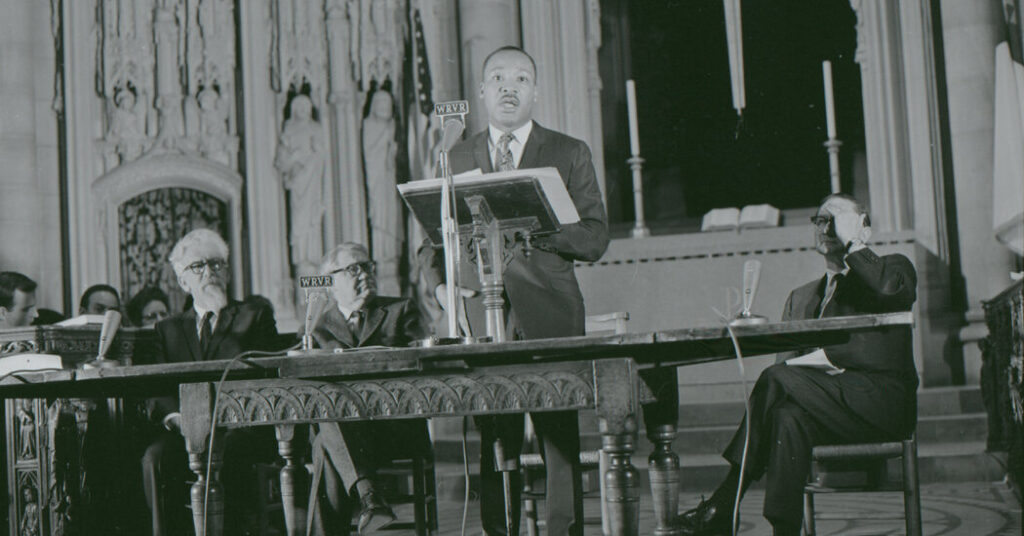
When the Rev. Dr. Martin Luther King Jr. stood at the pulpit of the Riverside Church in Manhattan and condemned the war in Vietnam, some of his closest allies decried it as a terrible betrayal.
It was April 4, 1967. The Voting Rights Act was not yet two years old; the civil rights movement was unfinished. The war was still overwhelmingly popular among Americans, and President Lyndon B. Johnson was determined to maintain that support. The N.A.A.C.P. called King’s attempt to draw a link between civil rights at home and peace abroad a “serious tactical mistake.” A Black columnist took to the pages of Reader’s Digest to disparage the speech as “utterly irresponsible.”
Liberal critics accused King of jeopardizing the fight for racial equality. King allowed that his antiwar position was “probably politically unwise.” But he added that it was morally necessary, and that anyone who truly comprehended what the civil rights movement was ultimately about should have recognized that in the face of “hundreds of thousands trembling under our violence” he could not be silent. “Though I often understand the source of their concern,” King said of his skittish colleagues, “I am nevertheless greatly saddened, for such questions mean that the inquirers have not really known me, my commitment or my calling.”
The philosopher Omri Boehm cites King’s outspokenness on Vietnam as a moment when the profound stakes of the civil rights movement were laid bare. King was announcing that, as much as the interests of Black Americans were a crucial element of the struggle, they were not the whole of it. King had dedicated himself to “justice, abstractly conceived,” Boehm writes in “Radical Universalism,” an invigorating and timely new book. Genuine justice was abstract because it could never be limited to the interests of any one group. Unlike his critics, King had not forgotten the meaning of the Declaration of Independence. “King’s duty was to the idea that all men are created equal,” Boehm adds, “not ‘his country’ or ‘his people.’”
The Declaration of Independence is one of the texts that Boehm explores in his compact and readable treatise on universalism, an idea that has fallen out of fashion with identitarians on the right and on the left. In contemporary politics, parochialism reigns: “The right fights in terms of traditional values, the left fights in the name of gender and race.“
This initially sounds like the kind of both-sidesism that political centrists find appealing. But Boehm finds fault with centrists, too, who have done their part to hollow out the idea of universalism. They have been so enthralled by the concept of “rights” that they have neglected the concept of “duty.” Universalism, properly understood, doesn’t just rest on some minimal understanding of the “right” to act in your own “interest.” In fact, he argues, universalism entails a duty that sometimes requires people to act against their interests. Hence King’s refusal to take the safe and pragmatic course, which would have meant complying with popular opinion by saying nothing about Vietnam.
Boehm, who teaches at the New School, was born in Israel and is the grandchild of a Holocaust survivor; he points to the war in Gaza as evidence that “the meaning of universalism has been successfully shredded to pieces.” He denounces those who depict Hamas’s massacre on Oct. 7 as an act of “resistance”; he also denounces those who cast Israel’s brutal response — the “destruction of the possibility of life in Gaza” — as an act of “self-defense.” In “Haifa Republic” (2021) he called for a one-state solution, a “binational utopia” in which “all are equal.”
Earlier this year, Boehm was scheduled to give an address at the Buchenwald concentration camp in Germany to mark the 80th anniversary of its liberation from the Nazis. The invitation was withdrawn after pressure from the Israeli embassy in Berlin, which accused Boehm of “attempting to dilute the commemoration of the Holocaust with his discourse on universal values.” The text of his canceled speech is reprinted in “Radical Universalism” as an appendix. In it, he laments that the potent universalist vow of “never again” has too often been taken to mean “never again to us.”
Throughout the book, Boehm’s lodestar is the philosopher Immanuel Kant, who defined the Enlightenment as “man’s emergence from his self-imposed immaturity.” Kant warned about the temptations of mechanical thinking — the lazy habit of falling back on an external authority (the will of the king, the consensus of public opinion) in order to avoid the difficult work of thinking for ourselves. When the Nazi official Adolf Eichmann stood trial at Nuremberg, he declared — absurdly and abominably — that he had lived his life according to Kant’s precepts, yet was helpless before his superiors’ command to follow orders. Boehm quotes Hannah Arendt’s response: “In Kant, nobody has the right to obey.”
Before I started reading this book, the title “Radical Universalism” struck me as an oxymoron. I associated the word “universalism” with an inclination toward complacency — an approach that deployed the tepid vocabulary of reform and individual rights to preserve the status quo. There seemed to be little that was radical about it.
But Boehm’s book has persuaded me that universalism could be more profoundly transformative than anything offered by the self-styled “radicals” on either end of the political spectrum. Recognizing our duty to one another will be a hard sell in a world where we have been encouraged to think only about our own convenience and interests. Boehm makes an inspiring case for why this impossible project is necessary work. He quotes the rabbi and civil rights activist Abraham Joshua Heschel, who once compared the world to a pit of snakes whose venom was “dulling our minds, darkening our vision.” The result has been a culture that teaches us to worship force, despise compassion and nurture only “our unappeasable appetite.”
Heschel noted how diligently we pursue technological feats while letting our inner life fall to pieces: “The greatest task of our time is to take the souls of men out of the pit.”
RADICAL UNIVERSALISM: Beyond Identity | By Omri Boehm | New York Review Books | 191 pp. | Paperback, $17.95
Jennifer Szalai is the nonfiction book critic for The Times.
The post A Philosopher Gives the Old Idea of Universalism a Radical New Spin appeared first on New York Times.