Kevin Merida is a contributing essayist for The Post. He is the former executive editor of the Los Angeles Times, a former senior vice president of ESPN and a former managing editor of The Post.
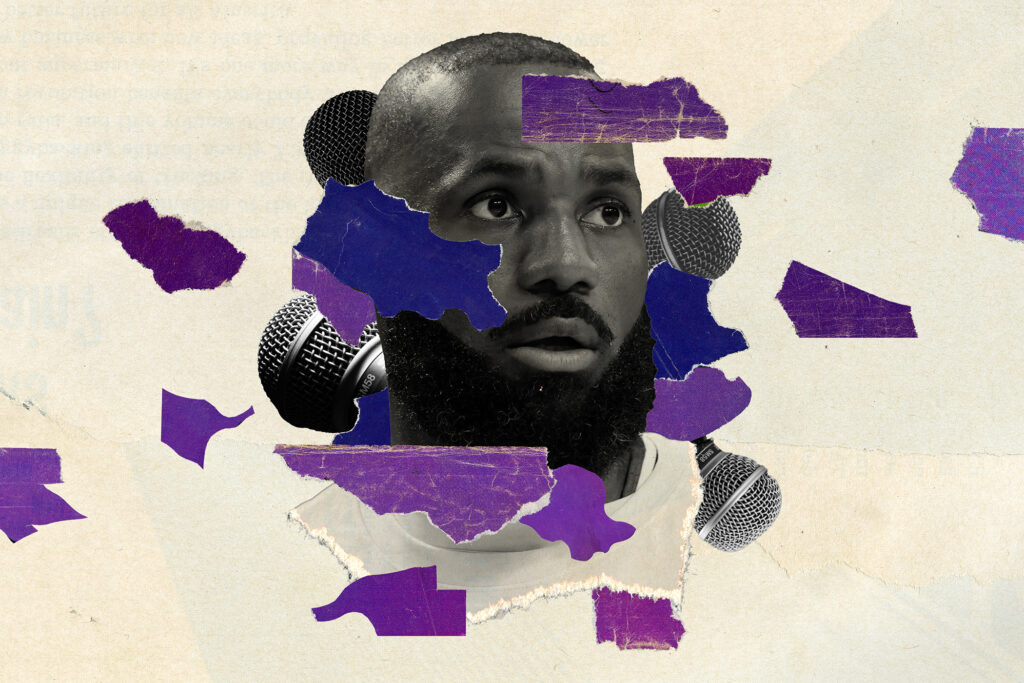
“Mind the Game” is a cerebral podcast, as its title might suggest, an astute, contemplative listen about the strategies and vagaries of professional basketball. It stars LeBron James, who is in the epilogue of his marvelous career, still in contemplation on how to end it.
“Mind the Game” is more than a podcast in the global ether of 4.5 million such shows. It’s a showcase for LeBron’s hoops knowledge, a window into his mind. Impressively co-hosted by NBA Hall of Famer Steve Nash, “Mind the Game” tells you a lot about how one of the world’s greatest athletes thinks and interacts.
As one fan commented on the podcast’s YouTube page: “It’s all basketball insights, no time wasted.”
I randomly binge-watched episode after episode on YouTube, seeing LeBron always pour the red wine and sometimes hang back while Nash took the lead and guests such as Stephen Curry and Kevin Durant occupied the spotlight. It’s fascinating to observe LeBron both patiently listen to other great players and choose which moments to expound on the thing he knows best: basketball.
He has strong opinions about his disappointments with today’s media culture, the necessity of preparation, routine and conditioning, and the hidden pressures of superstardom. He has a microscopic memory (he can recount details about 1990s Sacramento Kings players) and a studied view that there is a right way to learn and play the game that doesn’t change from youth hoops to the pros.
“Basketball IQ 101 is basketball IQ 101 on any level,” LeBron said on one episode.
Intellect is one of those words that sometimes drips with pomposity and pretentiousness, especially in the wrong hands. But it is a worthy word, one that conjures promise and potential, especially in the right hands. It is a word that deserves more consideration from us, and by that I mean more elasticity and less snobbery.
LeBron James would not be considered an intellectual by any conventional measure. He has very little formal education. He did graduate from high school, but his young self was devoted to and consumed by basketball. He didn’t go to college. I would not describe him as a candidate for the TED Talk Hall of Fame. He is not what teachers might call “book smart,” well-read smart. He sometimes does puzzling things that make you wonder about him — like taking a copy of “The Autobiography of Malcolm X” to a postgame news conference and being unable to say anything meaningful about what he read.
But intellect is multifaceted. LeBron is intuitive smart, fact-finding smart, observant smart, strategic smart, focused smart. “His discipline, as far as his work ethic, is unmatched,” said Patty Burdon, who was once admissions director at LeBron’s high school alma mater in Akron, Ohio, and has known him since he was a teenager.
LeBron was smart enough to trust close friends, even when they didn’t have the requisite experience, to help him build a business empire that made him a billionaire while still playing the game he loves. Most of them are still by his side. One of them, business partner Maverick Carter, tells the compelling story of LeBron saying “no thanks” to a $10 million check, more money than he had ever seen in his life as an 18-year-old not yet drafted into the NBA.
The story goes like this: When the sneaker companies were courting him during his senior year in high school, the initial meeting was with Reebok, which offered him a deal worth $60 million. As the meeting wound down, Reebok owner and chief executive Paul Fireman decided to sweeten the deal with a $10 million signing bonus and wrote the check right in the room, passing it across the table. According to Carter, who was in the room, Fireman said: “If you accept my deal, you take that home tonight.” LeBron didn’t take the check home that night; he wanted to see what Adidas and Nike would offer in their meetings, ultimately signing with Nike. The point of the story, as Carter recounted it recently on Shane Smith’s VICE News podcast, is that LeBron had enough confidence in his future greatness, even as a teenager, that he was willing to bet on himself and turn down the immediate pot of gold.
“The people who usually get to be the best in the world at something,” said Carter, “whether they say it, feel it, they know it. And they make decisions along the way that get them there.”
What does it mean to be intelligent? We all have our notions, some of which involve rare achievement such as winning a Nobel Prize, earning advanced degrees, realizing the kind of outsize success that generates widespread public praise.
I admire quiet intelligence, the kind that doesn’t shout for attention. My late grandmother was a soft-spoken genius in figuring out how to stretch meals — she’d make a pigeon savory — to feed 11 kids growing up poor in Wichita, Kansas. The Black male janitors I worked alongside one summer in D.C. were brilliant in portraying the dignity of manual labor and scaling the walls of invisibility.
One of the gifts of journalism is it can take you across the spectrum of humanity — from the determined women braiding hair on the stoops of housing projects to the complicated men who’ve occupied the Oval Office.
One of my most challenging story assignments was to explore a fundamental question that had been widely raised about then-Texas Gov. George W. Bush: Was he smart enough to be president? It was, as I wrote back then for the Washington Post, like “a recurring plume of doubt that hangs in the air like cigar smoke.” That was in 2000, which seems in the context of American politics today, like a golden century ago.
Bush was right to respond to me the way he did when I introduced the subject at his Austin governor’s mansion. “You’ve got to be a little amazed at yourself coming to do a story asking some guy who’s been an accomplished governor of the second-biggest state in the union about trying to figure out whether I think I’m smart enough to be the governor or the president,” he told me. “It’s slightly satirical.”
The truth is that Bush was smart about some things and not so smart about others. Like most of us. In Bush’s case, he was more instinctive than erudite, more linear than visionary. He was smart enough to be elected and then reelected president.
Understanding the mind, not judging it, is where I want to be. Some 25 years ago, Harvard professor Howard Gardner, a specialist in cognition and education, helped me think differently about intellect. He pioneered the theory of “multiple intelligences” in the 1980s, which punctures the popular notion that intelligence is a singular trait for which there are standardized measurements. In Gardner’s theory, there are nine categories of intelligence.
I suspect LeBron fits comfortably into several of Gardner’s categories, including “spatial intelligence,” the ability to mentally visualize, spot patterns, recognize angles, understand spacing and dimension. This intelligence often applies to architects and engineers. But LeBron, the exceptional basketball player, has mastered the space of the court.
He and Nash sit down and chop it up every other Tuesday, often speaking in the NBA jargon of hugged up, blur screens, pin downs, floppy actions and gaggle actions. Sometimes they have superstar guests, sometimes they address fans’ questions, sometimes they just riff with each other.
Now in its third season, the show’s initial co-host J.J. Redick left the podcast chair to coach LeBron and the L.A. Lakers. Now, Nash is the one who pushes LeBron to say things like three-time NBA MVP Nikola Jokic is the most dominant, complete offensive player he has ever played against. That there is nothing The Joker, as he’s known, can’t do. “Nothing at all,” LeBron says.
They both agree that the 82-game regular season is physically brutal, too long, and that maybe the game itself needs to be shortened to 40 minutes, like in international play. When Nash asked him which team he’d like to coach, LeBron wouldn’t even engage the hypothetical. “No team. Zero chance.”
Increasingly, the time he spends talking hoops leans toward reflection, memories and moments. LeBron is still capable of playing the game at a high level, and we still get treated to some magnificent nights. But his consistency at that level is shrinking, and the end is near.
“Mind the Game” provides room for introspection. LeBron, who turns 41 today, talked about spending last summer differently staying off the court to save his body for the current season, his 23rd. Focusing on Pilates, yoga, the weight room and family time. And taking up a tough but energizing hobby: golf. “I actually wanted to challenge the mind with something else,” he said, noting it’s the first time he has ever played an individual sport. “It’s just you versus the greens.”
When Kevin Durant joined the podcast as a guest, Nash led the conversation toward an appreciation of the extraordinary careers Durant and James have had. Durant, a 15-time NBA all-star and former league MVP, is now 37 and can also see the sunset in the near distance. They all talked about the approach to greatness, the obsession with getting better every day, learning how to train the right way, how to get the most out of workouts, how to watch film, how to cherish the journey and not get overburdened by the expectations of winning, to enjoy what time is left.
“There’s nothing like it,” observed Nash. “And when it’s gone … Once you’re done playing, you’re done playing. That never comes back.”
I don’t have any inside information. But I suspect next season will be LeBron’s last. And if it is, he’ll deserve a season-long celebration of his contributions to the game and to the canon of sports greatness. This is my last essay for The Post on this subject, and from here, I will follow and watch with special interest.
In the meantime, as LeBron said about the time he has left: “We gotta make the most of it.”
The post The intellect of LeBron James appeared first on Washington Post.