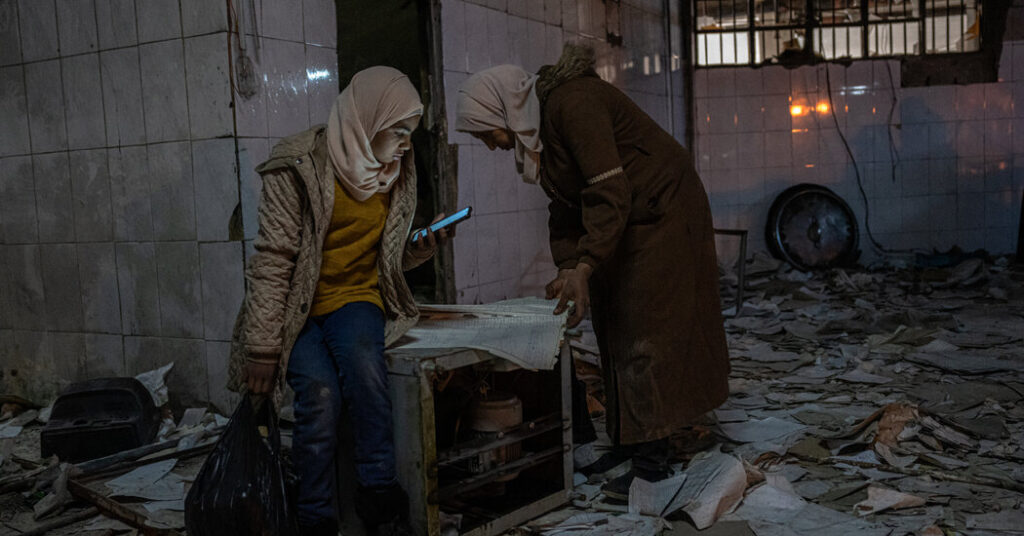
A year after rebels toppled the Assad dictatorship, Syrians are still seeking answers to what happened to the more than 100,000 people who vanished into the government’s secret prisons.
Bashar al-Assad’s security agencies kept meticulous records of every Syrian they arrested, once-hidden ledgers that many hoped would offer clues to the fates of their missing loved ones after the government fell.
Over the past year, my colleagues and I reviewed thousands of pages of internal government documents, including memos marked “top secret” between security officials. We also interviewed more than 50 security and political officials, interrogators, prison guards, forensic doctors, mass grave workers and others from the Assad regime.
The documents and interviews showed how Mr. al-Assad and his top henchmen conspired to cover up evidence of the torture and deaths of detained Syrians in the final years of the civil war that led to the government’s fall. Those efforts obscured the very clues that families of the missing hoped would bring them answers.
Here are four takeaways from our investigation:
The regime shifted its tactics
As evidence of its atrocities came to light during the nearly 14-year civil war, the efforts by Syria’s leaders to evade accountability shifted from discrediting the reports of abuse to erasing, altering or otherwise covering up evidence of its crimes.
The first batch of incriminating evidence against the regime was published in 2014 after a Syrian military police photographer, code-named Caesar, smuggled images of more than 6,000 dead bodies from security agencies out the country.
At the time, senior officials opted to undermine the credibility of the photographer and to dispute that all of the photos were of political prisoners who died in custody, documents show. Officials thought they could argue that many were rebels killed in battle or petty criminals.
But from 2018 onward, as allegations of the regime’s brutality mounted,government officials decided they needed to take a more proactive approach to combat the accusations and began working to cover up evidence of crimes, according to documents reviewed by The Times.
Officials forged paper trails
In 2019, some security agencies began changing their record-keeping practices to insulate themselves from scrutiny. Some started omitting the identifying information they had once sent with the bodies of detainees to military hospital morgues.
One agency, Branch 248, stopped sending its branch number, according to two interrogators there. Another, the Palestine Branch, began omitting not just its branch number but also prisoner identification numbers, two interrogators there and a worker at one of the military hospitals, said.
As for the thousands of Syrian prisoners who had died in earlier years, government officials sought to find ways to justify their deaths.
Senior officials ordered security agencies to create false confession statements for anyone who died in custody and backdate them, according to two people with knowledge of the directive. Some falsified confessions included an admission of belonging to an international terrorist group, the officials said.
Bodies were moved from a mass grave
The government also sought to obscure evidence of at least one mass grave near the city of Qutayfa, which had been revealed by satellite imagery to the outside world.
In 2019, government officials began to transfer the bodies of Syrian detainees from that grave to a new one in a secret site in the desert outside the capital, Damascus. That operation, which was first reported by Reuters in October, was carried out over the next two years.
Torture carried on during the cover-up
Even as security officials conspired to conceal evidence of their brutality, the abuse itself continued unchanged. American sanctions imposed in 2019, aimed at curbing brutality, appeared to have little deterrent effect.
The Times spoke with eight interrogators from the Assad government. None recalled receiving instructions to lessen the torture in their security branches.
Interrogators in two agencies said that they and their colleagues became more ruthless with prisoners as they took out their anger at the plummeting value of their salaries as the economy weakened, in part as a result of international economic sanctions.
There was also growing concern that if prisoners were released, they might recount their experiences to human rights groups.
Interrogators in three security agencies described their fear that prisoners would start talking about the horrors they endured if they were ever released.
Christina Goldbaum is The Times’s bureau chief in Beirut, leading coverage of Lebanon and Syria.
The post How the Assad Regime Covered Up Its Crimes: Key Takeaways appeared first on New York Times.