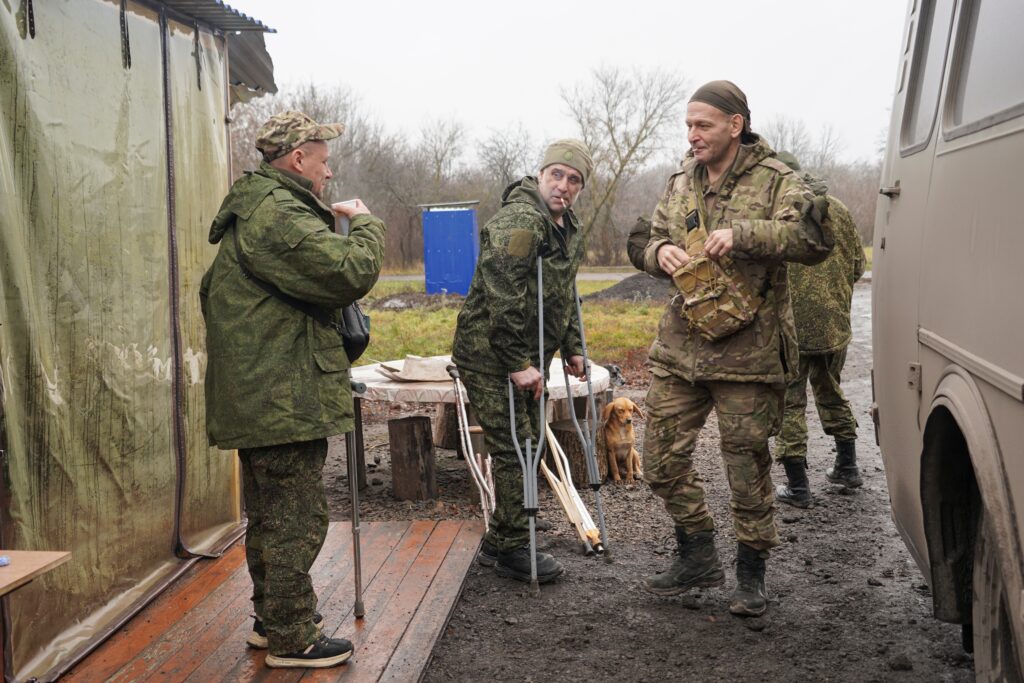
OLKHOVATKA, Russia — The bus from the front lines ground to a halt outside the roadside kitchen, and the soldiers on board limped out into the winter mud.
Most were missing feet or a leg.
A water bottle filled with blood swung precariously from a plastic tube attached to one soldier’s stomach as he was helped toward a bench. Another stared blankly at the bloodied stump where his right hand had once been.
“I would never have signed a contract if I’d known what it’s like out there. Our television is lying to us,” said Fyodor, a young soldier from Siberia. Like others in this article, The Washington Post is not identifying him by his full name to protect him from any repercussions for criticizing the war.
Fyodor had his lower leg blown off by a mine two days previously during an advance on Lyman in Ukraine with what remained of his unit. He said he was one of just 10 people left of the 110-strong unit he joined two years ago.
He had no regrets over the loss of his leg. “It means that I can finally go home — alive.”
“We’re fighting for fields that we cannot even take,” interjected a fellow soldier, Kirill, also in his 20s, laughing wryly. “This war will never end. … It feels like it’s only just begun.”
Scenes like this one remain invisible to most Russians, erased by state propaganda and glossy government projects supporting returning veterans. But inside the country, fatigue and resentment are festering beneath the suppression of dissent.
There is no outlet for public frustration and no relief from the mounting national exhaustion with a four-year-long war that is corroding the country from within and making society more dysfunctional, broken and paranoid, according to observers and those interviewed for this article.
Over the past year, the Russian economy has lurched from spectacular growth to near stagnation. Russia’s digital repression and isolation are deepeningas more apps and platforms are banned. According to Western intelligence, more than a million Russian fighters have been killed or wounded — many in battles for marginal gains. And as Moscow’s search for internal enemies intensifies, its machine of repression is turning on its own children and patriots.
During Russian President Vladimir Putin’s meeting with his Human Rights Council this month, film director Alexander Sokurov spoke out against censorship, the country’s suffocating foreign agent laws, the rising cost of living and the lack of opportunities for young people. “If Russia doesn’t change how it works with young people, it faces a dead end,” he said. Putin said he would respond later to his grievances.
A former senior Kremlin official told The Post that he was “very worried” about the “dark picture inside Russia.”
“We can’t turn the clock back easily; political will is needed to reverse this, and it simply does not exist,” the former official said, speaking on the condition of anonymity to speak freely on sensitive matters.
Bearing the brunt
In Belgorod, a Russian border city that once enjoyed close links to Ukraine’s Kharkiv — just 46 miles to the southwest — the price of this war is particularly tangible.
Daily drone attacks have long become part of the routine here. Mud-spattered ambulances and camouflaged air-defense units tear through the center of town. The city’s volunteer networks — an integral part of the war effort that has supported the troops with clothing, food and equipment where the government has failed — continue to work around-the-clock, with retirees sewing anti-drone netting and 3D-printing plastic bomb casings for drones.
Deaf to the suffering and mass destruction taking place just across the border, Belgorod regards itself as the main victim of this war. The city illustrates the widening gap in Russian society between the indifferent, metropolitan majority and the “warring” few.
On a cold November afternoon, a group of volunteers helping deliver supplies to the army huddled around a table to eat soup. They told The Post that they felt abandoned by Moscow.
“They have absolutely no idea what is going on here!” exploded Edik, 52. “In Moscow there are parties, people having fun, going on vacations. How is that possible? Here blood is being spilled, and there they’re celebrating. How can they reconcile that?”
Several volunteers said they had noticed a lull in donations since the start of the year, as many expected the war to end soon. Yevgenia Gribova, 35, who coordinates a center in Belgorod, said that the volunteer movement is facing a crisis. In the first year, she said, people were spending the last of their rubles to support the troops, working constantly, without days off or vacation.
“Now people want to rest, they want to spend money on themselves rather than on materials for the front lines,” she said.
But while people said they want to see an end to the conflict, some also spoke of their desire to keep fighting and the need to end the war under the “right” conditions.
“Everyone still wants to take Odesa. It’s a common opinion: People want to go to Odesa on vacation again,” Gribova said. “For us, this is a civil war between Russians and Russians who have forgotten a bit that they are Russians, that’s all.”
Belgorod and residents of Russia’s regions bordering Ukraine form part of what pro-Kremlin sociologist Valery Fyodorov, the director of VCIOM polling institution, has defined as “warring Russia”: a minority of the country — roughly 20 percent — consisting of soldiers, their families, patriotic volunteers and workers in military factories who consider the war vital for Russia’s survival and who are pushing for victory. The rest, he says, are either passively loyal, indifferent to the war, opposed to it but taking refuge in their private lives, or living in exile.
Dmitry, a deputy commander of a grenade-launcher platoon in Russia’s 116th special purpose brigade, said that Russia would fight for a very long time and “with sticks, if necessary.”
“Everyone wants to go home, everyone wants all of this to end. But even tired people carry out their tasks,” he said.
Return of the heroes
How does a nation sell to its people a war that is destroying the country — and how does it ensure that it continues?
To keep the war effort rolling and to stave off discontent, the Kremlin has poured money into projects supporting soldiers and veterans, including the nationwide Defender of the Fatherland State Foundation, which was established in 2023 by Putin and is led by his niece, Deputy Defense Minister Anna Tsivaleva.
For their sacrifice, soldiers are rewarded with financial benefits, social prestige, and significant employment and education opportunities for themselves and their children.
Denis Poltavsky lost the sight in his right eye after he was swarmed by drones in battle last year. Unwilling to share many details about his time on the front, Poltavsky said he suffered from extreme PTSD, haunted by nightmares and insomnia.
But without a doubt, he says his life has materially improved since returning home. “The support is very extensive. The state is doing everything for veterans and soldiers. … They didn’t abandon us. They keep track of you and provide everything.”
Poltavsky was paid an initial $51,000 for his injury, plus insurance and a military pension. He has access to free transport, and tickets to museums and theaters. He recently completed Belgorod’s Time of Our Heroes management and leadership training, and hopes to soon receive a grant for his metalworking business.
Veterans also have access to round-the-clock support from psychologists, doctors, carers and volunteers; they are given tax breaks and secure employment, even with disabilities. Belgorod’s program is even offering veterans free land on which to build a house.
Middlebury College professor Will Pyle, who studies Russia’s economy, has found that in some regions a larger share of Russians report being satisfied with their lives than at any time during the decade preceding the February 2022 invasion. The finding is based on analysis of longitudinal survey data from the Russian Longitudinal Monitoring Survey, which is maintained by Moscow’s Higher School of Economics.
According to Pyle’s research, conducted with the Bank of Finland, the increase in reported life satisfaction is especially pronounced in regions whose economies have benefited from wartime and military-adjacent industrial production.
This chimes with Fyodorov’s research. “The more depressed the region, the more people have noticed their improvement in life,” he said.
But underneath the lionizing of the soldiers and this temporary uptick in prosperity, there is also the darker acknowledgment about the impact of returning veterans and the longer-term social consequences of its invasion. Already a string of horrific murders, rapes and crimes have been committed by returning soldiers— many of the convicted criminals who signed contracts to win their freedom have returned home to commit more crimes.
“Every governor in Russia knows that a wave of problems is coming with the soldiers returning home from the front with serious post-traumatic stress disorder,” said a Kremlin insider, speaking on the condition of anonymity because of the sensitivity of the issue. “And they know the responsibility to deal with this will fall to them.”
The patriots and the teens
Since the start of the war, Russia has gone after its dissenters, pursuing LGBTQ+ people, artists and opposition figures; and made criticism of the conflict and the military illegal. But now, some of the state’s most fervent supporters are running into trouble as well.
The vocal, ultrapatriotic “Z” military bloggers, initially a backbone of support for Putin’s invasion, have gone on to criticize corruption and shortcomings in the army. The most radical of their leaders, such as ultranationalist hawk Igor Strelkov, were initially jailed. But this fall, they saw their ranks swept by an unexpected purge as the whole movement became the focus of repression.
In September, authorities branded Roman Alyokhin, a prominent blogger with 151,000 subscribers on Telegram, a foreign agent (a label usually reserved for liberal opposition figures). In October, blogger Tatyana Montyan was declared a “terrorist and extremist.” Another, Oksana Kobeleva, was detained by the police. All had publicly criticized senior officials or other propagandists. The Z community has since turned on itself, with bloggers racing to denounce one another.
“The moment of unity did not last very long, and after almost four years, we are seeing how people begin to oppose each other as well, deciding which of them is more patriotic,” said military blogger Mikhail Zvinchuk, the founder of Rybar Telegram channel, which has links to the Defense Ministry.
He added that the movement became corrupt and embezzled funds that were raised to support the troops. “Over the years, there have been a number of crooks who are trying to exploit the war.”
In Russia’s second city of St. Petersburg, security services have found a different target — teenagers.
At the Izmailsky courthouse last month, masked police officers escorted two teenage musicians from their hearing to the secret service cars waiting outside. The pair, 18-year-olds Diana Loginova and Alexander Orlov — from the street band Stoptime — had just had their arrest extended for a third time. Orlov, the guitarist, fist-bumped one of his friends as he exited the courthouse. Officially, they stood accused of blocking the entrance to a metro station during an impromptu street concert this autumn; but their true crime was their viral performances of anti-war songs.
To many, the consequences of Stoptime’s performances were inevitable. But the young musicians’ case sent a chill through this still liberal Baltic city, where street performances are an integral part of local culture.
Copycat acts and musicians performing in solidarity with the imprisoned band members in the Urals and other cities in Russia were also arrested and charged as security services moved swiftly to crack down on the slightest flicker of dissent. Now, even singing the wrong kind of music can get you jailed; a development that many regard as a return to the days of the Soviet Union.
The hearing in St. Petersburg was tense, at times Kafkaesque, as the defense lawyer unpicked the details of the performance in question. “There are approximately 47 meters between the entrance to the metro and the spot where they were performing. It is therefore impossible that the people who stood in a circle around Stoptime could have blocked that space,” she said.
Loginova, known by her stage name, Naoko, spent the last 20 minutes in the courtroom clasping her mother’s hands. “I really hope this is the last time they arrest me,” she whispered. Irina, her mother, smiled and held her daughter close, looking dazed. “Don’t you remember that they said that they would let you go on the first night? It’s now been a month.”
What made Stoptime’s rebellious music performances so striking was that they came at a time when free, creative spaces and opportunities to escape are fading fast.
“The very fact that they performed such songs was captivating,” said Ivan, 26, a history teacher, who attended many of their performances. “It was like an echo of normal life in our time. These are songs you want to listen to: they are kind, they’re meaningful, they promote universal human values, they remind that you can overcome things.”
He said in Russia right now the state is trying to build a strict loyalty based on behaving a certain way “in order to simply exist.” Around him he’s watched people accept a situation they were once horrified by and shift into a survival mode.
On Nov. 23, the Stoptime musicians were secretly and unexpectedly released, and they immediately fled the country. They were spotted in early December in Yerevan, Armenia, still performing the same opposition songs that got them arrested.
Others have not been so lucky.
Tatiana Balazeikina’s 19-year-old son, Yegor, is three years into his seven-year sentence for terrorism after he attempted to throw a molotov cocktail at a local military registration office in 2023. Yegor is one of hundreds of teenagers and children arrested for anti-war protests, sabotage or treason since the war.
“Stoptime were singing what so many people already had on the tip of their tongues,” said Balazeikina from her home an hour south of St. Petersburg. “This is dissent. And the only way for this state to remain what it is, is to cut off all these signs of dissent right at the root.”
She believes that young people present a special kind of threat to the Kremlin.
“These young people who essentially have nothing to lose except their freedom, are very dangerous,” she said. “And if those young people are not only capable of thinking but can also sing what they think … that’s an even bigger threat.”
Natalia Abbakumova in Riga, Latvia, contributed to this report.
The post As Russia’s war grinds on, its society is fraying appeared first on Washington Post.