The thing about space is that you have to be patient. The universe does not bend to earthly time scales, and events are governed by the unalterable realities of physics and engineering. They will happen when they are good and ready.
Sometimes we have to wait much longer than expected for events in our solar system, and beyond. Especially in spaceflight, you might hear about events, learn they are postponed and then eventually hear about them again. In 2026, there is some hope that your patience will be rewarded.
Below, enjoy this list of developments that New York Times reporters and editors are anticipating in the year ahead.
The Artemis II Mission
NASA is sending astronauts back toward the moon. No, for real this time.
It has been more than 50 years since humans exited low-Earth orbit and traveled around the moon. In the time since, space agencies have built space shuttles and space stations, but their crews have remained within our planet’s close embrace.
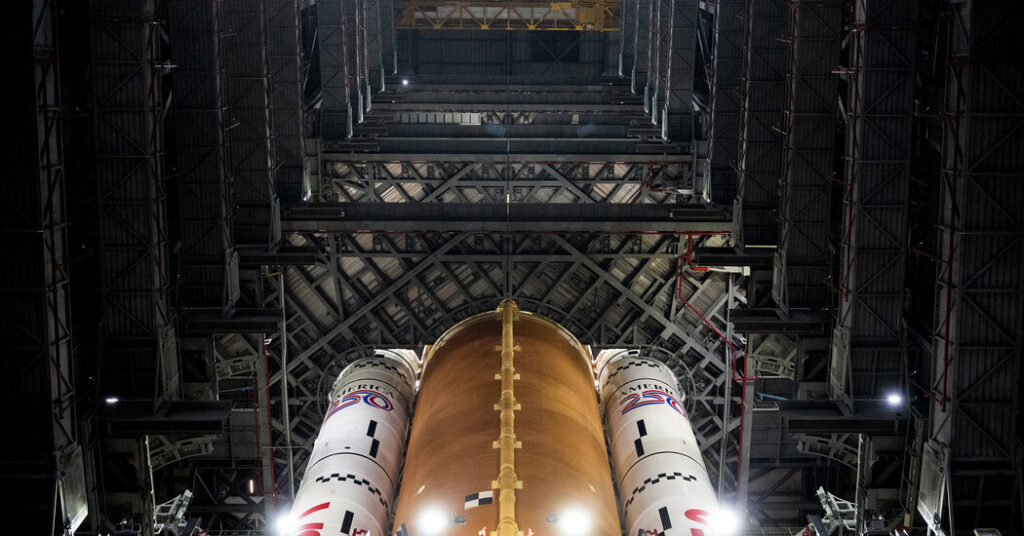
Early in 2026, astronauts from NASA and the Canadian Space Agency will again travel around the moon and back. The crew of four is made up of Reid Wiseman, Victor Glover, Christina Koch and Jeremy Hansen. Mr. Glover will be the first Black person to shoot the moon, and Ms. Koch the first woman. Mr. Hansen will be the first Canadian, and the first non-American, to ever do that.
The 10-day journey will not greatly differ from that of Apollo 8, the first time NASA astronauts looped around the moon, in December 1968. But if the mission gets off the ground at Kennedy Space Center in Florida and splashes down in the Pacific Ocean, it will prove that the Orion capsule, a key vehicle in NASA’s lunar infrastructure, is a safe ride for astronauts. It could happen as soon as February.
Landing NASA astronauts on the moon is another story entirely.
The New Moon Race
China has set a goal of landing astronauts on the moon before 2030. In August, it conducted the first test on Earth of Lanyue, its lunar lander for astronauts. It intends to use that vehicle for an Apollo-like mission.
NASA, by contrast, has planned a more complex mission, Artemis III. It relies on Starship, a giant, next-generation spacecraft built by SpaceX, to land two astronauts near the moon’s south pole. The agency said late in 2024 that it would achieve this feat by mid-2027.
But SpaceX, Elon Musk’s company, struggled in its Starship test campaign this past year, and doubts grew about that timeline. In November, NASA sought alternative proposals for Artemis III, and President Trump signed an executive order in December that set a lunar landing in 2028 as the current goal.
That date is ambitious, and two events in 2026 could set the stage for whether China gets astronauts to the moon before Americans return.
First, SpaceX plans to test the latest version of its Starship vehicle. If early flights succeed and it is able to relaunch a vehicle that fully orbits the Earth, the company’s plans may be back on track, even if it cannot achieve a 2028 landing.
The second event involves Blue Origin, the spaceflight company owned by Jeff Bezos, the Amazon founder. The company is planning a robotic lunar landing with a version of its Blue Moon vehicle in 2026. If that mission is successful, NASA could confidently consider Blue Origin’s alternative lander proposal, which is simpler and could potentially be ready sooner than Starship.
Summer Eclipse
On Aug. 12, the moon will slide between Earth and the sun, causing a total solar eclipse.
The moon will temporarily block the light from the sun, casting a shadow along a path on the surface of Earth. The eclipse will begin in northern Russia and travel over the Arctic Ocean, south through Greenland and Iceland, and across the Atlantic Ocean. It will pass over the northern part of Spain and end in the Mediterranean Sea. Tourists from around the world are expected to flock to Iceland and Spain to view the solar spectacle.
Those who live in or travel to the path of the eclipse will be able to see the sun’s corona, or outer atmosphere, for up to 2 minutes 18 seconds, a phenomenon known as totality. People in regions that neighbor the direct path will see a partial solar eclipse, during which only part of the sun will be obscured by the moon.
Rubin’s Survey of the Stars
The Vera C. Rubin Observatory, which houses a telescope on a mountain in Chile, observed its first light in 2025 and shared breathtaking images of the universe with the world in June. The observatory is set to begin its official survey of space and time in early 2026.
For the next 10 years, Rubin will capture about a thousand images of the southern sky almost every night in one of the darkest places on Earth, using the largest digital camera ever constructed. The wealth of data will elucidate how objects in the universe, like black holes and asteroids, evolve over time. It will also help astronomers better understand the nature of dark energy, a mysterious force pushing the cosmos to expand ever faster, and dark matter, the invisible substance that shapes our cosmos.
Already, Rubin has discovered more than two thousand asteroids and spotted Comet 3I/ATLAS, an interstellar visitor from beyond our solar system that has generated a lot of buzz online.
Infrared Eyes in Space
NASA is preparing to launch its next-generation Roman Space Telescope, named after Nancy Grace Roman, the agency’s first chief astronomer, no later than May 2027. But the space agency plans to move the telescope to Kennedy Space Center in Florida next summer and to try to launch as early as the fall of 2026.
Astronomers will use the Roman telescope’s infrared vision to map billions of galaxies, data that will help them learn more about dark energy. Construction of the telescope was completed just months after astronomers uncovered evidence that the nature of dark energy is more complex than previously understood.
The telescope will also help researchers hunt for exoplanets and study the swirling disks of cosmic matter in which they form, expanding our catalog of other worlds in the Milky Way. Some of these planets may be orbiting within a star’s habitable zone or may have gone entirely rogue, existing in the galaxy unattached to any host star.
A Japanese Journey to Mars
The United States and China both plan to send robotic spacecraft to collect pieces of Mars for study on Earth. But Japan might beat them at that game. Sort of.
Mars has two small moons, Phobos and Deimos, which have long fascinated scientists. Theories about their origins vary. One holds that they are pieces of the red planet ejected into space by a collision that occurred early in the solar system’s history. Alternatively, they might be asteroids captured by Martian gravity.
Studying those moons up close, and bringing samples of them to Earth, could help sort out that mystery. Japan’s mission, called Martian Moons Exploration or MMX, intends to do that, reaching Mars to study the two moons, then attempting a brief landing on the larger one, Phobos, to collect samples.
Japan has completed similar missions twice with Hayabusa and Hayabusa2, with the second mission bringing material from the asteroid Ryugu to Earth in 2020. It might try to launch MMX at the end of 2026, although a recent failed flight of H3, a Japanese rocket, could affect the launch schedule.
Katrina Miller is a science reporter for The Times based in Chicago. She earned a Ph.D. in physics from the University of Chicago.
The post Your Wait for These Space Events Is About to Pay Off appeared first on New York Times.