If one elected official had a breakout year in 2025, it’s New York City Mayor-elect Zohran Mamdani. The 34-year-old former state assembly member came out of nowhere to win a Democratic primary that included established names such as incumbent Mayor Eric Adams and former Gov. Andrew Cuomo. Then, Mamdani won the election his way, lapping opponents with a modern campaign that effectively used social media, brought in new voters, and embraced his history of pro-Palestinian activism and longtime affiliation with the Democratic Socialists of America.
Key takeaways
- New York Mayor-elect Zohran Mamdani views his transition as continuing the work of his campaign — bringing the public in to help them better understand politics and governing.
- He wants the success of his mayoralty judged on whether he fulfills his three biggest campaign promises: free buses, universal child care, and freezing the rent.
- He argues the national lesson of his campaign for Democrats is a focus on affordability and meeting working people where they are.
But since his win in November, Mamdani has had to confront the challenges of governance. Sweeping campaign promises like fast and free buses, universal child care, and a citywide rent freeze for government-subsidized apartments will require, at minimum, continued public pressure to make them reality.
He has angered some progressives by retaining NYPD Police Commissioner Jessica Tisch and refusing to support a primary challenger against Democratic Rep. Hakeem Jeffries. Even more, Republicans (and some moderate Democrats) have sought to turn Mamdani into an avatar of incompetence, a boogeyman for left-wing politics ahead of this year’s midterm elections.
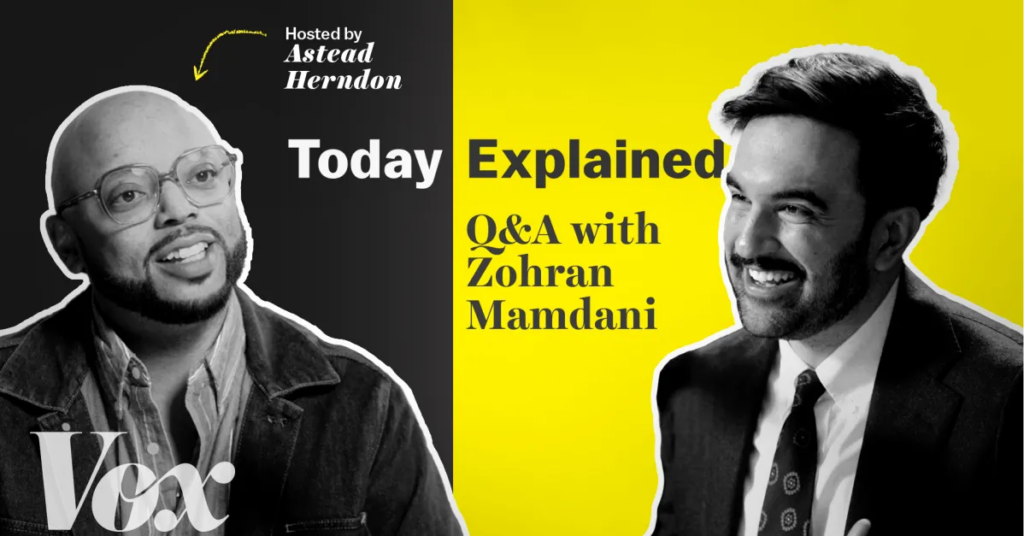
Against that backdrop, Mamdani recently sat down with Today, Explained at his campaign headquarters in Manhattan to discuss his administration’s priorities, his plans for keeping his coalition together, and how he’s prepared himself for City Hall.
Throughout the discussion, Mamdani stressed that he believes he will ultimately be judged by one thing — his ability to deliver on his affordability agenda. Everything else, he said, comes second.
Below is an excerpt of our conversation, edited for length and clarity. There’s a special reported section in our episode, so listen to Today, Explained wherever you get podcasts, including Apple Podcasts, Pandora, and Spotify. Early access to the full video interview is available right now on Vox’s Patreon.
We’re glad to talk to you at this point because we want to focus on the transition. We know that mayoral transitions can sometimes be the high-water mark for elected officials. I recently saw that you were +15 in your own favorability. How do you reverse what has been a historic trend? How do you make sure that this moment that you’re taking office is not the end of something but the beginning?
I think I am aided by the fact that I have not given much weight to polls and favorability in the past, which is part of the reason why I’m sitting in front of you, because I didn’t even have enough recognition to have favorability done at the beginning of this race.
So I think it comes back to the fact that we ran a race on an affordability agenda. It spoke to New Yorkers living in the most expensive city in the United States. We have to now deliver on that agenda. I think the premise of your point is that this is the moment of hope, and then the question of what comes next.
And even beyond the transition as a high-water mark, oftentimes in campaigns, there’s already a temptation of nostalgia for what the campaign was. We have to ensure the campaign is not the story we look back on. It’s the path to the story that we’ve yet to start. And I think that comes back to delivery. That comes back to freezing the rent, making buses fast and free, delivering universal child care. You have to transform people’s lives in a way that they can actually touch and feel and hold onto so that they’re not just grasping at the memories of what the struggle was like.
I feel like the first clues of how you all planned to do that came in the transition. You all had some unique moments putting out these explanatory videos about semi-mundane process things — like, the baseball cards for staff appointments. We were at the event that you all held last week at the Museum of the Moving Image. Why do that stuff?
I think there’s a temptation when you win — we’ve seen it in the past — to say, now trust me, you can go home. The point of me winning is we keep fighting for the same agenda together. And that means you bring people along with you, and you also demystify what it is that you’re doing. I mean, this transition period is probably the most opaque period, typically because it’s between a campaign and governance, and most New Yorkers are never brought into it.
Sounds like the demystifying efforts are connected to what has been described as an inside-out strategy — that to achieve the goal of delivering you feel as if you have to keep the public engaged. You have to keep that public pressure going.
You do. And I think there’s often a description as if the campaign ends and governance begins with the implication that you leave people behind. And in many ways, you have to keep going in the same kind of manner.
How does that get harder once you’re in office? To your point about the ways that campaigns and transitions kind of create a sense of unity, once the inauguration happens, everything becomes Mayor Mamdani’s problem. How do you reverse the trend of the public disengaging at that moment?
I think you have to do the work to create actual opportunities for engagement as opposed to vague invitations.
For 12 hours, I sat at the Museum of the Moving Image, and I listened to New Yorkers — more than 140 New Yorkers came to share their stories with me. And the point of that is not just to say I listened, it’s to actually take what they’re saying and then act upon it. And some of the concerns were large.
They were the concerns of undocumented New Yorkers sharing with me the immense fear that they live with on a day-to-day basis. And I think this idea that in fact governing could be informed by the people you’re governing for, as opposed to treating New Yorkers as if they’re just subjects.
And I think that’s the approach we’ve tried to take over the course of the transition. And also the understanding that, in order for people to act upon something, they have to know about something. We even take that approach to rights in this moment when so many New Yorkers are fearful of ICE agents and the potential of immigration enforcement, as we’ve seen it take place across the city. We thought it was important to remind every New Yorker of their own rights and so that — the only way they can exercise them is if they know about them.
Is there any argument, though, that this is a little glitz and glamor? I mean, these were largely supporters of yours. Did you hear criticism? Did you hear any critiques of your campaign from some of those New Yorkers?
Any gathering of New Yorkers has to have some critique; otherwise it’s not a gathering of New Yorkers. And I think there’s critique in a fear of, are you going to be able to deliver on these things? Because there’s a fear of should I have believed in this? And my job, and our job, in building a team is to showcase the seriousness with which we took those commitments and how we actually deliver them.
You know, one New Yorker spoke to me about how their number one concern was about casinos. And I shared with them that I’m skeptical of the economic development promises that come with casinos, and I also know that there’s a referendum that was passed by voters that creates the citation of three casinos within New York City. And I can’t actually change that myself. And the frustration of knowing that this is something that person does not want, and you cannot help them.
I know that you previously had said that you wanted a team that did not have policy litmus tests, that you wanted folks with differing opinions on that transition team. Has the staff you put in place lived up to that?
Absolutely. I think you’ll see that appointments are not simply a reflection of myself, and I think there’s a tendency sometimes to just look to reproduce yourself, your ideas, your preferences in each and every person you hire. What you do if you’re to do that is create the conditions where everyone in the room is measured by the quickness with which they can say yes to you and yes to any one of your ideas. You need to build a team where people can also say no to you, where people can push you, where you are able to have the debate inside the room as opposed to waiting to have the debate outside the room. And I think that, in the appointments we’ve made thus far, it’s not demanding alignment on each and every issue. It’s asking, do you believe in the agenda at hand, and do you have a vision for this specific position that shows you can fulfill that?
You know, at the same time, there’s folks who have been frustrated with that, have thought that some of this coalition-building has maybe betrayed the movement that got you here. I’m thinking about the appointment of Jessica Tisch as police commissioner. I’m thinking about a vocal rejection of a Democratic challenger to Hakeem Jeffries in Brooklyn. My question is, have you had to embrace a different side of yourself? Do you hear any of the critiques that we’re seeing of “insider Mamdani” these days?
I think you have to, first and foremost, take these critiques in good faith. As you win an election, you can start to tell yourself stories that any critique is critique you have to keep far away from you. People don’t understand. That is how you become removed from the reason you did this in the first place.
When you engage with it, you separate the good faith from the bad faith. And I think taking this in good faith, I understand the criticism that those have shared. I also think that it is important that it’s not just a reproduction of self in every single appointment and that we understand that, for example, with the NYPD, my decision in retaining Commissioner Tisch is a decision on the basis of looking at her record of coming into an NYPD that the Adams administration had stacked the upper echelons of with corruption and incompetence and starting to root that out while lowering crime across the five boroughs.
Making this decision not only in recognition of that, but also to fulfill the larger public safety vision that we had laid out over the course of the campaign, which focused on the creation of a department of community safety that will tackle the mental health crisis, the homelessness crisis. With the commitments I’ve made specific to the NYPD, like the disbanding of the strategic response group—
Those things still happen.
That still happens, and I think that’s what’s important to make clear to New Yorkers is that the things that we campaigned on, these are still things that we will fulfill. We will do so with the teams that we’re building around us.
One question I have is there’s so much national and international focus on both the campaign and your administration going forward, but it’s such a hyperlocal job. How do you balance what will be the intense attention with the reality of who you’re serving?
You have to remember not just that reality, but the point of this is to serve this city, right? It’s not like a reality check. It’s the reason why I did this. It’s the reason why it was possible to weather difficult moments because it’s all in service of a city that I love. There’s some days where it’s hard to believe that my job is traveling around New York City and meeting New Yorkers and listening to their concerns and having the opportunity to act upon them. And I also think the greatest thing you can do is the power of example, of what you can do, what you can succeed, what you can deliver.
Because what we’re talking about right now, the growing sense among New Yorkers that politics is irrelevant to their day-to-day struggles, the inability for our political system to deliver on crises large and small, these are not uniquely New York issues. These are issues that people feel outside of the city, outside of this country, and we have an opportunity to show that by serving New Yorkers, we can also showcase a politics that can serve working people wherever they may be.
I want to look ahead. How would you define the priorities for your agenda? What would you define as success or failure for the Mamdani administration?
It comes back to affordability. The priorities have to be the fulfillment.
Are those the three? Are we talking about buses, child care— What am I missing?
Hit ’em. Come on.
Buses, child care, rent freeze, boom. But what about things like the publicly subsidized grocery stores? Is that a priority too?
Yes.
Well? So it’s all of the above.
I would say that the first order of priorities — like ranking best friends — the first order of priority are the three that we built the campaign around.
Okay.
There are obviously other commitments we made in addition to that. Five city-owned grocery stores, one in each borough.
The fulfillment of these things are not just critically important because you’re fulfilling what animated so many to engage with the campaign to support the campaign, but also because of the impact it can have on New Yorkers’ lives. There’s a lot of politics where it feels like it’s a contest around narrative that when you win something, it’s just for the story that you can tell of what you won, but so many working people can’t feel that victory in their lives.
The point of a rent freeze is you feel it every first of the month. The point of a fast and free bus is you feel it every day when you’re waiting for a bus that sometimes never comes. The point of universal child care is so that you don’t have to pay $22,500 a year for a single toddler. These are not things I have to explain the worth of to you or an intellectual victory. It is a material one. And so to me, when we talk about the struggles of our democracy, when we talk about a withering faith in it as a political system, we have to understand that the withering of that faith is intensely connected to the inability of that system to deliver on the needs of the people of it.
So success is the big three promises.
Success is the big three.
What about political goals? I mean, I was on cable news today, and they’re talking about the “Mamdani wing of the Democratic Party,” and they’re talking about all challengers facing incumbents and the goal of spreading progressivism, I think specifically socialism, across the country. Is that a goal you share? Do you look out at those challengers and say, that is the Mamdani wing?
I think that anyone fighting for working people and fighting for a politics that doesn’t just think of working people, but puts them at the heart of what it is that we’re doing is critically important anywhere in this country. I think that for me, this is a moment in time where we have to reckon with why people feel this way about politics, and there is oftentimes an inability to reckon with the failures that have come before us because they implicate a lot of what we’re doing right now.
But the implication is that part of your political project is to spread across the country and to Congress. Is that?
I mean, part of my political project is to spread the fight for working people everywhere, and I think that can mean new candidates. It can also mean a renewed belief amongst those who are already there to fight.
One of the things I also wanted to ask is like, it feels like core to the kind of Democratic Party’s questions of moving forward has been to what to take from your campaign. I have heard people say everything from, it’s all about social media to kind of separate from the substance. I actually want to read you a quote and have you respond.
Hit me. Is this mean tweets or good tweets?
No, no, no. Not tweets at all. Pete Buttigieg just said, “But I think if my party wants to learn lessons from Mamdani’s success that are portable to a place like Michigan where I live, it’s less about the ideology and more about the message discipline of focusing on what people care about and the tactical wisdom of getting out there and talking to everybody.”
I wanted to know, do you think this is true when we get outside of New York, are we thinking that it’s less about the substance of campaign than tactics? Or can we separate those things?
I don’t think you can fully separate the medium and the message. I think that that person is correct, that you have to have a politics that relates to working people’s lives and their struggles. It can’t be one that needs to be translated. I would also say that yes, there are far more New Yorkers who do not ask me about how I describe my politics and more they ask me, do I fit in that politics?
I also think, however, that if all we did was make videos without a vision and affirmative vision of how working-class New Yorkers could afford this city, then I wouldn’t be seated across from you right now.
There are aspects of this campaign that are very much focused on New York City, right? I don’t know if there’s a rent guidelines board anywhere else in this country that can freeze the rent for more than 2 million tenants. We do have the slowest buses in the country. We do have child care at costs that are astronomical, but the struggle for working people to afford day-to-day life, to afford dignity in the city they call home. That’s not New York City specific.
And what I would say is wherever anyone is to ask the people around them, what is the example of that struggle in your life, and what are the tools? And then for you as the candidate to think about what are the tools that government has to intervene in that to actually provide relief to that? Because so often politics feels like an exercise in language and ideas that you need to have been at the last meeting to understand this meeting. And you actually need to meet people wherever they are and not explain to them why they should listen to you, but to actually have a vision that is intuitive for the struggles that they’re living through.
The post Zohran Mamdani on his mayoral transition and what comes next appeared first on Vox.