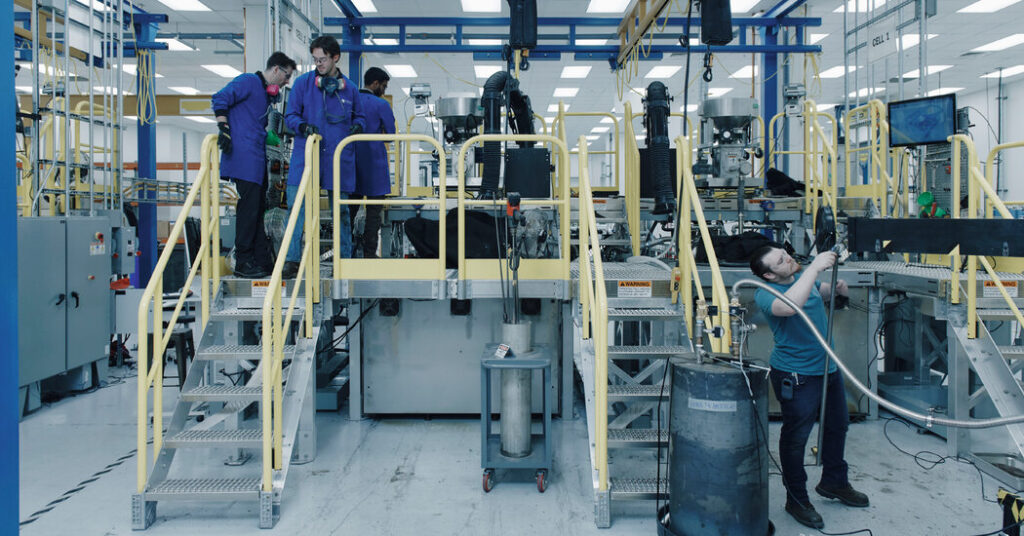
Every few hours, two furnaces in a New Hampshire office park quietly transform batches of taupe-colored powder into rough ingots.
These mottled chunks of metal, about the size of a few bricks, ultimately will be used to make electric vehicle motors or maybe a fighter jet.
This is what rare-earth processing looks like in the United States, where university researchers and start-ups are trying to wrest a slice of this small but vital industry from China.
Rare earths are a family of elements toward the bottom of the periodic table, with tongue-twister names like neodymium and dysprosium. They are used in powerful magnets, lasers, M.R.I. machines and other instruments.
And while they are not actually rare, they are difficult to process into usable forms. China refines more than 90 percent of the world’s rare earths, a level of control that is of growing concern to Western governments and businesses.
The United States was a big player in this industry until the mid-1990s, but China’s robust industrial policy, along with looser environmental regulations, allowed companies based there to establish a dominant position and sell metals and magnets for a lot less than suppliers elsewhere. Over time, many rare-earth miners and processors outside China withered away.
There is too little money to be made in rare earths for the elements to be of much interest to mining giants, so the challenge of re-establishing a domestic industry has fallen to small companies like Phoenix Tailings, a Boston-area start-up that runs the metal-making plant in Exeter, N.H. A handful of other companies in the United States are processing rare earths in small quantities, including MP Materials, which owns a mine in Mountain Pass, Calif., and recently began producing rare-earth metal in Fort Worth. Similar efforts are underway in Europe and Asia.
“It’s small volumes of low-value materials that are very expensive to process,” said Elsa Olivetti, a materials science and engineering professor at M.I.T. “Meaning it’s hard to make money.”
Phoenix Tailings’ New Hampshire operation is about two months old, housed in a converted medical device plant. The company buys metric-ton bags of powder — a mixture of neodymium and praseodymium bound with oxygen — from mining and refining companies in the United States, South America and Australia. It funnels that flour-like material into a drying oven and eventually into furnaces that heat it to the temperature of volcanic lava.
This circuit takes up less than 15,000 square feet and is designed to generate no emissions other than those associated with the electricity Phoenix Tailings uses. The closed-loop design distinguishes this process from the more energy-intensive techniques used in China, where workers scoop up molten metal with ladles. That approach releases perfluorocarbons, potent greenhouse gases that do not break down easily.
Phoenix Tailings used to buy some raw material that came from China but hasn’t relied on that country in several years, said Nick Myers, the company’s chief executive.
“To untangle yourself from China, you have to force yourself off the original drug,” Mr. Myers said during a recent tour of the New Hampshire plant, his words tumbling out like a podcast played at 1.5 speed. “You can wean yourself off, or you can go cold turkey. But at the end of the day, you’ve got to get off.”
It has been a whirlwind year for Mr. Myers, 34. His company, recently valued at $189 million, was three weeks from bankruptcy in late 2024. President Trump’s trade war lifted the company’s fortunes, as China responded to higher U.S. tariffs by restricting exports of rare earths. That got more investors interested in Phoenix Tailings and led new customers to place orders, putting the company on surer financial footing.
The large majority of Phoenix Tailings’ customers are in the auto industry, and a small share are U.S. defense contractors.
The Trump administration has agreed in recent months to pour more than $1 billion into the industry, taking stakes in companies involved in mining, refining and magnet production. It also is subsidizing MP Materials products by guaranteeing the company receives a set price for them.
Phoenix Tailings has been awarded more than $6 million in federal funding, most of it before Mr. Trump returned to power in January, and is hoping to secure more.
“My grandmother tells me about rare-earth elements now,” Mr. Myers said. “Previously, it was a very lonely journey.”
Mr. Myers co-founded Phoenix Tailings in 2019 after meeting Tomás Villalón Jr., the company’s chief technology officer, at a Bible study retreat outside Boston the year before. Mr. Myers was working for a genomic sequencing company while Dr. Villalón was finishing his doctorate in materials engineering at Boston University. The pair identified rare-earth processing as an opportunity during a late-night discussion about markets they found interesting, Dr. Villalón recalled.
They eventually teamed up with three others and built a prototype of their processing system in Dr. Villalón’s backyard in Cambridge, Mass., home to M.I.T., where two of the five founders earned their undergraduate degrees. “I don’t know how legal it was,” Mr. Myers said.
Investors in the company include the Central Intelligence Agency’s venture capital fund, In-Q-Tel, and BMW’s venture capital arm.
Metal making is the last step in the long and often fragmented process that is rare-earth refining. Eventually, Phoenix Tailings aims to control all of those stages, taking in waste from iron mining — known as tailings — removing the rare earths and separating them into individual elements to be made into metal.
It will not be easy. Tom Lograsso, who directs the Critical Materials Innovation Hub at Ames National Laboratory in Iowa, described the technical challenge of metal making as “undoing what Mother Nature has naturally done.”
Much of the pollution risk associated with rare-earth production occurs in the early stages, as companies remove thorium, a radioactive element that is not one of the rare earths but is almost always found mixed into them. The thorium and the powerful acids used to extract it need to be disposed of safely.
Then there is the matter of making money. China’s grip on the industry is so tight that it can be difficult to answer even seemingly simple questions, such as how much demand there is for rare-earth metal.
“Estimates vary widely, and the market is difficult to assess due to gray- and black-market trade,” the Atlantic Council, a Washington research organization, said in a report this year, referring to the value of the global rare earths trade.
Of particular concern for Phoenix Tailings is that China has been known to sell rare-earth metal for less than it costs to produce it.
“We chose to do the hard path because we weren’t focused monetarily at first,” said Mr. Myers, who incorporated prayer into early board meetings.
But metal prices have risen in recent months, he said, as Western companies have sought supplies outside China. A poster showing the planned capacity of the New Hampshire plant had been taped over three times. As of early December, it read 1,000 metric tons, equal to about 1 percent of global demand by Mr. Myers’s estimate.
“If you see everything from tailings to metal, you have the capacity to be able to mitigate price fluctuations,” Mr. Myers said.
A big question is whether the U.S. government will continue to subsidize the domestic industry, and at what level. It will be hard for companies to compete with China without significant intervention, said Dr. Olivetti, the M.I.T. professor. “Traditional market mechanisms are going to struggle.”
Keith Bradsher contributed reporting.
Rebecca F. Elliott covers energy for The Times.
The post Meet a U.S. Start-Up Trying to Break China’s Rare-Earth Monopoly appeared first on New York Times.