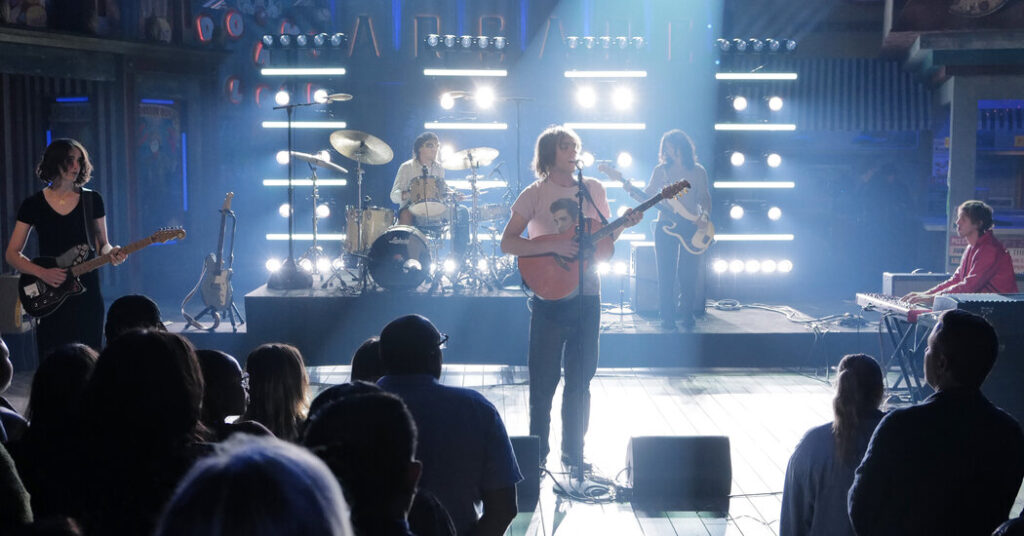
The 21st century has not been kind to rock. Pop, hip-hop, R&B, country and Latin music have all pushed the genre out of the commercial and cultural mainstream. In retrospect, rock’s last grand heyday was in the 1990s, when grunge, nu-metal and pop-punk were all happily — well, more like furiously — blasting away.
But rock was already being stripped for parts. Country was latching onto arena rock’s most crowd-pleasing sounds, hip-hop was borrowing drumbeats and riffs, and pop performers learned to treat electric guitars as fashion statements and attitude signals, if only for the length of a song. While some surviving classic-rock acts still sell out arenas today, most 21st-century rockers are well aware that their chosen idiom is likely to remain a niche choice. One indicator: In recent years, the Grammy Awards haven’t handed out the best rock album trophy during prime time.
But rock has stubbornly stuck around, and in 2025 rock bands still raised a ruckus. They have a vast available vocabulary: psychedelia to punk, rockabilly to shoegaze, yacht rock to emo, prog-rock to industrial. And it’s not as if a band has to choose just one. In an era of streaming that offers every timeline all at once, the most striking rock bands have been demolishing pigeonholes.
The limited expectations for 21st-century rock may just have turned out to be freeing. For songwriters, musicians and — with luck — enough fans to support them, rock is far from played out. Consider just a few examples from bands that have been forging their music in time-tested rock style: gigging, making multiple albums, gigging some more.
The New York City band Geese stirred up wildly disparate praise and scorn in 2025. Its third full-length album, “Getting Killed,” flaunts Cameron Winter’s wayward vocals, songs that hopscotch through decades and lyrics that pivot from heartfelt insights to absurdist doggerel and back. Is Geese a rightful critic’s darling, a spoiled put-on, neither, both or more? Winter’s stage presence drew enough notice to merit a parody on “Saturday Night Live.”
Turnstile, a 15-year-old band from Baltimore that emerged from hardcore but was never constrained by it, released “Never Enough,” a sleek, electronics-buttressed outpouring of songs about connection, longing and loss. Another band with a punk and hardcore foundation, the Armed, charged off in the opposite direction; it ferociously cranked up the frenzy and distortion, screaming and stomping its way through the songs on its aptly titled album “The Future Is Here and Everything Needs to Be Destroyed.”
M(h)aol, a post-punk Irish band — named after an Irish feminist, Gráinne Mhaol, and “maol,” the Irish Gaelic word for shorn or bare — honed terse, clattery, dissonant songs on its album “Something Soft.”
On “Bleeds,” the North Carolina-rooted band Wednesday, led by Karly Hartzman, backed her calamitous narratives and leaping melodies with explosive, feedback-laced grunge dynamics or twangy country-rock. And the New York duo Water From Your Eyes used the studio to toy with low-fi indie-rock, intricate math-rock and more, twisting every source.
Now that every computer is a potential instrument, library and recording studio, it has never been easier to create music alone or via shifting virtual collaborations. Artificial intelligence promises to reduce human input even more; for some listeners in 2025, the hollow mediocrity of the A.I.-generated band Velvet Sundown was palatable enough. But rock’s persistence in the face of machine-tooled music is a welcome sign of humanist obstinacy.
For all the attractions of computerized convenience and digital precision, there’s still traction in the longtime archetype of the rock band as a gang of unruly outsiders. A working band is a contentious team that makes its own rules, unites incongruous personalities, works beyond (or revels in) limitations, aims for improbable synergies and makes a lot of noise along the way. There’s friction, but there’s also purpose; there’s instinct along with calculation. Rock promises the physical sensation and lived-in experience of hands on instruments and voices being pushed, of callused fingers and breathless effort. And there’s passion, even when it’s wrongheaded or contrary to convention.
A rock band is also a bulky physical presence: a roomful of people, instruments, amplifiers and mics, not to mention the pedals and cables and stands. It’s not necessarily streamlined or digitally optimized. Anything might fritz out or feed back — and might make a sound no one expected and everybody loves. Machines can sample those unforeseen sounds — hip-hop regularly turns noises into hooks — but rock makes them happen in real time.
It’s easily possible to dial some randomness into the tempo of a drum loop or to tweak the tone of a recorded instrument. But happy accidents, and what happens as people respond to them in turn, are still best left to musicians who are listening to one another.
Human perception perks up at imperfections, irritants and disruptions. As a matter of survival, we need to decide, and fast, what’s a threat and what’s simply a thrill. Rock constantly takes advantage of those reactions. A great rock song is a battle, and a balance, between order and chaos, feeling and technique, signal and essential noise.
In 2025, hand-played rock infiltrated at least a little upper-echelon pop. Justin Bieber enlisted the songwriter, producer, guitarist and multi-instrumentalist Dijon (whose last name is Duenas) for his albums “Swag” and “Swag II.” Dijon is one among many credits on the tracks, but “Daisies” — a megahit that helped earn Grammy nominations for “Swag” and a producer nomination for Dijon — has a jammy, guitar-plucking feel that’s only a little more sleek and poppy than the Prince-like rock-R&B songs on Dijon’s 2025 album, “Baby.”
Bieber has long been a savvy trend-spotter, anticipating pop currents. Maybe he senses some residual, primal longing for a human touch as the machines encroach ever further.
Yet even with those stirrings, no one should expect rock to ever dominate music again. Generations of listeners have been trained on computer-tuned voices and metronomic beats, and streaming algorithms are relentlessly tabulating mass tastes. A.I. will no doubt be regurgitating whatever got the most clicks.
Rock seems more than likely to remain a minority preference — but that might be the best outcome. Whenever rock has grown too mainstream, polished or pretentious, it has self-corrected, knocking itself off its own pedestal with punk in the 1970s, thrash in the 1980s, grunge in the 1990s. Its best chance at 21st-century survival — sustainable survival — is to stay on the fringes, to stay scruffy and intuitive and imperfect, to flaunt its humanity. To be hard, messy work, and to find the beauty in that.
Jon Pareles has been The Times’s chief pop music critic since 1988. He studied music, played in rock, jazz and classical groups and was a college-radio disc jockey. He was previously an editor at Rolling Stone and The Village Voice.
The post Who Says Rock Is Dead? appeared first on New York Times.