NEW DELHI — Every couple of weeks, the Indian pilot is required to make three short-haul night flights over two consecutive nights. As she tries to rest up before her next daytime flight, the 40-year-old says she often lies awake worrying about her health.
“I don’t think I will live long if I continue flying,” said the Delhi-based pilot for IndiGo, India’s largest airline. “My body, my brain — everything has just shut down. This is zombie work.”
She was hopeful when she learned the country’s aviation regulator was instituting new rules to combat pilot fatigue — eliminating the most punishing flight patterns, limiting night landings and mandating longer rest periods. But when the rules finally came into force in November, chaos followed.
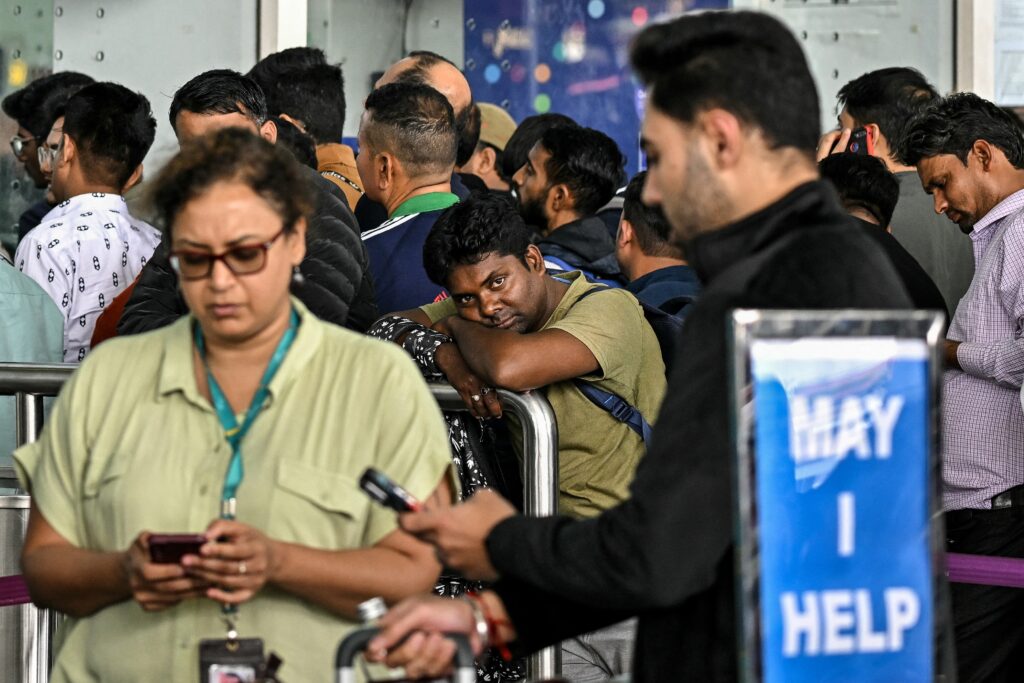
It coincided with an expansion of flight schedules, in part to accommodate India’s largest-ever wedding season, and soon cancellations and delays were piling up. By early December, IndiGo faced a snowballing disaster, described by pilots and aviation experts as a crisis unique in Indian aviation history. Almost 1 million bookings were affected between Nov. 21 and Dec. 7, the Civil Aviation Ministry told local media.
During the worst week, Indigo said it canceled about 4,500 flights, including almost all of those in and out of the capital of New Delhi on Dec. 5. Across the country, airport departure boards glowed red. Passengers were left with little information. Bags piled up and went missing.
“No airline, however large, will be permitted to cause such hardship to passengers,” Civil Aviation Minister Ram Mohan Naidu told Parliament on Dec. 9. But the ministry and its main regulator, the Directorate General of Civil Aviation (DGCA), temporarily exempted IndiGo from the new rules governing flight schedules to help stabilize the situation. The 40-year-old pilot and her colleagues felt like they were back where they began.
“In the crossfire, the people who are actually getting hammered here are the pilots,” said a senior Indian aviator with five decades of experience, who, like others in this story, spoke on the condition of anonymity for fear of professional retaliation.
Aviation experts and pilot groups say the scheduling crisis in early December was not an aberration, but a predictable outcome for an industry that has long resisted addressing pilot fatigue.
“We always knew there would be a tipping point,” said an Indigo pilot based in southern India. “This wasn’t just cost optimization,” it was “cutting corners, pushing man and the machine to its absolute limits.”
In response to questions, IndiGo directed The Washington Post to public statements, including one from Dec. 3 that said “minor technology glitches, schedule changes linked to the winter season, adverse weather conditions, increased congestion in the aviation system and the implementation of updated crew rostering rules … had a negative compounding impact on our operations in a way that was not feasible to be anticipated.” On Dec. 8, the company said it had paid out about $100 million in passenger refunds.
The DGCA and the Civil Aviation Ministry did not respond to requests to comment.
An aviation boom in a shrinking field
Two decades ago, India had a plethora of domestic carriers. IndiGo, known for its lean staffing, punctual takeoffs and fast turnarounds, steadily rose to dominance, powering the world’s fastest-growing aviation industry.
But that growth was accompanied by unprecedented consolidation. Since the early 2000s, at least three major Indian airlines have folded and at least five have been acquired or merged, leaving two major domestic players: IndiGo and Air India.
IndiGo has continued to outpace its older, more established rival, amassing more than 60 percent of the domestic market and more than $800 million in profits, according to the company’s latest annual report. For those looking to fly out of smaller airports or to less-frequented cities, IndiGo is often the only available option.
Underlying IndiGo’s ascent, pilots say, was a culture of intense pressure around work schedules that reshaped industry norms, particularly after the coronavirus pandemic. “I have often gone to the brink before I get rest,” the senior pilot told The Post.
Amit Singh, who has more than three decades of experience in the cockpit, said pilot rest standards in the United States and Europe are designed to protect sleep quality through circadian modeling and fatigue research, while India’s approach has largely been based on counting hours. U.S. airlines are required to guarantee pilots eight hours of uninterrupted sleep opportunity and adhere to cumulative limits that account for fatigue over time, he said.
India’s rules, by contrast, have focused on how long a pilot is off duty — in some cases they provide more rest hours on paper, he said, but don’t account for whether that time allows for restorative sleep. The problem is exacerbated, Singh said, by “poor airline safety culture and regulatory oversight.”
After the chaos last month, IndiGo circulated an apology script for pilots to read from the cockpit. Two pilots told The Post they had refused to comply with the order.
“It is so infuriating that management … did not once apologize to us or sympathize with us,” said the Delhi-based pilot. “And I’m supposed to apologize on behalf of them?”
Flying on empty
The Delhi-based pilot said she now regrets the nearly $80,000 she spent on flight training. But her biggest mistake, she believes, was the contract she signed with IndiGo, which included clauses that require her to pay more than $50,000 to the company if she leaves before five years are up.
Pilots said such contracts are common at Indigo and Air India. The airlines say the financial penalties for opting out are necessary to help recoup training expenses.
Last year, the pilot in Delhi fell seriously ill. After she had exhausted her 12 days of sick leave, she said, the airline threatened to place her into a “dependability” program that freezes promotions, bonuses and travel benefits. She returned to work, she said, but her health has continued to suffer.
“If I keep working like this for 10 years, I will be completely useless to the company,” said the pilot. “It is plain cruelty.”
Singh recalled one former colleague from IndiGo who was fired for reporting fatigue. Another with a different airline, he said, received a warning letter for voluntarily reporting that he had briefly nodded off before a delayed flight.
Singh is now the head of the Safety Matters Foundation, a nonprofit organization focused on air safety. Of the 530 Indian pilots who filled out his organization’s online surveys last year, more than half said they suffer from excessive daytime sleepiness. Almost three-quarters of respondents said they had flown while knowing they were too tired to do so. A majority of the respondents worked for IndiGo, Singh said.
The issue extends across the industry, pilots and aviation experts said. An online survey conducted by the Airline Pilots’ Association of India in July and sent to DGCA found that almost half of 610 respondents had recently filed a fatigue report. Fewer than one-third of respondents flew for IndiGo.
Such reports sometimes lead to schedule changes, pilots told The Post, but the same demanding flight patterns often reappear.
C. S. Randhawa, head of the Federation of Indian Pilots, said airlines treat limits on pilots’ schedules as guidelines rather than hard caps.
“They want to squeeze everything out of us,” said the pilot in southern India.
Turbulence and resistance
In 2019, India’s pilot organizations took their concerns to court, demanding limits to nighttime flying, which eventually paved the way for the new regulations rolled out last month. Originally scheduled to take effect in June 2024, DGCA delayed the rules after resistance from airlines.
As the date of implementation approached, pilots say IndiGo failed to hire more staff to make up for the reduced duty hours. Even as DGCA approved an increase in IndiGo flights this year, the number of pilots employed by the airline decreased, from 5,463 in March to 5,085 in December, according to answers given by the Civil Aviation Ministry in Parliament.
In a Dec. 3 letter to the aviation minister, the Airline Pilots’ Association of India said the pilot shortage was probably due to a “failure in planning” and a “calculated strategy” to “arm-twist the regulator.”
Aviation expert Kapil Kaul dismissed the theory of a calculated strategy as “absurd.” But “you cannot overlook the responsibility of the regulator,” he said, which must “make sure this doesn’t happen again.”
India’s state competition commission announced Dec. 18 that it would launch an inquiry. The Aviation Ministry gave an initial clearance to two new airlines in the country in late December.
Transparency was key, said Randhawa, a former Air India executive and aviation regulator: IndiGo is “not coming out with the truth as to what happened, and that is causing a lot of speculation.”
The pilot based in the south said he is considering declining a promotion to avoid being locked into another multiyear contract.
“It’s a beautiful profession,” he said. “But if you suffocate us, we won’t want to fly anymore.”
The post India’s aviation meltdown exposes long-brewing pilot fatigue crisis appeared first on Washington Post.