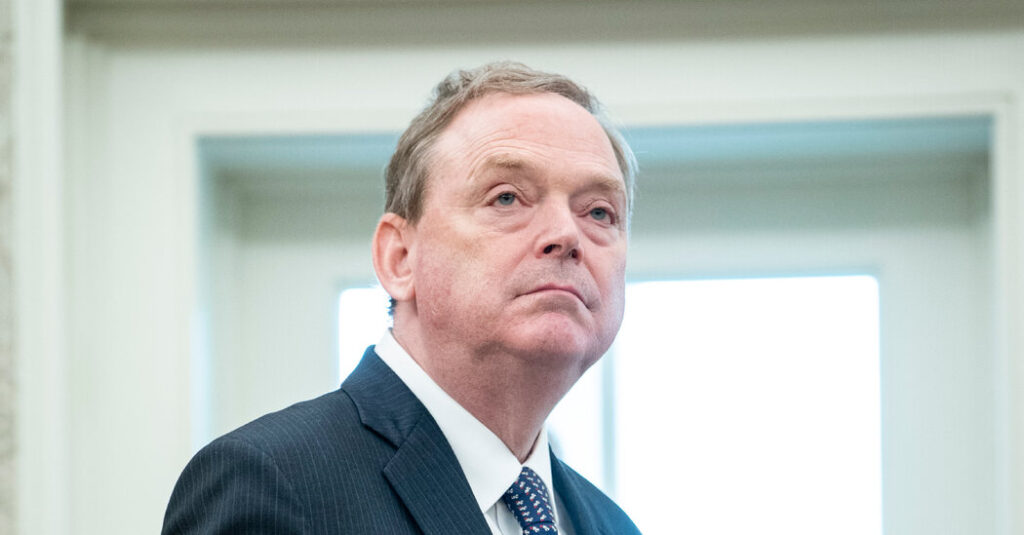
For years, Kevin Hassett, an economist who advised the presidential campaigns of John McCain, George W. Bush and Mitt Romney, favored classic conservative economic principles. A longtime scholar at the right-leaning American Enterprise Institute, he promoted the idea that free trade was the path to national prosperity and argued that more immigration was good for the economy.
But as the director of President Trump’s National Economic Council, Mr. Hassett’s policy views are barely recognizable to those who have known him for decades. These days he supports tariffs and claims they are having little impact on consumer prices. He also says deportations are healthy for a labor market that has long relied on immigrants.
“When foreign-born workers depart, then it creates jobs for people who are native-born,” Mr. Hassett said on the CBS program “Face the Nation” this month, explaining that many of those who left the labor force were illegal immigrants. “Instead of having, you know, basically illegal people come in and take jobs away from native-born Americans at low wages, we’re seeing people re-enter the labor force at high wages.”
Mr. Hassett’s ability to adjust his policy positions as needed has allowed him to rise within the president’s orbit of advisers and helped put him in pole position to be Mr. Trump’s pick for the next chair of the Federal Reserve. As one of the front-runners on Mr. Trump’s shortlist to replace Jerome H. Powell, investors and policymakers have been straining to divine what Mr. Hassett truly believes, and if he wins the job, whether he will be able to endure political pressure from the White House to cut interest rates at all costs.
The president is expected to name his Fed chair choice in early 2026, slightly later than many had expected after Mr. Trump at the end of November said he had narrowed a list of 11 contenders down to just one person.
That was presumed to be Mr. Hassett, who has since been on the defensive to allay concerns that his loyalty to the president will not hobble his ability to be an independent chair. As part of that effort, Mr. Hassett told CBS News recently that Mr. Trump would have “no weight” on interest rate decisions. But the president has made clear that he will pick only someone who supports significantly lower borrowing costs.
In a social media post last Tuesday, the president was even more explicit about his criteria: “Anybody that disagrees with me will never be the Fed Chairman!”
The president has in recent weeks sat down with Kevin M. Warsh, a former Fed governor whom Mr. Trump considered for the role in his first term, and Christopher J. Waller, a Fed governor he appointed in 2020. He has spoken glowingly of them both, suggesting that the job is not Mr. Hassett’s just yet. A White House spokesman, Kush Desai, said that any discussion about potential nominations is “pointless speculation” at this point.
From Critic to Loyalist
Mr. Hassett, 63, has always been an unlikely fixture in Mr. Trump’s world of advisers, confounding traditional Republicans and drawing skepticism from the populist right.
After earning his Ph.D. in economics from the University of Pennsylvania in 1990, Mr. Hassett was a professor for about five years at Columbia University’s business school. He then shifted toward policy work as an economist at the Fed before gravitating toward the world of politics and campaigns.
Mr. Hassett helped design Mr. McCain’s tax and Social Security plans during the senator’s unsuccessful Republican primary campaign in 2000. A Star Wars fan, Mr. Hassett sometimes referred to the Bush campaign, which secured the nomination, as the “Death Star.”
Mr. Hassett then went on to become an economic adviser to Mr. Bush in his 2004 campaign and the 2012 presidential campaign of Mitt Romney. When Mr. Trump was contemplating a presidential run in 2011, Mr. Hassett suggested in a Bloomberg opinion essay that his ideas were “too radical” for Republicans and that he had a “tin ear” on tax policy.
“Trump has an impressive history of achieving the seemingly impossible,” Mr. Hassett wrote. “As he considers a presidential run, he should weigh whether he can do it again, this time by persuading conservatives to ignore his past.”
Mr. Trump did not hold that skepticism against Mr. Hassett. As Mr. Trump’s first presidential campaign was getting underway, his advisers turned to Mr. Hassett to help shape and add credibility to his economic agenda.
In his 2021 book, “The Drift: Stopping America’s Slide to Socialism,” Mr. Hassett recalled how he came to embrace Mr. Trump’s candidacy despite his brash personality.
“I signed up with Donald Trump knowing that some in my party might never forgive me,” Mr. Hassett wrote. “Like many, I was wary of his public persona, of the guy who was much ruder than any politician in my memory. But I did so because Trump saw truths in plain sight ignored by political professionals and coastal elites.”
When Mr. Trump picked Mr. Hassett to lead his Council of Economic Advisers in 2017, many of the Republicans who helped propel Mr. Trump to victory were outraged. Mr. Hassett’s position that immigration spurs economic growth was particularly appalling to those who embraced Mr. Trump’s policies of mass deportations of illegal immigrants and building a border wall.
Mr. Trump’s right-wing media supporters were particularly critical. Breitbart, the website that was formerly run by Stephen K. Bannon, who at the time was the president’s chief political strategist, said Mr. Hassett’s appointment showed that the “corporatist, business-first” wing of the Republican Party was muscling out the “populist, America-first” contingent that got Mr. Trump elected. Commenters on the conservative website Infowars were similarly appalled, with some lamenting, “We have been sold a false bill of goods.”
An Economic Evolution
But Mr. Hassett has proved to be a loyal aide to Mr. Trump. And those who know him well wonder whether he really believes in the policies he publicly articulates.
When James K. Glassman sees Mr. Hassett defending tariffs and trade wars on television, he said, he often does not recognize the views of his friend and colleague of three decades.
Mr. Glassman, a former official in the administration of George W. Bush, worked with Mr. Hassett at the right-leaning American Enterprise Institute, and they co-wrote the book “Dow 36,000.” Mr. Glassman, who said that Mr. Hassett essentially trained him in the field of economics, recalled that Mr. Hassett used to be a believer in the merits of classic conservative economic principles like low taxes, free trade and limited government.
“You certainly have to give up some autonomy to work for an administration,” said Mr. Glassman, who described the Trump administration’s economic policies as destructive. “It certainly doesn’t fit with anything that the Kevin I knew and worked with would believe.”
During Mr. Trump’s first term, Mr. Hassett drew scoffs for presenting an analysis that appeared to predict — incorrectly — that coronavirus deaths in the United States could fall to zero by May 2020. He also found himself in the awkward position in 2018 of dismissing an internal White House analysis that found that Mr. Trump’s tariffs would hurt economic growth in the United States.
“If you model a future where everybody else reduces their trade barriers to ours, then that’s massively good for the global economy and massively good for the U.S. economy,” Mr. Hassett said at the time.
To those who know Mr. Hassett personally, such acrobatics come with the territory of being a top White House adviser.
“Kevin passed whatever tests were imposed for loyalty and so forth,” said Alan Auerbach, a professor at the University of California, Berkeley, who supervised Mr. Hassett’s dissertation in graduate school. “Economists in a situation like this speak carefully, but Kevin knows what the standard literature is on tariffs.”
Some prominent economists have been less forgiving of Mr. Hassett’s flexibility when it comes to discussing the economy.
After Mr. Hassett argued on ABC’s “This Week” program in March that it was “Econ 101” that the welfare of Americans was increased when goods were produced domestically, Greg Mankiw, the chair of the Council of Economic Advisers in the George W. Bush administration, pushed back on his popular blog.
“Trade restrictions do not increase G.D.P. Indeed, by interfering with the international marketplace and the forces of comparative advantage, they reduce productivity and thereby G.D.P.,” Mr. Mankiw wrote. “Please, Kevin, stop invoking Econ 101 to support President Trump’s trade policies.”
A Question of Independence
The biggest question about Mr. Hassett now is how his true beliefs about the economy will be applied if he becomes the Fed chair.
Mr. Hassett has treaded carefully when faced with questions about how he would handle the Fed job. Asked about the Fed’s independence in September, he suggested that political motivations could already be influencing the work of the central bank’s board.
“You can assert you’re going to be independent, you can assert you’re going to be nonpartisan, but in the end, the proof is in the pudding,” Mr. Hassett said on CNBC. “You have to look at the things that the Fed’s doing and decide for yourself whether it looks like they’re doing that just because of what’s happening in the numbers, or are they doing it for some political reason.”
It is not clear how Mr. Hassett would himself avoid being political. Even though he has said Mr. Trump will not factor into the Fed’s policy decisions, Mr. Hassett has also described the president’s views on interest rates as “very strong and well founded” and recently joked that he would be happy to talk to Mr. Trump every day as chair “because it’s so much fun to talk.”
He has also joined the president in some of his harshest attacks on the Fed, including suggesting that Mr. Trump had scope to fire Mr. Powell over his handling of costly renovations underway at the central bank’s headquarters in Washington.
“If you just gave me his résumé without a name, and said, ‘Is this person qualified to be the Fed chair?’ You’d look at it and say, ‘Yes,’” said Stephen Stanley, chief U.S. economist at Santander. “But financial markets are concerned about whether he would be independent or not.”
Tomas Philipson, who worked with Mr. Hassett at the Council of Economic Advisers in Mr. Trump’s first term and has known him for decades, said that he does not believe that Mr. Hassett would want the Fed to become an arm of the White House.
“He has a lot of respect for the institution,” Mr. Philipson said. “He doesn’t think that the Fed should be completely ruled by the White House.”
Mr. Glassman predicted that if Mr. Hassett did become Fed chair, his principles would be able to withstand the whims of Mr. Trump.
“I understand somebody who takes a look at him, what the administration has done, and the fact that he has defended it might say, “Is Donald Trump going to really be the Fed chairman if Kevin gets the job,” Mr. Glassman said. “My judgment is that no, Donald Trump will not be the Fed chairman.”
Tony Romm contributed reporting.
Alan Rappeport is an economic policy reporter for The Times, based in Washington. He covers the Treasury Department and writes about taxes, trade and fiscal matters.
The post How Kevin Hassett Became a Trump Loyalist and Fed Chair Contender appeared first on New York Times.