ISTANBUL — Amid mounting Israeli concerns over Iran’s ballistic missile program, Tehran seemed conflicted last week over the message it wants to send about its weapons capability.
A news outlet affiliated with Iran’s Islamic Revolutionary Guard Corps, which oversees the ballistic missile program, reported that missile tests had taken place across the country. But Iran’s official state broadcaster then quickly denied that any tests had occurred.
The back-and-forth came ahead of the trip by Israeli Prime Minister Benjamin Netanyahu to Florida for a Monday meeting with President Donald Trump, where the status of Iran’s missile program is set to figure prominently. Israeli airstrikes targeted Iran’s ballistic missiles capability during their war in June, but Israeli officials have recently expressed concerns that Tehran is reconstituting its capability and that it poses a growing threat to Israel.
Fars News, affiliated with the IRGC, reported on Monday that widespread missile tests had been held, and the outlet cited “field observations and public reports” as evidence. Hamshahri, a newspaper overseen by the conservative-controlled Tehran municipality, shared videos of what it said were missile tests, showing contrails. Those videos could not be independently verified by The Washington Post.
But Iran’s state broadcaster IRIB dismissed the reports, citing “informed sources,” and said the images that had been shared showed only contrails from high-altitude aircraft. The head of the IRIB is appointed by Iran’s Supreme Leader, Ayatollah Ali Khamenei, and the organization is overseen by a council made up of representatives of the presidency, judiciary and parliament.
Inside Iran, the state broadcaster’s denial of the missile tests became the subject of ridicule, even on its own airwaves. Mostafa Khoshcheshm, an Iranian international affairs analyst, joked on a state television program that the videos showing contrails were of “vertical flight, solid-fuel passenger airliners” before he and the host burst into laughter.
In Iran, it is relatively common for official messaging to be uncoordinated and even contradictory because the country’s governing structure is a blend of theocratic and republican elements, consisting of bodies with overlapping responsibilities.
Though the nature of any recent tests is unclear, the Iranian government tends to publicize successful missile tests “to send strategic messages or to reinforce deterrence” but downplays tests that fail, which could be the case this time, said Hamidreza Azizi, a visiting fellow at the German Institute for International and Security Affairs and an expert on Iranian security policy.
Another explanation, Azizi said, is that the reported tests were technical in nature rather than meant to send a message. He pointed to speculation that the IRGC’s aerospace force is moving toward a more decentralized system, perhaps in preparation for a new conflict with Israel. This interpretation could explain why missile launches were reported in various parts of the country, he said.
“If the tests were indeed part of such internal adjustments, there would have been little incentive to publicize them,” Azizi said.
Farzin Nadimi, a senior fellow with the Washington Institute and an expert on the Iranian military, said the videos seemed to indicate a field test of repairs, improvements or upgrades to the IRGC’s missile force “rather than a full exercise.”
If the military did carry out tests this past week, they could be the second missile test since the June war. In September, the Associated Press reported that Iran had probably carried out an undeclared missile test, citing satellite imagery and expert analysis.
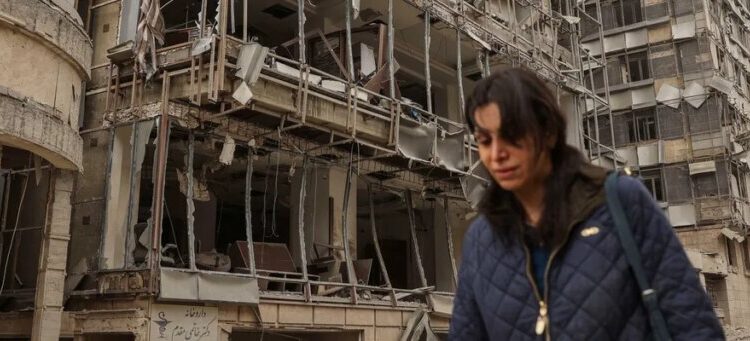
In the June war, Israeli forces struck Iranian military bases and missile defenses and killed military commanders and nuclear scientists. Iran struck back with missile fire, managing on repeated occasions to penetrate Israeli air defenses.
Toward the end of the conflict, the United States joined in, dropping massive bombs on three key nuclear facilities. Since the end of the attacks, Iran’s nuclear enrichment facilities largely “remain severely damaged or destroyed,” according to an analysis published last month by the Institute for Science and International Security. “After five months, Iran appears to have made minimal progress on reconstituting its destroyed capabilities.”
Despite the withering attacks on Iran, Israeli officials continue to sees Iran’s ballistic missile program as a threat. In a June report, amid the war, the International Institute for Strategic Studies said the scale of that remaining missile threat remains uncertain and “depends on several variables that are currently unknown.”
Speculation has circulated among Iran analysts in recent weeks that Israel could strike Iran again in the coming months to reverse any progress in rebuilding the program, which Iranian officials have said they are pursuing. The Associated Press also reported in September, citing satellite imagery, that Iran was rebuilding missile-production sites.
“After the war, Iran has become stronger than before, and its weapons production lines are active, so much so that even after the imposed 12-day war, the production line of our powerful missiles has not been shut down for a moment,” said the spokesman for Iran’s armed forces general staff, Abolfazl Shekarchi, in remarks this month.
Esmaeil Baqaei, spokesman for Iran’s Foreign Ministry, said Dec. 22 that Iran’s missile program is defensive and therefore not up for negotiation.
In the past few months, Iranian military officials have publicly boasted about Iran’s performance during the June war and asserted that Iran retains its missile capabilities, though outside analysts have said that Iran’s ballistic missiles failed in their goals of deterring an Israeli attack and inflicting sufficient damage on Israel once an attack had started.
“None of the [underground missile bases] have been damaged,” said Mohammad Ali Jafari, the former commander of the Revolutionary Guard, in an interview with Javad Mogouei, an Iranian documentary filmmaker close to the country’s security establishment, posted to YouTube in October. “All of these are under mountains, and none of them have seen damage. It’s possible that some of their entrances have been hit.”
Asked whether Iran had sufficient missiles left after the war, Jafari responded, “We have no limits on our missile capacity.”
The post Iran sends conflicting signals on its missiles as Israeli concerns rise appeared first on Washington Post.