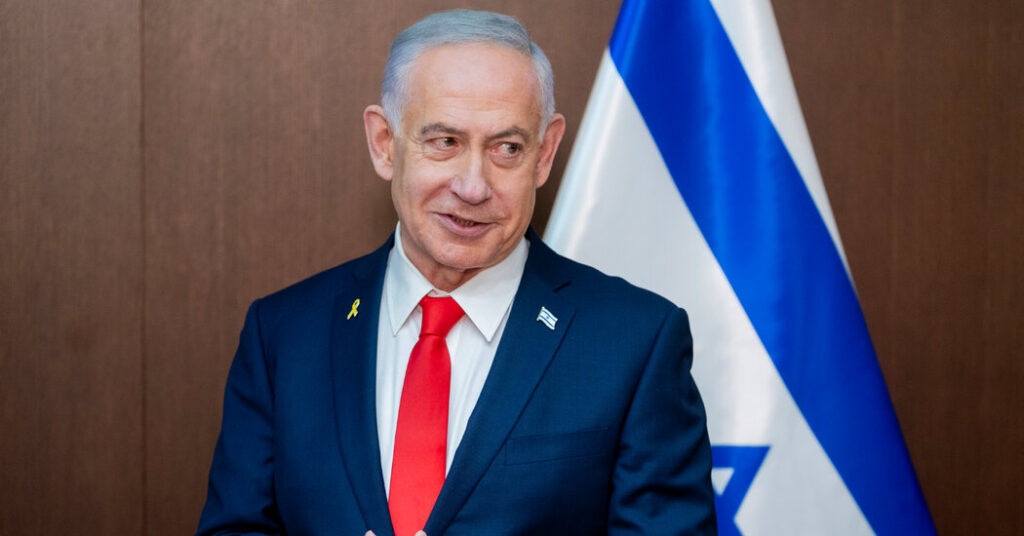
Benjamin Netanyahu has been prime minister of Israel for so long that nearly everyone knows how he governs.
He delays decisions. He keeps options open for as long as possible and creates new ones whenever he can. He wears down, outwaits and outlasts his adversaries — as well as his ostensible allies. He turns crises — including some of his own creation — into opportunities he can defuse, for a price.
But events are lining up in a way that may tax even his well-documented ability to stretch out tough decisions and shape them to his advantage.
Mr. Netanyahu’s criminal trial on charges of bribery and fraud is inexorably advancing. President Trump’s peace plan for Gaza is inching along toward a difficult Phase 2, and tensions are building with the White House over Israel’s actions in Syria and Lebanon. And polls indicate Mr. Netanyahu is headed to defeat in next year’s elections.
The pressure on him is mounting from every direction.
That includes from the Israeli right, Mr. Netanyahu’s political base, which is agitating for him to pursue annexation of the Israeli-occupied West Bank despite Mr. Trump’s warnings that doing so would trigger a harsh U.S. response.
On each of these fronts, 2026 is shaping up as a momentous year for Mr. Netanyahu, 76, and for the country he has represented for the better part of three decades. He is almost certainly going to have to make a series of decisions with great consequence — for Israeli society and security, for Palestinians, and for the broader Middle East.
As he prepares to meet Mr. Trump in Florida on Monday, and as Israel awaits an election at some point in 2026, here is a look at some of his pivotal choices ahead.
Conscription Exemption or Collapse
If he wants to maintain his decades-old political alliance with Israel’s ultra-Orthodox Jewish community, one of Mr. Netanyahu’s first tasks is to try to meet its demand for a law granting yeshiva students a new exemption from the draft, after an old exemption expired and the Supreme Court ruled in 2024 that they were legally obligated to serve.
A new exemption would be wildly unpopular with the vast majority of Israelis, who have been exhausted by the Gaza war’s demands on conscripts and reservists alike over the past two years.
Those opposing the exemption include members of Mr. Netanyahu’s own Likud party.
If Parliament does not enact the exemption, his government could collapse, precipitating elections early next year.
Analysts say Mr. Netanyahu wants to delay elections for as long as possible, hoping that his standing in the polls will improve the further Israel gets from the Hamas-led Oct. 7, 2023, attack, which happened on his watch.
Reuven Hazan, a political science professor at the Hebrew University of Jerusalem, said that Mr. Netanyahu clearly wanted to give voters time to be distracted by other pressing matters.
“And hopefully for him, the people of Israel are stupid enough and short enough of memory that they won’t remember all of this,” Mr. Hazan said.
Yohanan Plesner, president of the Israel Democracy Institute, said he believed Mr. Netanyahu wanted time for the Israeli public to vent its rage over a new ultra-Orthodox draft exemption but then also to get over it, and for the discussion to shift to other topics.
“It’s difficult,” Mr. Plesner said. “But if Netanyahu decides that the coalition needs to pass it, it will probably pass.”
Let Gaza Devolve or Align With Trump
Mr. Netanyahu went along with the Trump peace plan for Gaza, but he has never sounded like a big believer in it, telling Israelis that he is giving it time to play out but that Hamas will have to have its arms forcibly seized if it does not lay them down voluntarily.
The Israeli public is generally with him on that, polls show.
A majority of Israelis expect that war with Hamas will resume within a year. Exhausted as Israelis are, the freeing of their hostages — whose captivity fueled protests demanding an end to the war out of fear for their survival — could reduce opposition to an eventual return to war, analysts say.
But Israel’s continued strikes in Gaza since the cease-fire appear to have angered the Trump administration, which wants to extend and build on the truce, not jeopardize it.
Similarly, Israel’s military actions in Lebanon and Syria appear at odds with the Trump administration’s efforts to stabilize governments in both countries.
Mr. Trump has repeatedly shown impatience with Mr. Netanyahu. And he could use their meeting on Monday to squeeze the Israeli leader on some or all of these fronts.
Mr. Netanyahu is expected to urge Mr. Trump to back him in continuing to apply pressure to Iran, which Israeli officials say is rebuilding its missile arsenal.
It is Gaza that poses the most intriguing set of choices.
Mr. Netanyahu’s refusal so far to allow a role in Gaza for the Palestinian Authority, which administers parts of the occupied West Bank and is a bitter rival of Hamas, is making it difficult for the Trump administration to assemble many of the components of his plan.
Those include an International Stabilization Force, a technocratic committee of Palestinians to run Gaza and a supervising Board of Peace. Arab and European countries whose participation the Trump administration is seeking want the Palestinian Authority involved.
And Mr. Netanyahu’s oft-stated determination to prevent the establishment of a Palestinian state is deterring countries that want assurances that their assistance in disarming Hamas and rebuilding Gaza will lead to a renewed effort to establish a state, not just to a renewed cycle of violence a few years down the road.
Foremost among those countries is Saudi Arabia, which has long insisted on a pathway to Palestinian statehood as a precondition to normalizing relations with Israel. Both Mr. Trump and Mr. Netanyahu have consistently voiced their desire for normalization.
While the Saudis have indicated that they are nowhere near ready to establish diplomatic ties with Israel, if Mr. Trump seeks to enlist Mr. Netanyahu in winning them over, the Israeli leader could face a legacy-defining choice.
Stick With the Right or Reach to Center
For all of Mr. Netanyahu’s efforts to mollify ultra-Orthodox leaders — or at least to make a show of trying to — a collapse of his government could quickly lead him to pivot.
Polls have consistently shown the opposition much closer to winning a governing majority in next year’s election than Mr. Netanyahu’s own coalition. They suggest that his right-wing and religious bloc would win about 52 of the 120 seats in Parliament while the more liberal, centrist bloc would win about 58 seats. The Arab parties would win about 10 seats.
That may not be as dire for Mr. Netanyahu as it might seem.
If he hews to form and runs a campaign that delegitimizes Arab lawmakers, deterring the opposition from bringing them into a governing coalition, he could well force a deadlock that keeps him in power. But he could also create a new set of options for himself by reaching toward the political center.
Some Israeli commentators have already suggested that the prime minister forge a coalition with Naftali Bennett, the popular former prime minister whose political roots, like Mr. Netanyahu’s, are in the right wing.
Doing so might allow Mr. Netanyahu to cut loose not just the ultra-Orthodox, but also the extreme right-wing parties led by Bezalel Smotrich and Itamar Ben-Gvir — both government ministers.
But Mr. Netanyahu is counting on the ultra-Orthodox and the extreme-right parties to back his efforts to overhaul the judicial system to curb the power of the courts — something that opponents say would give Parliament far too much unchecked power and allow Mr. Netanyahu to legislate himself out of legal jeopardy.
If he finds another way to short-circuit his criminal trial, Mr. Netanyahu could create other options for himself.
Stay or Go
Mr. Netanyahu has requested a pardon from Israel’s president, Isaac Herzog, hoping to escape legal jeopardy well before a verdict in his trial is reached. Mr. Trump has endorsed that request, inserting himself into Israel’s internal affairs in a way that foreign leaders rarely do.
Mr. Trump may be motivated by more than merely sympathy for another world leader facing prosecution.
To veteran Netanyahu watchers, one of the most distracting notions — if one that sounds like fan fiction from the Israeli left — is that the prime minister might decide to cash in his chips in a way that surprises nearly everyone.
Gayil Talshir, a lecturer in political science at the Hebrew University in Jerusalem, argued that Mr. Netanyahu’s exit strategy from criminal jeopardy essentially boiled down to two choices: to complete his government’s judicial overhaul and “really ruin Israeli democracy completely so he can rule forever,” or push for normalization with the Saudis.
Ms. Talshir believes that Mr. Netanyahu preferred the latter.
“Geostrategically, this is the final achievement that he wants,” she said.
In some of the mind-bending scenarios that analysts like Ms. Talshir are gaming out, Mr. Netanyahu accepts a plea deal to leave the political stage after one huge, legacy-saving coup: opening Saudi Arabia to Israel and advancing the prospects for a lasting peace with the Palestinians.
Mr. Netanyahu has rejected the idea of moving on.
“When history is within reach, you don’t step aside,” he said Dec. 3 at The New York Times DealBook Summit. “You step forward, and that is what I am doing.”
Indeed, such a turn of events could also breathe new life into Mr. Netanyahu’s political career, said Nimrod Novik, once an adviser to the former prime minister Shimon Peres and now a distinguished fellow at the Israel Policy Forum, an advocacy group that favors a two-state solution. He suggested that Mr. Netanyahu still had a chance to become “the hero, not the villain, of the general public in a country that’s 70 percent against him right now.”
That, he said, would require Mr. Netanyahu to jettison Mr. Smotrich and Mr. Ben-Gvir from his coalition and then “present the opposition with an offer they cannot refuse,” including scrapping the judicial overhaul, curbing violence by Jewish settlers in the West Bank and more — each a screeching political U-turn from where Mr. Netanyahu is steering the country now.
It is, admittedly, difficult to imagine. But a deal with Saudi Arabia could remake the Middle East and Israel’s place in it.
“Saudi Arabia doesn’t come alone,” Mr. Novik said. “It’s a whole list of countries that follow, once the Saudis put a kosher stamp on Israel: Indonesia, Malaysia, maybe even Kuwait and Oman — who knows?”
David M. Halbfinger is the Jerusalem bureau chief, leading coverage of Israel, Gaza and the West Bank. He also held that post from 2017 to 2021. He was the Politics editor of The Times from 2021 to 2025.
The post With Critical Decisions Ahead, Netanyahu Faces Mounting Pressure appeared first on New York Times.