GOLDEN TROUT WILDERNESS, Calif. — The first two miles were pleasant enough. The grade was mild, the forest serene. It was what lay ahead that worried me:
A 2,500-foot descent to Jordan Hot Springs, a spot in California’s High Sierra backcountry that has long had a hold on my imagination — an idyllic meadow with rock-dammed bathtub-hot pools.
Given my age and lack of recent high-altitude exertion, I could easily need a helicopter to get out.
But that was a secondary concern. I was most anxious about what I might see along the way. Would it be an affirmation of nature’s power of renewal or an omen of irreversible decline?
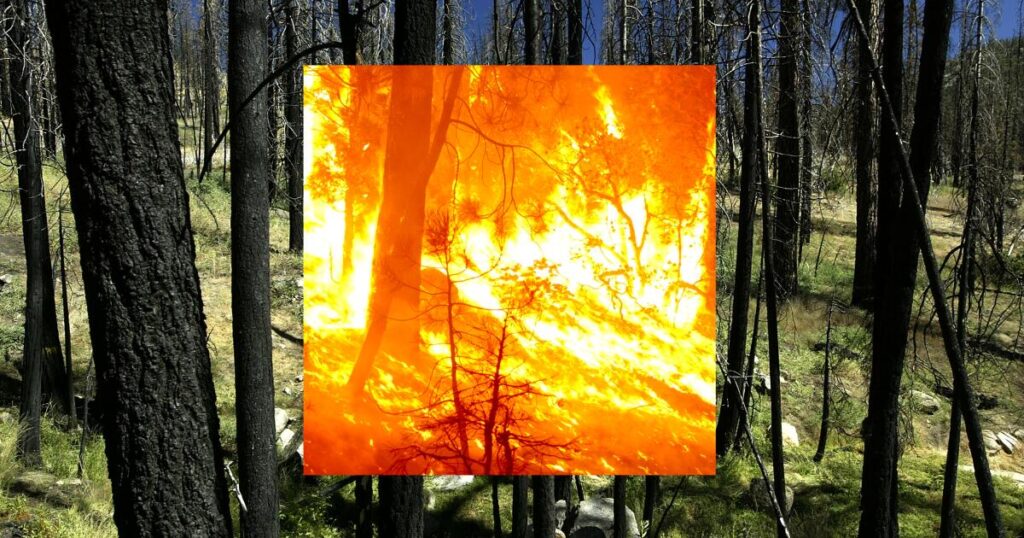
I was retracing my steps of 20 years earlier to a scene of mass death I had never been able to erase from my mind. At a small plateau alongside Ninemile Creek in the Golden Trout Wilderness Area, I had stood in a forest of black sticks standing on both sides of a steep canyon like whiskers on a beast too large to comprehend.
I had hiked to Jordan Hot Springs and the burn scar of the 2002 McNally fire to probe big questions of fire ecology: Are Sierra forests overgrown? Is fire management the unintended cause of destructive crown fires? Do forests reduced to blackened earth and charcoal trees recover?
At that time, the questions proved too big. I never wrote a story.
But the image stuck. Year after year I would wonder, “What does that canyon look like today?”
It took another fire to turn that question into action.
I did not grasp from the TV images of the 2020 Castle fire how deeply it would affect me personally when I saw its aftermath with my own eyes.
It was two years ago that I took a nostalgic drive up Highway 190 into the mountains east of Porterville in the San Joaquin Valley. At the elevation where the oak and scrub give way to cedar, fir and pine, I had a horrific shock rounding a familiar bend anticipating a thrill I had felt so many times before.
Instead of my favorite Sierra vista, I saw total disfigurement. The road ahead, once hidden in a sheath of forest, is now a scar carved into the side of a landscape of exposed soil and the standing carcasses of tens of thousands of blackened trees.
Those last 10 miles up the Tule River Canyon had always been a spiritual climb for me, releasing the weight of urban life along with the Central Valley heat and enlivening my spirit with cascading streams, pine-scented air and anticipation of the road’s end.
I had been enamored of this view since 1962, when I first drove to the end of Highway 190 in Quaking Aspen to begin my summer job packing mules into the Sierra backcountry.
Now it was gone. So much beauty lost. Never to return?
In the recent years of unprecedented wildfires, the public discourse has been filled with speculation that such a total tree die-off, combined with a warming climate, could irreversibly change a forest, leaving it barren of the conifers that dominate an alpine ecosystem.
I didn’t want to believe that. I wanted hope that in my lifetime I might see the Tule River Canyon once again as it was.
Thus arose the fanciful idea that a return to Jordan Hot Springs would allow me to see into the future by looking at the past. My purpose was aesthetic and emotional, not scientific. But if I was going to personalize nature, I thought it would be prudent to backstop my feelings with expertise.
I asked around and found a fire ecologist who has been studying the McNally fire almost since the embers went out. Chad Hanson, co-founder and principal ecologist of the John Muir Project and resident of nearby Kennedy Meadows, is the kind of scientist who returns to the field year after year and wades through waist-high underbrush to track the trajectory of recovery.
Hanson jumped at the opportunity to take a reporter off-road to see nature as he sees. He offered some advice that I understood better once we were on the trail: “Don’t wear shorts.”
On the first leg, a 650-foot drop to Casa Vieja Meadows, his commentary turned the hike into a walking lesson to reshape my view of the nature of fire and nature itself.
“To really grasp what’s happening in nature, especially after wildfires, you really have to think like a forest,” he said. “And forests don’t operate on human timescales, and they don’t operate the way humans do, especially when it comes to life and death.”
Hanson has a relationship with the forest that is at once clinical and lyrical.
“A standing dead tree is vastly more important to wildlife and biodiversity in the forest than a standing live tree of the same size,” he said. “A tree in the forest ecosystem may have two or three hundred years of incredibly important vital life after it dies.”
Woodpeckers carve nesting cavities in the softer dead trees and broken-off snags, then move on each year, leaving behind homes for other nesting creatures, such as nuthatches and chipmunks. As the trees break off or fall, the downed logs become food and cover for earthbound species and eventually decay into nutrients in the soil.
Our maps showed we were walking through forest burned in the McNally fire, but what I saw around us made that hard to imagine. A canopy of Jeffrey pine, red fir and incense cedar shaded the trail. Except for the blackened bark on their lower trunks, there was no sign of catastrophic fire.
“That’s because there wasn’t,” Hanson assured me. The fire had passed through where we were walking. But the common descriptors “scorched,” “blackened” and “destroyed” did not apply.
“Most of the fire area is like this, where it would have killed a few of the seedlings and saplings but basically almost nothing else,” Hanson said. “It’s largely unchanged by the fire.”
It took nearly five weeks for the McNally fire to cover 150,000 acres. Much of that time, at night or when the wind was down, it moved at a human walking pace.
“The temperature drops and the relative humidity goes up, the winds die down, flames drop to the ground and it starts creeping along,” Hanson said.
Several times as we walked, the canopy opened up nearby and Hanson stopped to point out a high-intensity burn where a burst of wind in the heat of the afternoon had lofted the flames into the living branches more than 100 feet above us. Some were an acre or two, some up to 50 acres.
A quarter century after the fire, each was a mini-laboratory of regeneration. My first impression was sunlight, a brightness that contrasted with the shade we stood in. Then brush, predominantly whitethorn and manzanita, interspersed in waist-high thickets. Then snags, standing dead trees broken off halfway up. Finally, patches of young conifer, some mere saplings, some 15 to 20 feet tall
The few trees that had survived the fire now looked like Christmas trees planted on top of telephone poles. For a year after the fire, Hanson said, they would have appeared dead with all their foliage scorched. But at the very top, surviving terminals had sent out new twigs in the next growing season.
Those were the starter trees that spread the seed that had germinated and was now thriving in the open sunlight.
At one burn, Hanson proposed that we make a side trip and wade through the brush up on a steep canyon wall where, he assured me, we would find even more saplings just breaking through. Knowing that we had completed less than half our descent, and that each step down would require a step back up, I decided to wait to see how I felt later in the day on the way back up.
Casa Vieja Meadows was a perfect Sierra scene: a half-mile plain of yellow-green grass, a ring of forest all around it, a cattleman’s shed across the way and tranquil Ninemile Creek running its length.
At the meadow’s end, the creek dived into a rocky canyon, the beginning of a 1,500-foot drop through patches of willow, cottonwood and fern.
When we reached that spot that has stuck in my memory for 20 years, my immediate reaction was disappointment. I saw no beauty, only a scar that was neither a forest of dead trees nor living ones. Only a few snags remained. The fallen trees must have been there — there had been no logging to remove them — but were submerged in the brush, out of sight. At most, a dozen or two pre-fire trees survived on both sides of the canyon.
From a belt of willow at the stream’s edge to the ridges above, both sides of the canyon were covered in gray-green hue of whitethorn extending as far as I could see toward Jordan Hot Springs, still a half mile beyond.
Here, Hanson preached a beauty based on the timescale of natural succession. Because of its size and severity, this high-intensity burn area will remain what is called montane chaparral for decades, he said. In doing so, it will give the greater forest ecosystem what it cannot survive without.
“That’s some of the best wildlife habitat,” he said, sweeping his hand over the horizon. “We’re not used to seeing it that way as humans where we see the flames go high and kill most of the trees. But it turns there are a lot of wildlife species in the forest that have evolved over millions of years to depend specifically on areas where most of the trees have been killed.
“This is actually really important habitat for shrub nesting birds, for small mammals, woodpeckers, bluebirds, nuthatches, any cavity-nesting species. They depend on these patches where you have a lot of dead trees.”
Hanson assured me this vast landscape of brush was already making its return as a conifer forest. To see the evidence, we’d have to slog into the whitethorn to see the future. I shakily followed Hanson up a canyon as he worked his way through openings he said were likely blazed by foraging bears, then over a fallen tree trunk that crumbled under my steps.
I was gasping for air and having difficulty maintaining balance when he stopped.
Hanson began noting tufts of pine needles poking out of the waist-high brush around us. “One, two, three, four, five, six,” he said, counting as he went along. Farther up, he pointed out clumps of new conifers, some up to 18 feet tall.
The saplings just now poking their needles into the sunlight, and hundreds more that we would only be able to be seen on our hands and knees, will grow and propagate, he said.
“It’s going to keep regenerating every year, every decade after the fire,” he said. “There’s going to be more new ones coming in and the earlier ones are going to get taller and older. And that’s just classic natural progression.”
In a hundred years, they’ll be so thick they’ll block out the sun, and the brush, starved of energy to drive photosynthesis, will wither, and the shrub nesting species will move to a different mountain cleared by a later fire.
I had seen what I needed to see. All that was left was to fulfill a personal desire to return one more time to Jordan Hot Springs.
Through all my youthful explorations of the Kern River Canyon — my Yosemite without crowds — that golden-green meadow with its pools had been only an illusion for me. Named for the man who came across it blazing a trail from the San Joaquin Valley to the Mojave Desert in 1861, it was a storied place just beyond my horizon.
Several times I led mule strings to Soda Flat, a private outpost in Sequoia National Forest. The hot springs beckoned only 3½ miles away. But after 20 miles on the trail, duty to my livestock and to my client, Bakersfield realtor Ralph Smith, prevented me from indulging that fantasy.
So much has changed since then. The pack station at Quaking Aspen was demolished and relocated four miles deeper into the backcountry on logging roads. A paved road was cut into the roadless area east of the Kern River giving automobile access to the five-mile John Jordan Hot Springs trail.
My visual memory of Jordan Hot Springs from that 2005 hike has faded. The catharsis I felt then of finally seeing it after so many decades has not. At the stage in life when I know that my return to many places will be my last, I wanted to fix its image in my memory, to sit simply one more time and contemplate the beauty of this small spot in the universe.
It wasn’t to be.
Noting my fatigue, Hanson asked if I wanted to go on. With the sun on its downward arc and a 500-foot descent ahead to fulfill that wistful desire, he thought prudence dictated that it was time to turn home. I had to agree. It was a slow ascent. I couldn’t go more than a few hundred feet without stopping to sit and catch my breath. But I made it, just before dark — without a helicopter.
I never intended to settle the big academic and political questions over what’s the right way to care for a forest: Indigenous stewardship vs. forest thinning; post-fire logging and bio-mass extraction vs. natural decay and regeneration; fire control vs. natural selection.
Much has been written about that. Much more will likely be before I could report that a consensus is achieved.
I do have a preview of the Tule River Canyon a quarter century from now, and it won’t be the place I have known for so much of my life. There will likely be no vistas of forest canopy, no shaded glens with water cascading through a tapestry of conifers, pine sap spicing the morning air.
More likely, there will be mile after mile of whitethorn and manzanita, a few grandfather trees identifiable by their odd conical foliage high on spindly trunks, patches of vigorous young pine 15 to 20 feet tall, and saplings whose tops barely break through the brush.
From my new perspective, I’m still not able to call that beauty, but I can call it hope. I’m betting on one who crawls through the brush to find answers that it’s only the beginning of something that will take longer than my lifetime to reveal itself.
The post A return to a past Sierra wildfire to see the future of a recent one appeared first on Los Angeles Times.