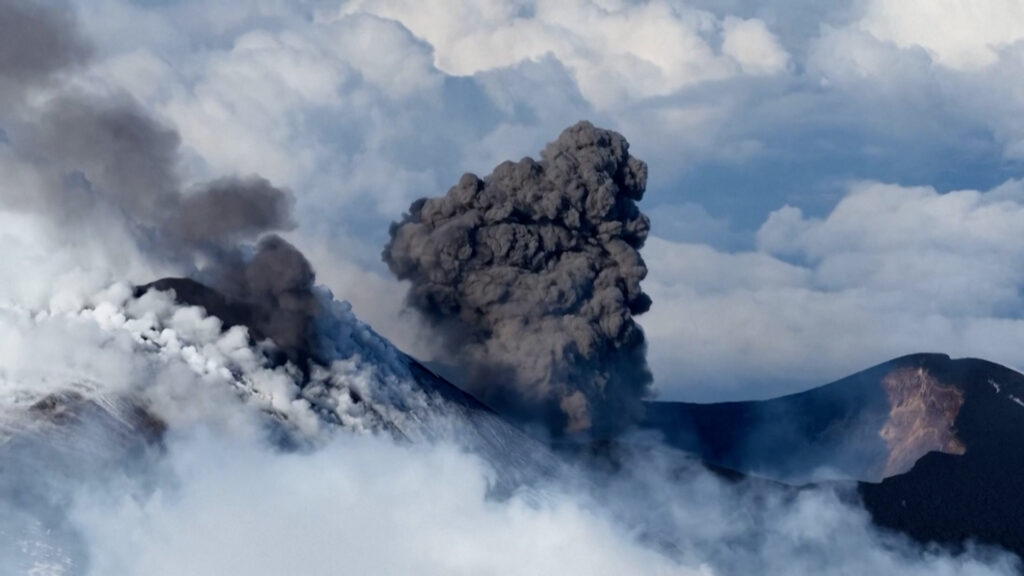
Mount Etna has been gearing up for 2026 with a bang — or, actually, several of them — with days of explosive activity, bringing lava fountains, loud booms and eruption columns that launched dark clouds of ash into the sky.
On Saturday, a lone skier was captured on video gliding down the bright white slopes as Etna, Europe’s largest active volcano, put on quite a display in the background.
The latest volcanic activity began Wednesday, when monitors detected a change in Etna’s usual signals, including volcanic tremors, changes in the Earth’s surface and infrasonic activity, Italy’s National Institute of Geophysics and Volcanology said.
The institute said that after years of “rather modest activity,” Etna’s northeast crater, the oldest of the volcano’s four main summit craters, made “its presence felt” — almost 28 years after its last major eruption.
The volcanic activity intensified Thursday and Friday, causing ejections of incandescent material above the crater rim, the institute said. Worsening weather throughout Friday night triggered “strong reddish flashes” among the clouds, along with repeated booms that could be heard along the slopes.
Activity on Etna “increased very suddenly,” the institute said, noting that the episode produced 300- to 400-meter lava jets and an eruption column loaded with rock fragments, which rose a few kilometers above the summit of Etna and were pushed west by the wind.
Etna is a popular tourist destination all year, with its snowy landscape and frequent volcanic activity attracting photographers, hikers and winter sports enthusiasts despite frequent eruptions and lava flows. Footage showed dozens of skiers continuing to summit Etna on Sunday as smoke rose in the background.
Following an eruption earlier this year, officials urged visitors to stop approaching running lava, calling the natural phenomenon “extremely dangerous.”
Etna had an “eventful year,” the institute said, citing three eruptions, the first beginning in February. A “spectacular” eruption in June sent tourists scrambling down the volcano. That eruption — which sent lava flowing in three directions — was probably caused by “the collapse of material from the northern flank” of Etna’s southeast crater, the National Institute of Geophysics and Volcanology said.
The post Skier glides down Mount Etna as volcano erupts in the background appeared first on Washington Post.