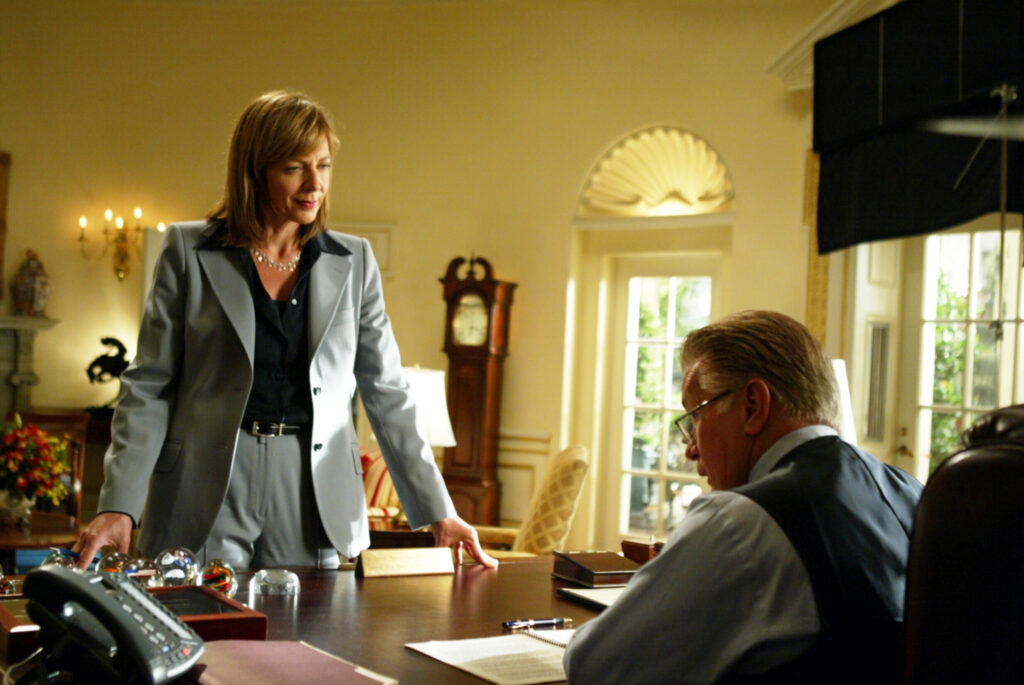
In Season 3, Episode 7 of the television show “The West Wing,” which originally aired in November 2001, White House press secretary C.J. Cregg (Allison Janney) exults when a contender for the presidency flubs the all-important question: Why do you want to be president? Yet moments after CJ finishes gloating, she realizes that her boss, the sitting president, may not have a better answer. When she anxiously questions President Josiah “Jed” Bartlet (Martin Sheen) about his motivations, he shrugs her off. “I’ve been thinking about it for the last couple of hours,” he tells her. “I almost had it.” A beat passes, and the episode ends. By the time the next one begins, Bartlet’s nonresponse is already long forgotten. The bustling denizens of the West Wing are too consumed by the crises of the hour to note that their employer has failed to answer the guiding question of his political career.
A quarter-century after Bartlet failed to justify his presidential ambitions to CJ, “The West Wing” occupies a curious place in the American imagination. It is remembered as the premier liberal artwork of the early aughts and touted as a nostalgic relic — an endearingly utopian artifact of a softer, purer time. If its fusillades of rapid-fire dialogue and its famed walk-and-talk shots of characters in motion remain as propulsive as ever, its political outlook is canonized as anachronistically earnest. “ ‘The West Wing’ was also a full-throated argument (perhaps too full-throated) for the essential goodness of government and a celebration of the talented people who fill its ranks,” wrote Ian Crouch in The New Yorker in 2012. “In Bartlet’s America,” wrote the New York Times’s James Poniewozik in a thoughtful reappraisal last year, “voters reward you for fighting lies and fearmongering with facts and reason. Good intentions and great oratory win the day. Well-meaning people reach across the aisle and reason with their colleagues. Politics is an earnest battle of ideas, not a consuming war of all against all.”
But “The West Wing” is a vastly more cynical show than many of its admirers remember, which why it is also a more compelling work of art than many of its skeptics assume. It is not, in fact, a paean to good government and the dedication of White House bureaucrats, nor is it an homage to good-faith debate or a portrait of political rationality. Rather, it is an honest and often quietly wrenching exploration of the Machiavellian maneuvering that corrupts even the most well-meaning people in politics.
The show’s main protagonists — Cregg, White House Communications Director Toby Ziegler (Richard Schiff), Deputy White House Communications Director and speechwriter Sam Seaborn (Rob Lowe), White House Chief of Staff Leo McGarry (John Spencer), Deputy White House Chief of Staff Josh Lyman (Bradley Whitford) and President Bartlet — spend most of the show fretting over PR disasters and comparatively little time worrying about matters of political substance. In the episode after Bartlet brushes CJ off, Sam tries to persuade an official from the Office of Management and Budget to recalibrate the poverty index — not because he believes the agency’s calculations are wrong, but because the new measure would deem an additional 4 million people impoverished, which would look bad for the administration. In another episode, Josh agrees to append a provision to a health care reform bill — not because he thinks it is a good idea (indeed, he has not researched the proposal) but because the addition will persuade a recalcitrant senator to sign on. When Bartlet’s staffers take a more active role in shaping legislation, it is almost always by negotiating with politicians on the president’s behalf and almost never by advocating for policies on their own merits.
Often, the characters go so far as to concede that the administration’s critics are right, at least behind closed doors. At one point, Sam finds himself at loggerheads with a Democratic senator intent on eliminating the penny — a proposal he comes to regard as reasonable but ends up rejecting on the grounds that it will make the president look foolish and piddling. (Just last month, the penny was retired without much outrage; it turns out Sam was wrong to worry.)
But it is C.J., the face of the administration, who is most often tasked with defending policies she despises. She is the one who escorts Native American protesters out of the White House lobby, even though she finds herself indignant on their behalf; she is the one who talks the parents of a murdered gay man out of criticizing Bartlet’s inadequate gay rights policies in public, even though she ultimately regards their complaint as righteous. When the administration makes an arms deal with Qumar, a fictional stand-in for Saudi Arabia, C.J. stands at the podium, smiling and quipping through her feeble excuses. Behind the scenes, she fumes.
Though C.J. finds herself rationalizing Bartlet’s failures more often than her colleagues do, all of the show’s main characters are called upon to manage their ambivalence when they discover that the President suffers from multiple sclerosis, a diagnosis that he concealed from the public throughout his campaign and tenure in office. His staff is outraged by the cover-up — Toby denounces it as a “deception of massive proportion” — but, ultimately, everyone chokes back their reservations and helps the administration navigate the inevitable fallout.
It isn’t that the wonks of “The West Wing” are villainous. On the contrary, they are winningly dedicated and endearingly well-intentioned. They also happen to be calculating and scheming, as their jobs often oblige them to be. At their best, they are bruised idealists; at their worst, they are jaded operators. In short, they are believably conflicted and inconsistent — and therefore interesting. Their tragedy consists in the ease with which their principles are compromised by the pressures of the job. They joined the Bartlet campaign because of their egalitarian aspirations, but several years into his presidency, they have perfected a politics of placation. Despite their nominal values, they spend their days managing and mollifying the public.
“The West Wing” aired from 1999 to 2006, and there is good reason to believe that it inspired a generation of influential pundits, a cohort that Vanity Fair dubbed the “West Wing Babies” in 2012. Its orientation no doubt colored the tenor of the Obama administration and the subsequent Democratic Party, encouraging campaigns to focus less on policy and more on public relations. There are many reasons the Biden-Harris campaign went up in flames, but one of them is surely its air of knowing better without deigning to articulate exactly what it knew.
What, in the end, are the actual politic commitments of the Bartlet administration? What are its signature policies? Beyond its embrace of polite platitudes and its veneration for norms, beyond its reverence for civility and its penchant for symbolic displays of bipartisanship, does it have a vision? It would be too generous to even describe Bartlet as an advocate of efficiency, since there is nothing in particular he cares to be efficient about. His is a politics of folksy charisma and, above all, of winning — of saying whatever is likely to poll well on any given occasion and leaving the rest to the experts.
Just after 9/11, that was enough; it was presented and interpreted as aspirational. But if rewatching “The West Wing” in our debased era teaches us anything, it’s that we have come to demand more from our politicians in the intervening decades. What struck contemporary viewers as utopian — and subsequent commentators as nostalgic — now strikes us tellingly vacant; what once seemed like bipartisan flexibility now looks like squishy evasion. In 2026, a more definite answer to C.J.’s question is required.
The post ‘The West Wing’ was more cynical than we remember – and better for it appeared first on Washington Post.