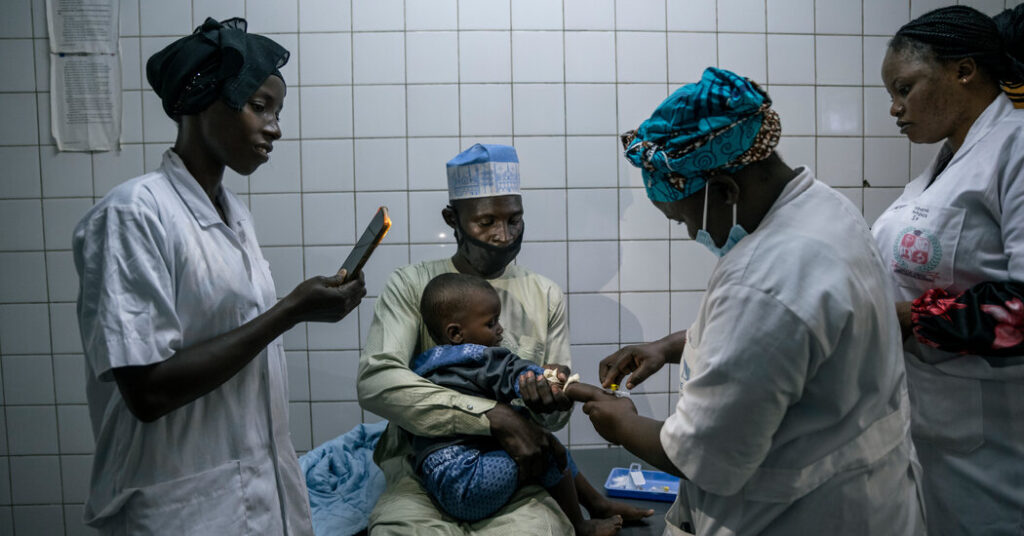
Abdul Aziz Adamou carried his son Mohammadou urgently through the crowded hospital, and the child did not stir. A wisp of a 3-year-old, Mohammadou was so sick he barely flinched when a nurse pricked his finger and squeezed out a drop of blood for a malaria test. His mother, Nafisa, looked on, her long blue veil fluttering as she shifted nervously.
The day before, he was vomiting and soaked in the sweat of fever; in the night, convulsions pulled his small limbs rigid. At first light, his parents climbed on the family motorcycle and drove him 20 miles on pitted dirt tracks to a hospital in the town of Maroua in northern Cameroon.
The malaria test was positive. Within minutes, a health aide gave him an injection of artesunate, the World Health Organization’s recommended first-line treatment for the disease.
Over the next 24 hours, Mohammadou was given two more injections and became alert enough to express his displeasure. Mr. Adamou grinned, scooping him up to hold him still. After three days, he was well enough to go home.
The lifesaving drug was provided by the United States, through a program that has cut malaria death rates dramatically here and across Africa. In February, the Trump administration shut down much of that program, saying most foreign aid was wasted. The supply of artesunate dwindled. By the time Mohammadou got it, a few weeks ago, it had become nearly as precious as gold in northern Cameroon.
This region has one of the highest rates of malaria deaths in the world. Yet hard work and American assistance reduced the rate in the far north by almost 60 percent from 2017 to 2024. But this year, the tumultuous events far away in Washington threw the work into chaos, leaving more children sick, parents frightened, and the public health experts who built this program scrambling to save what they could.
The fact that Mohammadou received artesunate is testament to a scramble by health workers, many of whom did their jobs unpaid for months; some eleventh hour emergency funding from a few new benefactors; and no small amount of luck.
Attacking from every angle
The President’s Malaria Initiative, known as P.M.I., came to Cameroon in 2017, in the last phase of an effort launched by President George W. Bush in 2005. P.M.I. aimed to end malaria deaths by taking new tools to villages like the small cluster of houses in a sandy Sahelian plain where Mohammadou and his family live.
Malaria has killed more people than any disease in history. Even with significant progress over the last two decades, there were 610,000 malaria deaths globally last year, almost all of them African children.
While malaria is not a direct threat to the United States, the U.S. government invested significantly in P.M.I. because the disease exacts such a large toll, in human suffering and in the economic burden of health care costs and lost productivity. Helping to ease that burden made African countries more stable. And like other big global health investments, P.M.I. burnished the image of the U.S. as a reliable ally.
P.M.I. came at malaria from every angle: controlling mosquitoes, delivering protective medications, rapidly diagnosing children who got sick, and improving the care in hospitals. In Cameroon, it targeted the two most northern regions, the country’s poorest.
Entomologists trapped mosquitoes and tested them for insecticide resistance. The program stocked prenatal clinics with preventive drugs for pregnant women and distributed bed nets. It set up new data collection systems, with apps, training and surveys, so that health officials knew where there were the most cases, the most deaths, the weakest clinics.
It took over and beefed up an experimental program that provided malaria prevention medication, called chemoprevention, to every child under 5, every month in the rainy season. It bought enough doses for two million Cameroonian children and set up a swift-moving supply chain that brought the medicine to the most remote villages.
It boosted training for more than 2,000 community health workers on how to use rapid tests to diagnose malaria and treat simple cases. It equipped them with briefcases of tests and drugs, bicycles, and a stipend of $25 a month, a significant sum in a place where most people rely on subsistence farming. Soon, they were treating a quarter of all cases, and fast intervention kept more children from developing potentially lethal complications.
An urgent scramble
When news that the American government was slashing the malaria program reached Maroua, the epicenter of the malaria fight in Cameroon, in February people feared they were about to return abruptly to a grim past.
“Everything was lost,” said Dr. Jean Pierre Kidwang, the National Malaria Control Program’s coordinator in the region.
Jean Marc Dahadai, a nursing assistant at the Episcopal hospital where Mohammadou went, has treated children with malaria for 18 years. “Ten years ago, in the rainy season, you would have people on the ground, people in the yard — we have a lot of space here, and it would be full of people with malaria,” he said. In recent years, he has treated just one or two children a week as sick as Mohammadou was.
When he heard that the American help was ending, he said, “the first thing I thought was, We are going back to the way it was.”
Soon, the hospital’s stock of artesunate began to run low.
And the rains were coming, and with them, the annual surge in malaria cases. Health workers were calling Dr. Kidwang to say parents were asking when their children would get the miraculous little blister pack of prevention medication that had improved their lives so much the past few years. He didn’t know what to tell them.
Then he learned that P.M.I. had ordered the crucial medications and other supplies needed for 2025 before the aid freeze. They had arrived in the country, and were in the custody of the government.
But the U.S. support that had delivered the drugs from warehouses to villages was gone.
That’s when, Dr. Kidwang says, GiveWell, an American nonprofit, called him, “like an angel from heaven,” to say it would provide funds to get chemoprevention to villages before the rains.
There was still had no way to pay the health workers. Most of them nevertheless went door to door, Dr. Kidwang said, to dole out tablets.
“We are the people who save small children,” said Bachirou Agarbel, who was employed by P.M.I. in his village, Ginadji, since the start of the program. “Of course we had to keep doing the job.”
By June, P.M.I.’s Cameroon director, Dr. Mohamadu Suiru Wirngo, was shutting down the office in the capital, Yaoundé. He made a last-ditch attempt to convince the Trump administration that chemoprevention was lifesaving and deserved an exemption from the aid freeze.
Washington approved enough funding to finish 2025; it had to be disbursed through an H.I.V. program because there was no malaria channel left.
Dr. Kidwang barreled around the region, urging on now-unpaid health workers who delivered the precious pills on bicycles, in regions under drone attack by the militant Islamist group Boko Haram.
However, the regular shipments of injectable artesunate — essential for treating cases of severe malaria that can claim a child’s life in just a day — did not resume. Parents had to travel farther and farther to find a clinic with the medicine to treat their children.
Olivia Ngou, the executive director of Impact Santé Afrique, a group that organizes West African communities to lobby for better malaria programs, said its network across the north was reporting deteriorating care, rising cases — and deaths. Despite the resumption of chemoprevention shipments, communities reported that the drugs came only intermittently, she said.
Dr. Kidwang was expecting to see deaths rise. “It didn’t happen,” he said. “It tells you a good system was put in place.” He credited the effectiveness of chemoprevention and the dedication of health workers.
Ms. Ngou believes the government’s case and death numbers do not reflect reality because the data is no longer being collected properly.
“Deaths have increased this year, we’re very sure,” she said.
Hope
In early December, Dr. Kidwang sat in his office in Maroua reviewing the post-mortem reports for each death that was recorded: an 8-month-old whose family had waited five days before going to town, a 3-year-old who was treated with traditional remedies instead of artesunate.
In the hallway was a precarious stack of the 19 boxes of the chemoprevention left at the end of the rainy season. Each contained enough medication for 50 children and was stamped with an American flag and the words “Gift of the American people.” Dr. Kidwang was squirreling away the leftovers, unsure of what, if anything, he would have for children in the region next year.
The Trump administration has said countries need to contribute more to help their own people. In the P.M.I. years, Cameroon’s government was spending just $2.1 million annually on malaria compared with $22 million sent to the country by the United States. Cameroon is an autocracy that has been run by Paul Biya, now 92, since 1982. Much of the government’s spending goes to the military — the country has a domestic civil insurgency in its west, and Boko Haram in the north — and to pay interest on foreign debt.
Last week, Dr. Kidwang heard hopeful news: The State Department signed a compact with the government of Cameroon, pledging up to $399 million over five years in health funding — but only if Cameroon increases its own health spending by $450 million. The U.S. pledge is for less money than before the U.S.A.I.D. shutdown — aid to Cameroon was about $250 million each year, the bulk of it for health — but it could provide a lifeline for the malaria program. The two countries together will establish priority areas for spending.
While the text of the agreement has not been made public, the State Department said that the U.S. would fund the Cameroonian government directly, rather than using nongovernmental organizations as it had in the past. A State Department spokesperson said the new deal would “build country ownership, rather than maintaining parallel NGO delivery systems that can create dependency.”
For observers such as Ms. Ngou, that raises questions about how the use of funds will be monitored and how priorities will be established. Global watchdog organizations consistently rank government corruption in Cameroon as high, one reason the former aid system relied on partner organizations.
For now, the malaria program is revving up again. The State Department has ordered chemoprevention for Cameroon’s next rainy season, and more artesunate, a spokesperson for the aid contractor Chemonics confirmed. Some health workers are getting their stipends again.
It leaves Dr. Kidwang hopeful that he and his colleagues can preserve what they built. He doesn’t have to look far to see what might happen if they can’t.
The Adamou family lives in a district, Gazawa, that did not have a P.M.I.-supported community health worker. The family did not receive the chemoprevention tablets during the rainy season this year, Ms. Adamou said. Their mosquito net is tattered. There was no one in the neighborhood the family could ask to test Mohammadou when he first fell ill. The local clinic did not treat him with artesunate. It was a cascade of failures, and it ended only when they reached a hospital where the tail end of P.M.I.’s support was still in place.
Mohammadou’s swift recovery shows what can happen when the system has the necessary resources. After three days in the hospital, his family piled back on their motorbike, full of smiles and thanks for Mr. Dahadai, the nursing assistant, and the other health workers who treated him.
“We saw the impact of what we can do,” Mr. Dahadai said. “We can’t just give up.”
Stephanie Nolen is a global health reporter for The Times.
The post How Cameroon Fought to Save Its Malaria Program After the U.S. Cut Critical Funding appeared first on New York Times.