As a physician and medical journalist, I have spent years watching, with both fascination and concern, as anti-vaccine groups honed their persuasive techniques.
My colleagues largely considered me eccentric for paying attention to this coterie of cranks. I remember when a prominent oncologist, Dr. Vinay Prasad, suggested a few years ago that debunking alternative medical views was akin to “dunking on a seven-foot hoop.” The work that I and others were doing was so easy, in other words, as to be a waste of time.
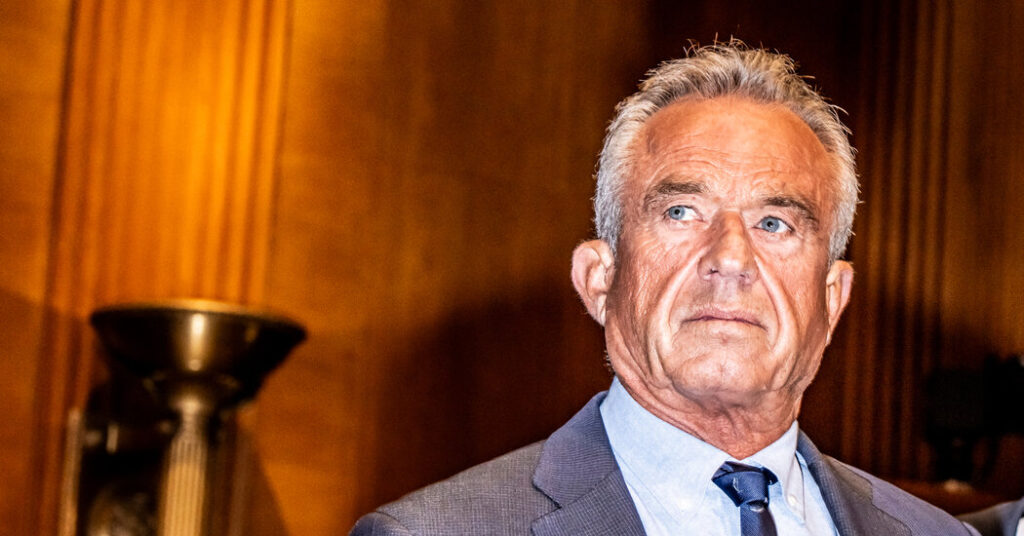
Today, Dr. Prasad is the Food and Drug Administration’s lead vaccine regulator. He works for one of the country’s most notorious vaccine critics, Robert F. Kennedy Jr. As secretary of health and human services, Mr. Kennedy has spent the last year not only remaking federal immunization policy but shifting the national dialogue about this essential public health tool.
I never predicted that a fringe conspiracy theorist like Mr. Kennedy would one day become leader of the health care system, but it doesn’t surprise me. Anti-vaccine groups have developed into a potent force. They have learned to stoke suspicion of authority with masterful precision, they have become adept at applying a veneer of scientific legitimacy to their ideas, and they’ve prepared a superficially compelling response to seemingly every argument that doctors make to encourage immunization. These rhetorical tactics were first worked out at dinky conferences and obscure media outlets, but now the government itself has become a propaganda organ for the movement. This makes confronting vaccine skepticism much more challenging — and, amid growing measles outbreaks nationwide, far more urgent.
The message emanating from U.S. public health agencies used to be simple: Immunizations are safe and effective. Those halcyon days are over. Mr. Kennedy has been hard at work distorting the truth.
Take the false idea that vaccines cause autism. The Centers for Disease Control and Prevention once plainly declared that they didn’t. Mr. Kennedy instructed the agency to take a different position: “The rise in autism prevalence since the 1980s correlates with the rise in the number of vaccines given to infants,” the C.D.C.’s website has been updated to read.
This sort of claim is typical of the anti-vaccine community. A nearly identical statement appears on the website of Children’s Health Defense, the anti-vaccine group Mr. Kennedy was formerly a part of. It isn’t true: Studies have shown that neither the number of active ingredients nor the amount of additives in vaccines corresponds to an increased rate of autism. But it sounds faintly data-driven and taps into a widely held belief that society has become overmedicalized.
Vaccine critics have won converts by branding their opposition to proven public health interventions as advocacy for individual liberty. “The decision to vaccinate is a personal one,” Mr. Kennedy wrote last March in response to the country’s measles outbreak. The C.D.C.’s acting director, Jim O’Neill, has followed the health secretary’s lead. In December he refused to endorse universal vaccination as a solution to the measles outbreaks, only going so far as to issue a vague recommendation for parents to “consult with their health care providers about vaccination options.”
Most parents, for the time being, seem to trust their doctor’s advice. Childhood immunization rates remain relatively high in the United States. But it has taken only a slight decline in vaccine confidence to set off the disease outbreaks we are seeing. It is easier for anti-vaccine groups to chip away at public trust than it is for the medical community to rebuild it.
Mr. Kennedy and his compatriots are able to draw from a vast body of literature — largely created by physicians and scientists themselves — documenting where more research is needed and the conflicts of interest that persist in modern medicine. Rather than use this scholarship to show that doctors are able to acknowledging their own limitations, they hold it up as proof of malign intent.
There is no surefire strategy for countering vaccine skepticism. Distrust of immunization is nearly as old as the technology itself. Still, medical organizations must ramp up their efforts to disseminate persuasive rebuttals to anti-vaccine talking points wherever people get their health information.
Physicians should also do a better job at making the case for vaccines clear. Many doctors have witnessed the harms of vaccine-preventable diseases. Relaying those firsthand experiences will be more compelling than simply dishing out data.
It is important for medical professionals to express how much they care, not just how much they know. The anti-vaccine community has showed staying power because it serves as a home for people who feel neglected or dismissed by conventional medicine. Doctors could do more to make patients, whose experience of the health care system is often that it is convoluted, callous and expensive, feel welcome.
Vaccines may be safe and effective, but just saying so is no longer enough. We’re only one year in, and how physicians and public health experts respond will shape what happens next.
Benjamin Mazer is a physician and a writer covering medicine and public health.
The Times is committed to publishing a diversity of letters to the editor. We’d like to hear what you think about this or any of our articles. Here are some tips. And here’s our email: [email protected].
Follow the New York Times Opinion section on Facebook, Instagram, TikTok, Bluesky, WhatsApp and Threads.
The post We Don’t Seem to be Making America Healthy Again appeared first on New York Times.