What if we think about humanity not as a state of being but as something we must actively practice — something we have to do? That’s the question posed by this year’s Bienal de São Paulo, on view through Jan. 11.
The chief curator, Bonaventure Soh Bejeng Ndikung, who was born in Cameroon and lives in Berlin, writes in his curatorial statement that he wants to move beyond identity politics, diversity and inclusion, or debates about migration and democracy. Instead, he and his international team of collaborators sought to highlight “the adamant beauty of the world.”
There are more than 1,200 works by 125 artists and collectives in the exhibit, titled “Not All Travelers Walk Roads,” with many of them proposing ways of creating new, kinder, more just forms of existence. Even as the art deals with questions of war, poverty and inequalities of all kinds, the result is joyful, even optimistic. And it is very beautiful, aesthetically and otherwise.
That beauty includes a sensitive photographic series of the people of São Paulo by the Berlin-based British photographer Akinbode Akinbiyi — a cross-cultural encounter. It also encompasses a massive chandelier-like, robotic flower by Laure Prouvost, a French artist who lives in Brussels. The flower opens and closes in sync with the amplified growth sounds of a live plant, an example of nature setting the pace for technology.
The São Paulo biennial is the largest, in terms of size and attendance, in the southern hemisphere, typically receiving nearly 700,000 visitors over the course of its run — almost as many as the better-known Venice Biennale and hundreds of thousands more than the Whitney Biennial. It takes place in a pavilion with 323,000 square feet of exhibition space — the equivalent of five American football fields — designed by a team led by the Brazilian architects Oscar Niemeyer and Hélio Uchôa, set in São Paulo’s largest popular public parks. The current edition breaks up the open-plan interior with delicately colored, flowing curtains and enclosures, transforming the building into a vast waterway with lots of side streams and eddies to break up the flow.
The show isn’t for the faint of heart; it is not always user friendly. (The curators’ decision to avoid putting identifying labels close to each object in order to encourage viewers to engage more directly with the art was a bad idea.) But it is absolutely worth the effort to see what the current moment looks like from a distinctly Brazilian perspective.
Here are some of the most venturesome works. Think of them as propositions for creating societies of the future.
Listening is key. (And maybe also smelling.)
Attending to what those around us are trying to say, and to what the earth itself is trying to say, are major through-lines of the show. Not surprisingly, sound-based work is everywhere; perhaps more unusual is the role that smell plays.
“The Way Earthly Things Are Going II,” 2025, by the Nigerian artist Emeka Ogboh, is exhibited in a dark room bathed in blood red light. In the piece, tree stumps surrounded by fragrant wood chips are embedded with speakers. The layered audio of breathing, sawing, expressions of pain, and a woman’s choir singing a mournful song give the sense that we are hearing the Earth’s suffering in the wake of deforestation and other devastations.
The Colombian artist Leonel Vásquez says he makes his works in collaboration with rivers, seeing them as active agents in creation. In “Templo da água: rio Tietê” (“Temple of Water: Tietê River),” 2025, he creates a dimly lit, churchlike atmosphere to honor a polluted waterway that runs through São Paulo. As long copper flutes and glass bulbs dip in and out of basins of river water, changes in air and water pressure create eerie whistling sounds — the Earth’s own music.
Honoring ancestral ways of living and resisting, and moving forward by working together.
Models of solidarity are on full display in the form of collectives that aim to create the world they want to see, even if only in microcosmic form. One of the most interesting is Sertão Negro, an Afro-Brazilian led experimental studio, residency program and school in the central Brazilian city of Goiânia. It adopts the principles of the country’s quilombos: communities established centuries ago by African people escaping enslavement that survive today, thanks to self-sufficiency and resistance. The group’s installation, an adobe covered circular enclosure, hosts botanical and cooking workshops, open studios and a film club — an insistence that art is not just objects, but also a whole process of being in the world.
Metta Pracrutti is a Mumbai-based collective that came together around the occasion of the biennial. In “Monsoon” (2025), the group’s members contribute work in a variety of media — embroidered wall hangings, contemporary mandalas, vivid paintings of inequities and the figures that led the struggle against them — that spotlight historical resilience in the face of caste oppression. The cacophony of individual forms and styles amounts to a gorgeous display of Dalit voices, which are marginalized too often.
Borders can’t stop creativity.
One of the first pieces you see and hear when you walk into the pavilion takes the form of a “radiola”: a wall of speakers, the trademark sound system of reggae parties in the city of São Luís, along the northern coast of Brazil. Despite the repressions of Brazil’s decades-long military dictatorship, reggae — a music style that originated in Jamaica — entered over the airwaves in the 1960s, and was adopted by Afro-Brazilian residents.
Gê Viana’s “A colheita de Dan” (“Dan’s Harvest”), 2025, adorns the speakers with collage-embellished photographs, record covers, newspaper clippings and historical paintings depicting early encounters with Europeans, while old film footage plays on small cathode-ray TV monitors. The result is a historical archive and dance party waiting to happen.
“Gondwana la fabrique du future” (“Gondwana, the Factory of the Future”), 2025, by the Senegalese artist Mansour Ciss Kanakassy, is a sharp and witty reminder that connections between countries in the Global South run long and deep.
The title refers to the supercontinent that included South America, Africa, South Asia, Australia and Antarctica eons ago; the artist imagines reforging those ties through the creation of the Quilombo Bank, creating a currency that would be freely traded and not subject to the World Bank or Western influence. It comes complete with a nonfunctioning A.T.M., and exhibition staff on hand to distribute bank notes to visitors.
Build from what we have.
It’s not surprising that questions of sustainability run through the exhibit, especially given that it overlapped with COP30, the U.N. Climate Change Conference in Belém, Brazil. The Chinese artist Song Dong created a spectacular hall of mirrors out of household lighting fixtures he borrowed from private homes, while the Jamaican American Nari Ward reclaimed discarded metal box springs for his installation.
But it was the Zimbabwean sculptor Moffat Takadiwa’s “Portals to Submerged Worlds” (2025) that really caught my imagination: a wondrous, colorful structure woven out of postindustrial plastic and metal waste, much of which is produced in the West and disposed of in poor African countries. Moving through the tunnel, you hear the sounds of the mbira, a traditional instrument from southern Africa, turning the piece into an almost spiritual journey.
The Earth is full of wonders.
If we need a reminder of why paying heed to the environment is worth it, a number of artists show us just what we might be losing. Otobong Nkanga, who was born in Nigeria and lives in Antwerp, created three intricate large-scale tapestries that depict a world both beautiful and abused: a glittering seashore littered with erosion nets and detritus, including eerie mannequin parts; a fiery-hued landscape of trees that may well be going up in flames; and an underwater realm where jellyfish swim around perilous fishing nets.
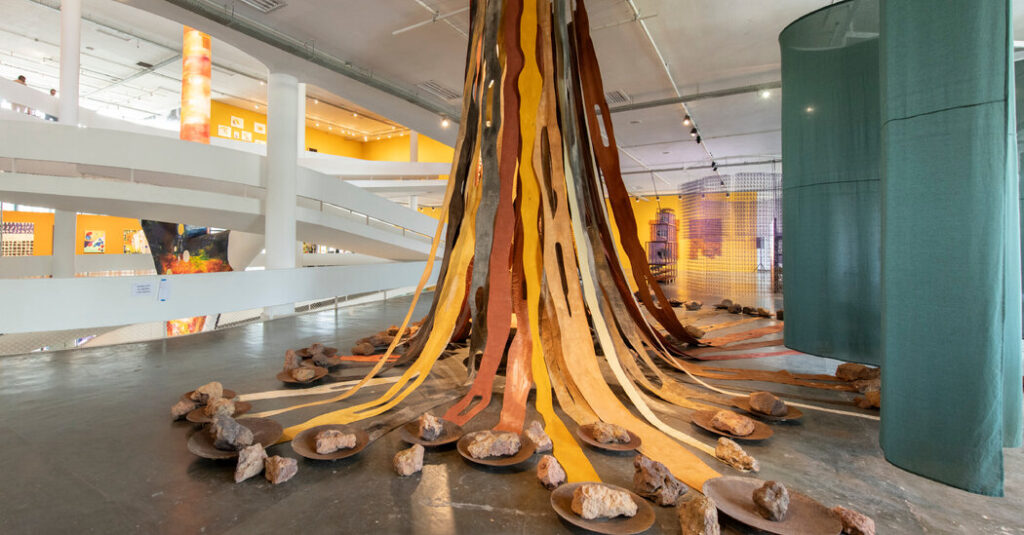
The octogenarian Brazilian artist and agricultural activist Marlene Almeida scours the land for natural materials that could be used as pigment and binder. “Terra Viva” (“Living Earth”), 2025, shows the results of these decades of research. A laboratory-like installation is composed of shelves and vitrines filled with soil samples, plant resins, scientific equipment and notebooks jotted with field notes, while long strips of cotton colored with those same specimens hang from the rafters outside — a three-dimensional painting constituted from Brazil’s own geology.
Indigenous knowledge holds answers.
The Enlightenment privileged strict definitions of science and technology, dismissing thousands of years of Indigenous knowledge in the process. This exhibition is filled with art that aims to recover that lost wisdom and put it to use today.
In “A Laboratory for Traditional Hybridity” the Sami artist and architect Joar Nango, along with his collaborators, draws upon what he calls “indigenuity” — Indigenous ingenuity. A library of building forms and books about decolonial theory, it’s both a demonstration piece and cozy hangout spot. The architecture is adaptable, made of natural and reclaimed industrial materials, and draws not only from Sami tradition but also from Indigenous cultures in Brazil and the lessons of the quilombos.
The future can be anything we want it to be.
Some of the sweetest works in the exhibition are those that dream up solutions to problems, no matter how improbable or even whimsical. My favorite is offered up by Manaurara Clandestina, an artist and filmmaker who lives in São Paulo.
“Transclandestina 3020” imagines a future in which transgender people are given the opportunity to transition into new lives with the help of an underground network. The installation includes a clothing line made of repurposed worker’s uniforms and a film depicting a sort of refugee processing center and a fashion show that takes place in the emptied-out Bienal pavilion.
The collaborative project, borne from the pain and violence so many transgender people experience today, doesn’t imagine a future free of oppression, but one in which people save each other from whatever is to come. That’s inspiring enough for me.
Not All Travelers Walk Roads: Of Humanities as Practice, 36th Bienal de São Paulo
Through Jan. 11, 2026. Fondação Bienal de São Paulo, Ibirapuera Park, Ciccillo Matarazzo Pavilion, São Paulo, Brazil; 36.bienal.org.br/en.
The post Want to Build a Better World? The São Paulo Bienal Has Some Tips appeared first on New York Times.