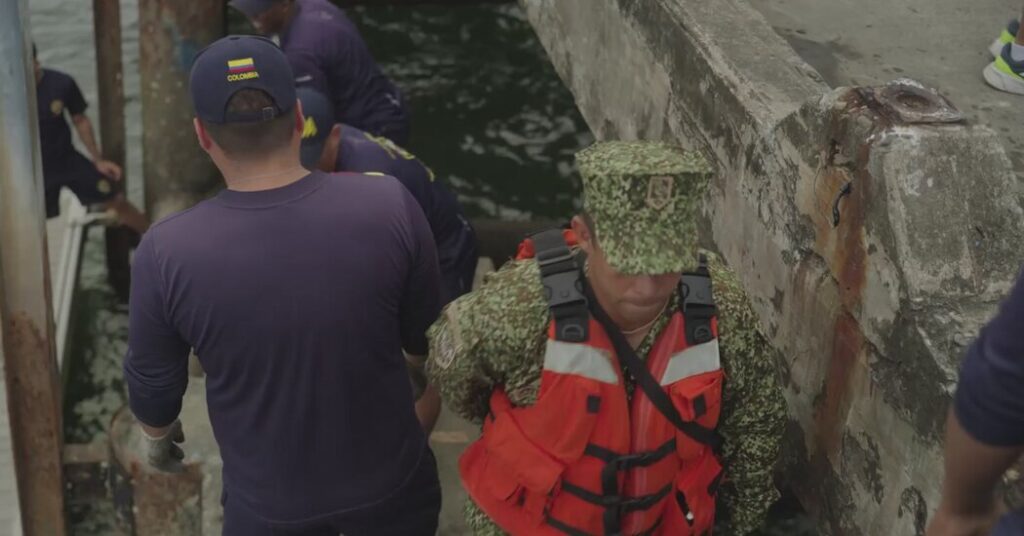
Colombia is locked in an escalating dispute with the United States over a series of boat strikes in the Caribbean and eastern Pacific — initially aimed at Venezuela — that Washington claims are targeting drug smugglers.
As the feud has intensified, President Trump has called Colombia’s president, Gustavo Petro, an “illegal drug leader” and warned this month that he could be “next.” Mr. Petro has fired back, saying that Mr. Trump “deserves nothing but jail” for having the U.S. military destroy the vessels and kill their crews.
While critics have long assailed Mr. Petro’s approach to drug policy, accusing him of being too lenient on coca growers and armed groups, there is no evidence he leads or is tied to any criminal organization.
How did Colombia become the world’s cocaine hub?
For nearly a half-century, Colombia’s geography and history have made it the world’s largest cocaine producer. Dense jungle; jagged mountains; long, porous borders; and decades of internal conflict have left vast remote regions under the control of armed groups, creating the ideal conditions for an illicit industry to thrive.
Successive governments, backed by billions of U.S. dollars, have tried nearly every enforcement tool available: extraditing traffickers, killing cartel leaders, spraying coca fields with herbicides from the air, pulling up plants by hand, destroying laboratories, intercepting shipments and battling the criminal groups that protected the trade.
None have produced lasting results.
Did a peace deal change anything?
A landmark peace accord in 2016 with the country’s largest armed group, the Revolutionary Armed Forces of Colombia, or FARC, demobilized the guerrillas after decades of brutal internal conflict and promised sweeping rural development to help farmers reliant on coca move into the legal economy.
Instead, the drug trade splintered. Smaller criminal groups moved into former FARC territories, and in isolated regions without roads, markets or basic services, coca remained the only reliable source of income.
Critics say the rural development provisions of the peace deal were never fully carried out under a right-wing government elected in 2018.
What did Petro promise to do differently?
When Mr. Petro took office in 2022, he pledged to reverse course. He vowed to focus on rural development and prioritize the arrest and prosecution of the leaders of trafficking organizations rather than poor farmers, in part by ending the state-led destruction of coca crops without farmers’ consent.
His government proposed a 10-year drug policy that included helping farmers replace coca with legal sources of income, expanding the legal uses of coca leaf, regulating cannabis beyond medical use and broadening harm-reduction services like treatment and overdose prevention. But almost none of it materialized.
“Well intended, well phrased publicly — extremely poorly implemented,” said Diego García-Devis, who manages the drug policy program at the Open Society Foundations, a liberal grant-making organization.
How has Trump influenced Petro’s policy?
While Mr. Petro has publicly criticized a tough-on-drugs strategy, he has never abandoned traditional enforcement and has maintained law-enforcement cooperation with the United States — unlike some other leftist governments in the region.
But under pressure from Washington and domestic critics, Colombian officials have signaled a return to traditional metrics: forced eradication, military operations and cocaine seizures. Colombia has announced plans to spray herbicide on coca crops using drones, a modified return to a practice restricted by court rulings over health and environmental concerns.
Mr. Petro’s message has, at times, been contradictory, said Alejandro Gaviria, Mr. Petro’s former education minister who resigned in early 2023 after objecting to a proposed government health measure.
“He says the war on drugs must change,” Mr. Gaviria said. “But then he says, ‘I’m the one who has seized the most cocaine’. So he also plays the spokesman for the war on drugs.”
How has Petro’s ‘total peace’ strategy affected the drug trade?
Mr. Petro campaigned on a plan to negotiate peace deals with armed groups, but has struggled to follow through. During the early phase of his “total peace” plan, when many military operations were paused, armed groups expanded coca cultivation, consolidated trafficking routes and boosted production.
Sergio Guzmán, a Colombian political analyst, said Mr. Petro bore some responsibility for stressing rhetoric over building political coalitions to carry out his peacemaking agenda, but, at the same time, cannot do much about global drug demand.
“Colombia’s in an impossible position where we have to keep on fighting a war that is not ours to begin with,” Mr. Guzmán said. “A war which we will never win because the economics are simply not there.”
What’s the cocaine paradox?
Cocaine seizures in Colombia have hit record highs, yet so has cocaine production.
Supporters of Mr. Petro note that the cultivation of coca, the crop that is the base ingredient of cocaine, has been rising for years under Colombian governments of all political leanings.
Analysts say the two trends underscore a central paradox of the drug war: As long as global demand persists, enforcement alone will do little to dent the trade significantly.
“This is not a political problem; this is an economic problem,” said Geoff Ramsey, who studies Venezuela at the Atlantic Council, a Washington research institute. “We can blow up as many drug boats in the Caribbean as we want, but it’s never going to address the root causes.”
Why is Colombia pushing to rethink global drug policy?
Even as domestic changes stall, Colombia has moved to shift the international debate. At the United Nations’ top drug-policy forum in March, Colombia won support for an independent review of how the coca leaf is classified under global drug treaties.
Mr. Petro entered office arguing — correctly, analysts say — that targeting small-scale farmers is futile because they simply replant.
“He’s at least started asking questions,” said Elizabeth Dickinson, an analyst at the International Crisis Group, which monitors and tries to prevent armed conflicts. “We’ve been doing this for, like, half a century. It hasn’t worked.”
Eradication and seizures amount to “treading water,” she added. “It’s not doing anything to eliminate the problem.”
Genevieve Glatsky is a reporter for The Times, based in Bogotá, Colombia.
The post Trump Calls Petro a ‘Drug Leader.’ What’s the Colombian Leader’s Record? appeared first on New York Times.