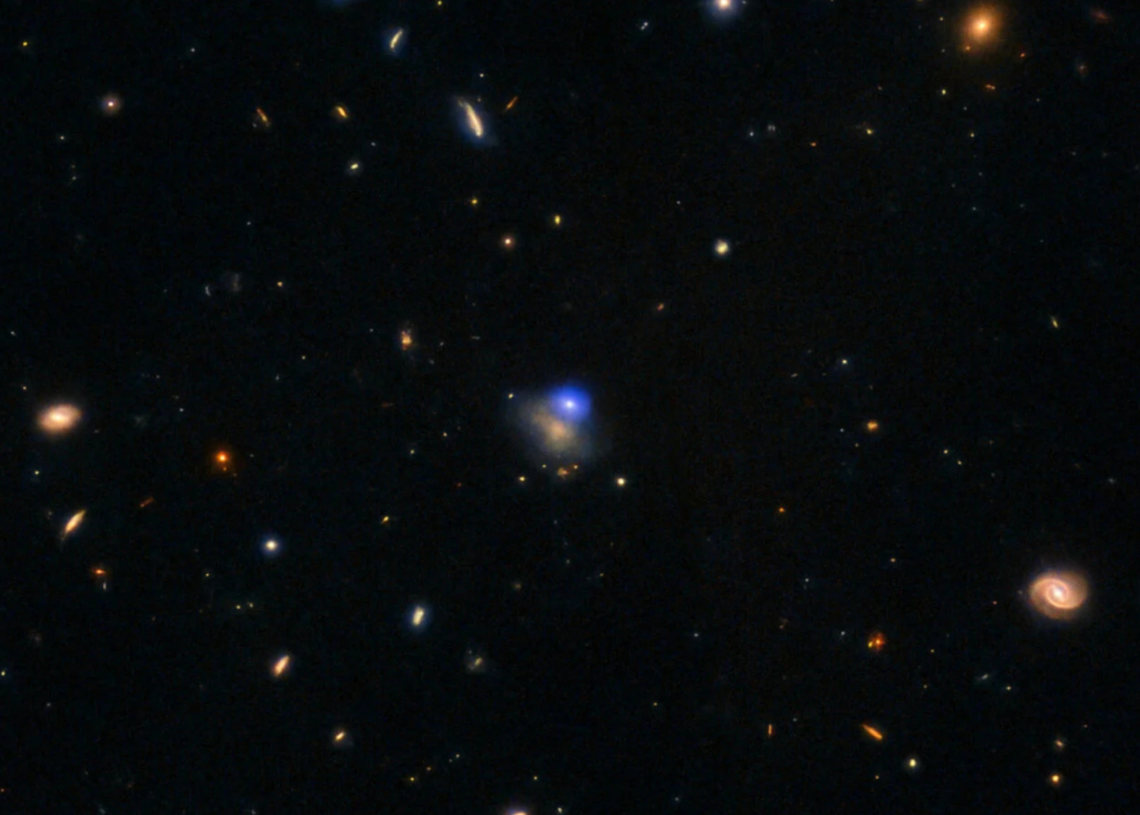
Astronomers have spent the past few years staring into space, trying to unravel the mystery of LFBOT’s, the deeply uninteresting acronym that tightens up the unwieldy and somehow even more uninteresting longer name: luminous fast blue optical transients. In English, that’s events that show up as blinding blue flashes that last only a few days, briefly rivaling or outshining entire galaxies before fading into faint X-rays and radio waves. Until now, no one could say what they actually were.
According to not one, but two research papers available to read on arXiv, a newly observed event that goes by the super catchy codename AT 2024wpp may have finally provided researchers with a massive clue as to what these things are. I hope you understood everything I’ve written so far, or this next sentence is going to throw you for a loop: AT 2024wpp is a super-bright LFBOT. It’s about 100 times brighter than a typical supernova, which means that it’s implausible that it’s a more conventional, run-of-the-mill stellar explosion. To be that bright, a star would have to convert a preposterous fraction of its mass directly into energy.
Black holes can do that, but this doesn’t seem like one of those either… but maybe it’s caused by one?
Researchers now think AT 2024wpp was caused by a relatively small black hole that is roughly no more than 100 times the mass of the Sun, ripping apart a companion star in the process. As the shredded star’s material was gobbled up by the disk circling the black hole, it produced intense ultraviolet, x-ray, and blue light. Some of that matter was funneled into jets shooting out at near light speed, generating the radio waves astronomers detect after the flash fades.
LFBOTs offer astronomers a new way to study medium-sized black holes. By pinpointing where these flashes happen inside galaxies, scientists hope to learn how such black hole–star pairings form in the first place.
The post What’s Causing Those Blinding Blue Flashes in Space? Scientists May Have an Answer. appeared first on VICE.