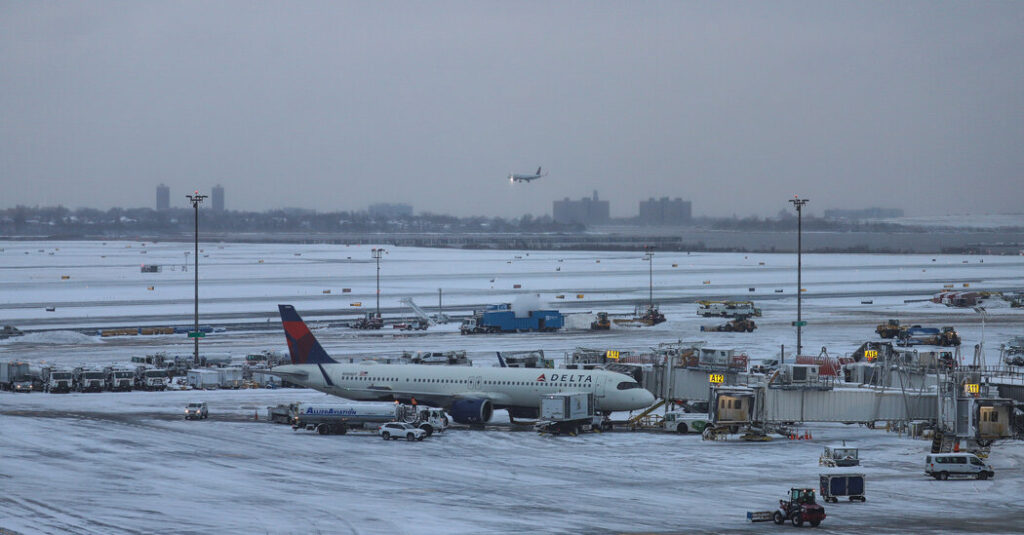
Forecasters had predicted that as much as nine inches of snow would fall in the New York area on Friday night and into the morning. The major airlines, fearing the worst, began to cancel hundreds of flights at the region’s big airports.
That decision meant that, even as the worst of the storm missed New York, thousands of holiday travelers were still left scrambling to rebook seats and change their travel plans.
The three main airports serving the region — Kennedy International, LaGuardia and Newark Liberty International — had more than 400 inbound and outbound canceled flights on Saturday, according to FlightAware, a tracking service. Hundreds more flights were delayed. On Friday, nearly 900 flights were canceled at the three airports.
Spokesmen for the airlines said they had pre-emptively canceled flights to avoid a cascading effect from real-time adjustments. Even small disruptions can be consequential for airline’s schedules, employees and customers.
“The worst thing you can do for your whole operation is to cancel flights really close into the time they’re supposed to depart,” said Chris Perry, a spokesman for Southwest Airlines. “Then you’re stranding airplanes and you’re stranding flight crews along with the customers.”
Almost exactly three years ago, in 2022, Southwest was forced to cancel thousands of flights when a severe winter storm stranded its planes and crews at big and small airports across the country. It took days for the airline to recover, even as the other big airlines, which use a hub system with a ready pool of crew members and pilots at the major airports, were able to quickly bounce back.
Pre-emptive cancellations, Mr. Perry said, had become more standard across the industry. “That’s really the best strategy,” Mr. Perry said, adding, “There was a lot of lessons learned” from the 2022 experience.
“It’s not worth the risk to put our airplanes and our crews there waiting to see if they’re going to be able to depart,” he said. “If they’re not able to, then we’re stranded, and that’s how you get into what becomes a multiday operational failure.”
Michael Thomas, a Delta Air Lines spokesman, said Delta used the same playbook. “A flight cancellation is a last resort after all other options have been exhausted,” he said in an email. “Given forecasted snow accumulation, cancels were made proactively in order to manage expected Air Traffic Control delay programs, constraints at airfields brought on by the snow.”
Mr. Thomas also noted that flights were delayed by snow removal efforts and de-icing procedures. Plus, he said, additional delays were the result of limits on how long crews could be on duty, even if they’re waiting at the airport for their flight to get the go-ahead.
Still, not all travelers needed to toss out their weekend travel plans. At Kennedy Airport on Saturday, Gary Gitelson landed after his original red-eye flight from San Francisco was canceled, but he was automatically rebooked and landed around 8 a.m., less than two hours later than his first flight was supposed to get in.
“Given that it was probably still snowing at 6:30 this morning, it probably was better to get in a little later,” said Mr. Gitelson, 49, who lives in San Jose, Calif., and was in New York to visit family for New Year’s.
Some travelers had scheduled flights, but still had to rearrange their plans. Rebecca Mazumdar was holding out hope on Saturday morning that her flight to India would depart as scheduled later in the day.
To avoid getting caught in the snow en route to the airport from her home in Clifton, N.J., Ms. Mazumdar paid around $700 for a last-minute reservation at the T.W.A. Hotel at Kennedy Airport on Friday night.
“I wish there was a little more snow to make me feel like that was worthwhile,” she said. “But I’m going to face the day with a smile and patience, and hope for the best.”
Gabe Castro-Root contributed reporting.
Emmett Lindner is a business reporter for The Times.
The post Hundreds of Flights Canceled at New York Airports, Even With a Few Inches of Snow appeared first on New York Times.