
When I got my book deal with HarperCollins UK, I was thrilled that a childhood dream of becoming an author was coming true.
Then, reality hit. I had less than a year to research and write an 80,000-word book.
I had never taken on anything this big before, and certainly not alongside a full-time job. The prospect of juggling a 9-to-5 as a journalist with such a time-consuming passion project felt terrifying.
But by being intentional with my time and relying on a few key productivity habits, I’ve ended up with a book I’m proud of, all without losing sleep.
I need sleep to be productive
I asked a couple of author friends how they balanced their day job with writing a book. One said he wrote in the twilight hours; the other woke up at the crack of dawn.
I also looked for clues from people I interviewed at work, like 21-year-old Nathaneo Johnson, who ran a startup while studying at Yale and told me he often put in 18-hour days.
It became clear they found time for their passion projects by eating into their sleep. But sacrificing precious shut-eye was not something I was prepared to do.
While some people are able to get by on less than the recommended seven to nine hours of sleep, I’m not wired that way. When I’m sleep-deprived, I am not my best self, nor my second or third best. I tend to get grouchy, lose focus more easily, and become more prone to getting sick.
If sleep was non-negotiable, I knew that I needed to carve out time elsewhere.
How I found the time to write
My free hours after finishing work and at weekends seemed like the most obvious place to claw back some time to write my book. Normally, those slots would be filled with episodes of “Below Deck,” reading fiction, or meals with friends.
I worked out that freeing up roughly two hours on workdays and a sensible eight hours on weekends, by cutting down on my favourite activities for almost a year, would be manageable. Although it doesn’t sound like much, the hours add up.
Over a month, it would give me more than 100 hours to work with.
Across the eleven months between signing my deal and my deadline, that would come to almost 1,000 potential hours — the equivalent of 45 straight days of work without sleep.
I didn’t know how many hours it would take to finish my book, but the math showed that the workload would be feasible if I chipped away at it steadily, rather than cramming the writing into an impossible final stretch.
In the end, I doubt I racked up anywhere close to 1,000 hours (I took days off to relax, socialize, and vacation), yet I still managed to finish my first draft several weeks ahead of schedule.
Habit 1: I created a system and stuck to it
While writing a book is a creative process, I approached my schedule with scientific precision.
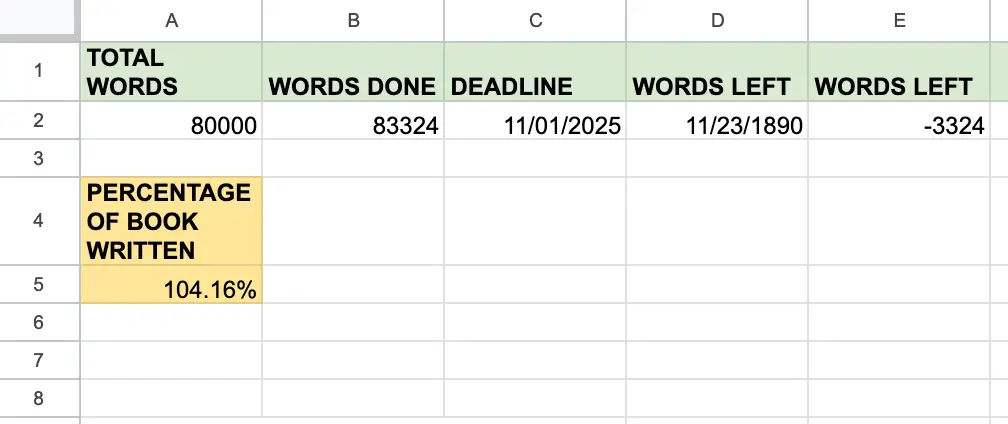
I built a basic Google Sheet template to track my progress and created a formula that took into account my total word count target and the number of days I had left. This gave me a total number of words I needed to write each day to stay on track. I updated it after every writing session.
Watching the total word count climb and the daily target shrink gamified the process, which was both motivating and reassuring. It also helped me judge when I was ahead of schedule and could therefore say “yes” to social plans.
I saw how my incremental efforts were adding up. Consistency, I learned early on, was the only way to tackle such a project.
I didn’t follow my schedule perfectly: there were impromptu reporting trips, days I was too exhausted to work, and social plans I didn’t want to turn down. But being consistent on average gave me enough wiggle room that these interruptions didn’t derail my entire schedule.

Habit 2: I celebrated small wins
Throughout the process, I tried not to become a recluse. I didn’t want to lose friends or my sanity along the way, so I made sure to have at least one thing each week to look forward to, whether it was hanging out with family or simply taking a long walk and enjoying a chai latte with friends.
Marking milestones mattered, too. At a third, halfway, and two-thirds of the book, my husband and I either went out for dinner or popped open a bottle of Prosecco. And when I finally handed in my manuscript, we went on vacation.
Celebrating the small wins gave me concrete, near-term rewards to work toward, which kept me motivated and protected my mental health. I locked in time for the gym, where I’d watch reality TV on the elliptical, to make sure that I was staying happy and healthy.
Habit 3: I worked smart, not hard
I tried to adopt a “work smart, not hard” mindset, occasionally using online tools to make my life easier. Instead of wasting time formatting or tidying my chaotic notes, I’d prompt ChatGPT to turn them into clear, bullet-point summaries. I also used AI transcription software to write up interviews.
Simple shortcuts like these saved me from tedious admin and freed up time for the stuff that actually mattered, like research and writing.
I didn’t get everything right. Some days I was well ahead of schedule, but pushed myself to work anyway, out of guilt for feeling lazy. A couple of times that brought me close to burnout and forced me to take a few days off from writing to recuperate. I should have listened to my body and paced myself.
I also recognize that I had some advantages: I don’t have kids or other caregiving responsibilities, my husband kindly took on more than his fair share of household chores, and my workplace allowed me a short period of unpaid leave to focus on my book.
Still, being intentional with my time made juggling a full-time job and a book far more manageable than I could have ever imagined.
I learned that I didn’t need to sacrifice sleep to live out a lifelong dream, as long as I used my waking hours wisely.
Now, with all that work behind me. I can simply look forward to Trauma Bonds being published in January 2027.
Read the original article on Business Insider
The post I wrote a book while working full-time. These 3 productivity habits helped me do it without sacrificing sleep. appeared first on Business Insider.