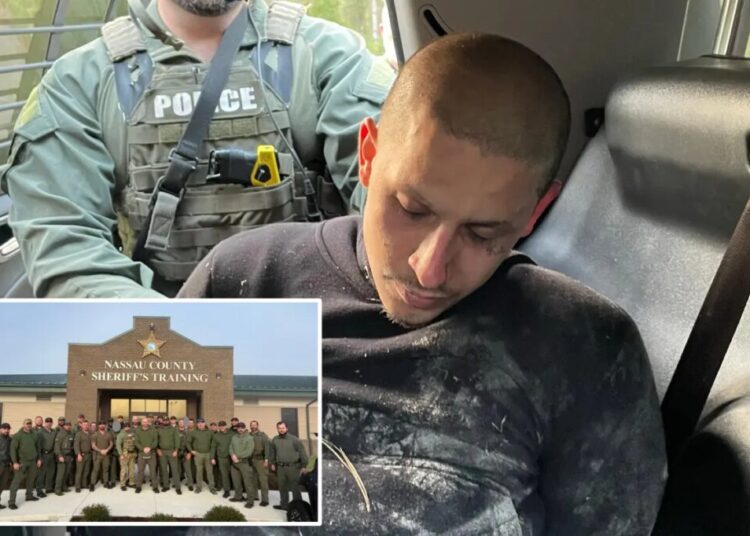
QUITO, Ecuador — The police arrived at the airport prepared to arrest a drug trafficker — a mariner whose crewmates the U.S. military had just killed.
Andrés Fernando Tufiño Chila was one of only two people known to have survived a U.S. strike on a vessel that the Trump administration alleged was smuggling drugs from South America. President Donald Trump had described the Ecuadorian and a fellow survivor of the Oct. 16 strike in the Atlantic Ocean as “terrorists” who would be returned to their countries of origin “for detention and prosecution.”
In Ecuador — a government closely aligned with Trump on counternarcotics enforcement — the administration had a willing partner, eager to learn, several officials here said, what the alleged trafficker could tell them about his employers.
Tufiño, then 41, stepped off the U.S. military plane at the Quito airport on the morning of Oct. 18 in shackles, cut and bruised from the attack but walking on his own, according to Col. Carlos Ortega, then the director of anti-narcotics for Ecuador’s national police. He was already a known trafficker: He had pleaded guilty in U.S. federal court to cocaine distribution conspiracy in 2021 and served more than three years in a U.S. prison before he was deported home to Ecuador last year. Now the U.S. military had picked him up amid the wreckage of a semisubmersible vessel — a “narco sub.”
In his gang-controlled hometown, Tufiño was known as Fresco Solo, neighbors said, a skilled navigator they alleged was recruited by criminals to smuggle drugs north.
But in transferring him to Ecuadorian custody, three officials here said, U.S. forces didn’t provide any evidence that could be used to detain him — no seized drugs, no phone or GPS records, no videos, none of the intelligence that led them to target his vessel.
On landing in Quito, U.S. officials told the Ecuadorians that the transfer was a “humanitarian” repatriation, Ortega said.
Within hours, Tufiño was let go.
U.S. forces have killed at least 105 people in 29 strikes on vessels in the Caribbean Sea and the eastern Pacific Ocean since the beginning of September, officials say, in a campaign that Trump and Defense Secretary Pete Hegseth say is aimed at stopping an existential threat: “narco-terrorists” flooding the United States with lethal drugs.
Others, including legal analysts and lawmakers from both parties have described the attacks as extrajudicial killings, which are illegal under U.S. and international law.
A Washington Post investigation into the Oct. 16 strike reveals a gap between the administration’s tough-on-trafficking rhetoric and its actions on the high seas. Trump has declared a “non-international armed conflict” on drug cartels. The White House and the Pentagon have likened traffickers to members of al-Qaeda and the Islamic State — terrorists who wield drugs as weapons to kill Americans.
But in destroying rather than collecting evidence, and turning the two survivors over to foreign governments rather than prosecuting them, they set alleged enemies free, cutting short a process that U.S. law enforcement has used to investigate smuggling operations and confront the criminals behind them.
“If these people were drug traffickers and deserving of death,” said Rep. Joaquin Castro (D-Texas), a member of the House intelligence and foreign affairs committees, “how is it that you would pick them up and just let them go?”
This report on the only strike known publicly to have left survivors is based on interviews with government and security officials in Ecuador, Colombia and the U.S., Ecuadorian intelligence and immigration records, a visit to Tufiño’s hometown and interviews with several people familiar with his alleged role in the drug trade. Several officials spoke on the condition of anonymity to discuss the sensitive details of an ongoing campaign.
Repeated attempts by The Post to reach Tufiño by telephone, email and social media were unsuccessful. Ecuadorian officials say they don’t know where he is.
Jeremy Warren, the San Diego lawyer who represented Tufiño in his 2020 case, has also lost contact with him, he said. He told The Post that Tufiño was an “unsophisticated” fisherman who lived simply. He was one of many skilled mariners who were recruited — sometimes lured by money, sometimes forced — to take jobs running drugs, Warren said.
For decades, U.S. law enforcement agencies have successfully interdicted drug traffickers in the Atlantic and the Pacific oceans, seizing multiton shipments of cocaine in operations that have helped prosecutors indict, extradite and imprison some of the most powerful cartel leaders in Latin America.
In January and February, the Panama Express Strike Force — which brings together the Coast Guard, Immigration and Customs Enforcement, Drug Enforcement Administration, FBI and federal prosecutors in Florida — seized more than 44,500 pounds of cocaine, worth more than half a billion dollars, and detained 34 suspected traffickers in investigations linked to the most powerful Mexican cartels, officials said.
Still, the cocaine trade has continued to flourish, breaking records annually to meet rising global demand for the drug. Europe has supplanted the U.S. as the primary destination for the South American product.
The decision to launch a military campaign against mostly small vessels off South and Central America has been consequential. U.S. military forces do not regularly collect evidence of crimes committed by civilians like drug traffickers, according to former military lawyers and current and former DEA officials. The Coast Guard, which is part of the Department of Homeland Security, is the primary agency for intercepting maritime drug traffickers. But instead of attempting to stop and detain suspected traffickers, the administration is launching lethal strikes.
Keeping survivors out of the U.S. justice system, critics say, helps the administration sidestep judicial scrutiny of its approach. “They are trying to avoid having to defend their policies and standards in court,” said one DEA official who spoke on the condition of anonymity to discuss sensitive details.
“Once they had custody of these people, it was clear … they were going to try to get rid of them expeditiously,” said Brian Finucane, a former State Department legal adviser on counterterrorism and military force. Revealing evidence in court, he said, would have been “politically disadvantageous.”
Keeping the case out of court also protects the policy’s architects from discovery and the people who execute it from being called in. “The military is not going to let their guys testify,” a former DEA agent said. “They don’t want to go down that road. It’s better to let the guy go than expose sources and methods.”
The Pentagon declined to answer further questions about the strike or Tufiño’s rescue and repatriation.
“We have consistently said that our intelligence did indeed confirm these boats were trafficking narcotics destined for America,” chief Pentagon spokesman Sean Parnell wrote in a statement to The Post. “That same intelligence also confirms that the individuals involved in these drug operations are/were narco-terrorists, and we stand by that assessment.”
Ahead of the Oct. 16 strike, U.S. personnel tracking Tufiño’s vessel assessed that it was headed for Europe, not the U.S., two U.S. officials told The Post.
Some of the U.S. strikes have targeted go-fast boats; others have targeted fishing vessels. But the Oct. 16 attack is the only strike known publicly to have targeted a semisubmersible. Such vessels, which can speed through the ocean just under the water’s surface, are relatively uncommon — but they’re prized by cartels because they can carry large shipments of drugs, and their low profiles make them harder to detect than ordinary boats.
Trump has describe the semisubmersible as “a drug-carrying submarine built specifically for the transportation of massive amounts of drugs,” though it doesn’t fully submerge. A senior Ecuadorian police official said it was clear that “the only thing [Tufiño] could be doing is taking drugs.”
“Someone on the high seas” in such a vessel, he said, “isn’t just out there to go for a ride for fun.”
But to charge a trafficking suspect picked up by a foreign government, Ecuadorian prosecutors require a sample of the drugs. And any such evidence, if it existed, is now at the bottom of the ocean.
A change in protocol
For the administration’s campaign against boats off South and Central America, the Oct. 16 strike was a turning point.
The first strike of the campaign, on Sept. 2, targeted a go-fast boat with 11 people on board in the waters off Venezuela and Trinidad and Tobago. (Trump said that vessel was carrying transporting illegal narcotics to the U.S.; U.S. and foreign officials said the route on which it was attacked is used to smuggle cocaine and marijuana to Europe and Africa.)
Hegseth gave his approval to kill the passengers, sink the boat and destroy the drugs, according to three people familiar with the operation. As two survivors clung to the wreckage, Adm. Frank M. Bradley, the strike commander, determined they were still viable targets and, after consulting with a military lawyer, ordered a second strike, killing them, The Post reported last month.
Subsequently, commanders prioritized rescuing strike survivors, according to three people with knowledge of the discussions. It is unclear who directed the change, when or why.
The Oct. 16 strike was the sixth reported by the administration.
Despite assessing that the semisubmersible was bound for Europe, according to two officials, U.S. forces dropped in for the kill.
An AC-130J Ghostrider, a manned Special Operations attack aircraft, struck the vessel twice in an opening salvo, overhead video posted by Trump shows, sending plumes of smoke into the air. The crew inside scrambled to escape through the hatch, according to a U.S. official familiar with the operation.
Tufiño and another man dropped into the water, leaving two others most likely inside the vessel, the official said. Tufiño and the other survivor, subsequently identified by the Colombian attorney general’s office as Colombian Jonatan Obando Paredes, held onto to some debris in the choppy waves, according to a second U.S. official, who reviewed surveillance video of the operation.
“We watched these guys just bob in the water,” the second official said.
A follow-up strike sank the vessel, and commanders determined the mission was over, according to a person familiar with the attack. U.S. forces rescued the survivors and took them back to the amphibious assault ship USS Iwo Jima, officials said.
Hegseth said that the Oct. 16 strike was “a different circumstance” than the Sept. 2 double strike.
“We didn’t change our protocol, it was just a different circumstance,” he told the Reagan National Defense Forum in Washington this month. “A couple guys jumped off and swam, from what I understand, a ways away. When we struck the submarine a second time, it sunk, and then you had two people that you had to go get, and we had the ability to go get them. We gave them back to their host countries.”
U.S. officials asked Ecuador and Colombia to prepare to receive repatriated nationals, officials from both countries said. A U.S. military flight departed from the Dominican Republic and took Tufiño to Quito and Obando to Bogotá.
Obando had suffered a brain injury, Colombian officials said. He was in an induced coma and attached to a ventilator. He was hospitalized for five days in Colombia, the officials said, and released.
Colombian President Gustavo Petro has condemned the U.S. boat strikes, saying that they kill mostly poor and young couriers without affecting the cartel leaders who are getting rich on the trade. But Colombia remains the most important U.S. ally in South America, and the countries’ security forces continue to work closely to combat drug trafficking.
Still, when the U.S. transferred Obando, a Colombian official said, “They hadn’t handed over any information, no elements to prosecute him.” The investigation is now closed, according to the Colombian attorney general’s office.
Tufiño refused to provide any information to Ecuadorian investigators, according to Ortega, the former director of anti-narcotics for Ecuador’s national police. He left no number with the authorities. A prosecutor asked police to track down contact information for the man, according to the attorney general’s office, but no progress has been made to reach him.
Some members of Congress have expressed frustration at the paucity of information provided by the administration about the strikes. Sen. Rand Paul (R-Kentucky) has called the strikes “illegal” and “outrageous.”
Rep. Gregory W. Meeks (New York), the top Democrat on the House Foreign Affairs Committee, questioned the decision not to prosecute the survivors in U.S. courts “as we would expect if these individuals were, in fact, dangerous drug traffickers bound for the United States.”
“No arrests. No interrogation. No intelligence collection,” he said on the House floor. “That decision raises serious questions about the administration’s own assessment of threat, necessity, and purpose.”
The White House did not respond to multiple requests for comment.
The journey of Fresco Solo
In a handwritten message from prison in April 2023, Tufiño warned his “friends” about the “American Dream.”
“The only thing I want you to know,” he wrote, “is that I’ll be waiting for you here with a cell, a broom, and a mop.”
Tufiño in 2020 had been the master of a go-fast boat carrying more than a ton of cocaine to a rendezvous with another vessel when it was intercepted by the Coast Guard, investigators said. He was arrested, pleaded guilty to cocaine distribution conspiracy and was sentenced to five years.
In that investigation, authorities recovered GPS units with coordinates, satellite phones, cellphones and the markings on the cocaine, according to Warren, Tufiño’s former attorney. “All of that is a treasure trove of intelligence information.”
In a sentencing memo, Warren told the court that Tufiño had been recruited for “a king’s ransom” — $6,000 — to pilot a small boat with a small crew moving cocaine on the high seas.
At the time, once-tranquil Ecuador was emerging as a major transit country for cocaine. With increasingly powerful gangs teaming up with Mexican cartels and Albanian mafias to compete for control of trafficking routes, it’s now one of the most violent countries in the region.
In the port town of Anconcito, residents said, fishermen began to buy 75-inch televisions, SUVs and rounds of drinks for at the bar for everyone.
Anconcito is Tufiño’s hometown. Neighbors, speaking on the condition of anonymity out of fear of reprisals, said he’s known locally as a fisherman who has smuggled drugs. The main employer here for skilled mariners, they say, is the Los Choneros gang, a longtime local liaison to the Sinaloa cartel.
In Anconcito, residents said, a kind of revolving door has become familiar: Fishermen are recruited to smuggle drugs; are arrested and taken to the U.S.; are tried, convicted, imprisoned and later deported, soon to return to the trade.
Few outsiders visit Anconcito. Los Choneros have for years controlled the port and others along this coastline, provincial police commander Jorge Hadathy says, extorting and threatening residents and increasingly killing fishermen in targeted attacks. Other gangs, such as Los Lobos and Los Lagartos, have stepped in to compete.
None of them appear to have been deterred by the recent U.S. boat strikes, Ecuadorian intelligence authorities say. Authorities here have seized more than 171 tons of cocaine at sea this year, up from about 129 tons in 2024.
One Ecuadorian official intelligence told The Post he expected that Tufiño would return to the trade. “What do you think he could do?” he asked. “That’s the easiest money. He already knows the route, he has the contacts.”
Schmidt reported from Mexico City, and Horton reported from Washington. John Hudson, Meg Kelly and Aaron Schaffer in Washington and Marina Dias in Brasília contributed to this report.
The post The U.S. sank the alleged narco-terrorists’ boat — and let them go appeared first on Washington Post.