SEOUL — The partygoers bopped their heads to club beats, holding a drink in one hand and fist-pumping with the other.
The vibes were just like a typical night out here. Except it was 9 o’clock. In the morning. And the drinks? Iced Americanos.
“Morning raves” have become the latest sensation among some South Koreans in their 20s and 30s who are looking for wholesome alternatives to booze-filled nights. They’re saying “no” to soju bombs — a common after-work rite involving a shot glass of potent rice wine dropped into a glass of beer — and round after round of drinking into the night.
They’re increasingly saying “yes” to morning runs and dancing while sipping on coffee.
“I came here today with a plan: Make this my stage,” said Kim Hyo-hee, 32, who joined the rave after a 5K jog with her running group. “I used to go clubbing when I was younger, but it’s exhausting, and you have to drink. But this is clean fun, and it’s cardio. I start my day feeling great.”
These dance parties have become popular around the world, including in Europe, the United States, Australia and Singapore, as the “sober-curious” movement of young people reevaluating their relationship with alcohol takes hold.
But South Korea is an unlikely place to be taking part. After all, alcohol is a huge part of life here — both social and professional.
South Korea is ranked among the top five advanced economies for binge-drinking, according to a 2025 report by the Organization for Economic Co-operation and Development.
There is a deeply ingrained etiquette around drinking, like turning your face sideways to sip your drink in front of someone who’s older than you, and never pouring a drink for yourself.
At social outings, groups of friends put on elaborate performances pouring soju and beer for others. Drinking games are so popular that one — “APT” — even made it into a K-pop song that was nominated for a Grammy this year.
Booze-filled work dinners are a central part of South Korean corporate culture, and alcohol has long been a way for employees to network and bond despite the strict seniority-based hierarchy. But surveys show people in their 20s and 30s dread those dinners, where some bosses pressure juniors to drink beyond comfort.
Hangover-free fun
Now, some younger South Koreans are wondering: What else can we do for fun other than drink?
“South Korea needs more occasions where people can have fun without alcohol,” said Kim Go-yang, 36, a social worker from Seoul who went to the recent morning rave. “What’s the fun in drinking all the time? You just end up getting into trouble.”
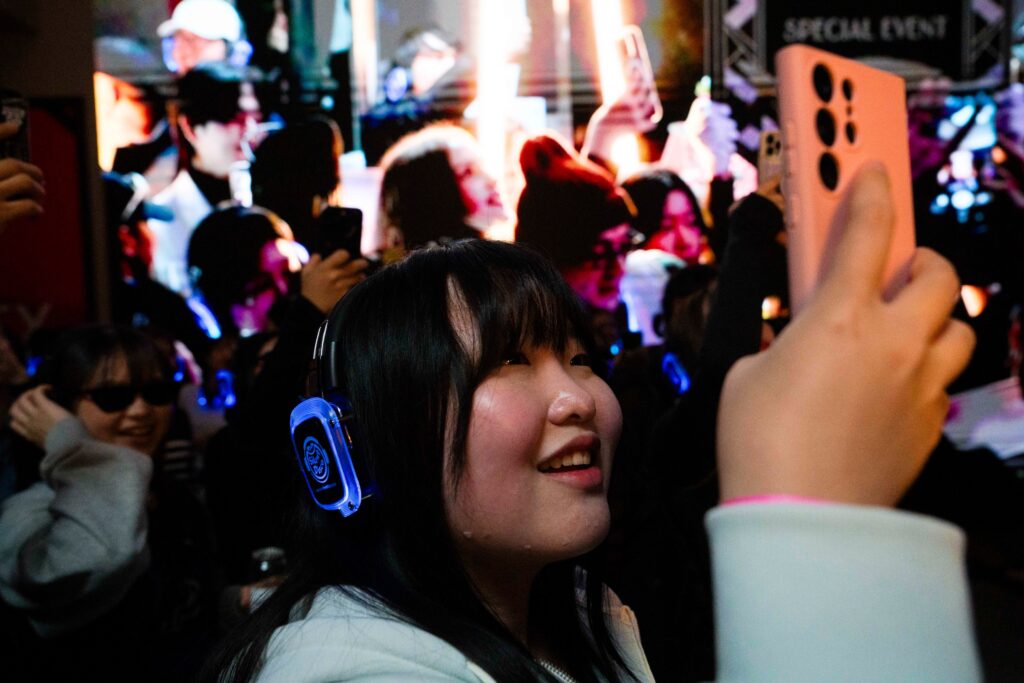
At a rave hosted by K-beauty brand Kahi on a recent Saturday morning, about 100 people gathered in the basement-level store starting around 8 a.m.
It was a little awkward at first, with no liquid courage to get attendees revved up. But after the caffeine kicked in, the crowd was uncontrollable. There was hollering, jumping — and even an impromptu party train dance around the store.
Some people huddled around the DJ to dance, while others hung back and enjoyed the music from a distance. Some wore headphones enabling them to crank up the volume louder than the store could handle.
As people finished their cans of iced coffee provided by Kahi, along came a procession of store workers holding LED lights and tubs of caviar. The crowd went wild as one employee — moving her head to music — made caviar-and-rice balls and fed them to partygoers, for a jolt of carbs and sodium.
The K-beauty brand wanted to capitalize on morning raves as a marketing opportunity, given the interest among younger clients, the company’s representatives said.
“Some people view party culture negatively, and others love music but can’t fully enjoy it because of that perception. So I think this shift is really great,” said Seo Minji, or DJ Minji, one of those at the turntable that morning. The dance party ended promptly at 10:30 a.m.
Culture shift
Event organizers, running crews, coffee shops and brands across the country are now catering to this emerging market of young South Koreans who are increasingly health-conscious. They are hosting dance parties, runs, yoga classes, book talks and “coffee chats” before work — specifically branded for healthy morning types.
The trend has been driven by people in their 20s, many of whom began emphasizing health during the coronavirus pandemic, which uprooted cultural norms of all kinds, said Yoon Duk-hwan, a consumer trends researcher and co-author of the annual book “Trend Monitor.”
They are now challenging alcohol-heavy work gatherings and nightlife-driven culture, Yoon said. The coronavirus pandemic also allowed for new company rituals shifting away from alcohol, like switching to work lunches instead of dinners, Yoon said.
Younger South Koreans also are seeking more agency over their daily lives, underscoring anxieties they feel about what they can’t control — like the job market, the AI takeover and income inequality, Yoon said.
“They are now in search of discipline. Rather than going somewhere to drink and get messy every day, they’d rather focus on maintaining control over what they enjoy,” Yoon said.
The alcohol market is shifting, too.
Alcohol consumption has dropped gradually over the past decade. In 2023, South Korean adults drank 2.2 gallons of alcohol per person annually, a drop from 2.6 gallons in 2011, according to a Health Ministry report this year.
Meanwhile, there’s been a rise in the consumption of nonalcoholic beverages, according to consumer reports. The nonalcoholic and low-alcohol beer market in South Korea grew by 118 percent from 2020 to 2024, according to Euromonitor International, a data analytics company.
“I love seeing people of all ages enjoying themselves together without drinking,” said Kim Yoo-jin, a 27-year-old consultant who attended the rave, then went to practice jujitsu.
One of the communities for early social events is Seoul Morning Coffee Club, which in 2022 began hosting small groups of people who wanted to meet others over a cup of joe before work.
Word spread online, and the group’s Instagram page now has about 53,000 followers. It now hosts a variety of events throughout the country, including six morning raves through the summer and fall, some of which drew as many as 600 people, said Siwon Moon, the club’s brand marketing director.
Kofe Haus Local Club, a wellness community and events group in Daejeon, a city in central South Korea, has held 10 morning raves this year. The events are becoming more and more popular, and the group even hosted a morning event in the mountains that included yoga, a run and a dance party.
“South Koreans work so hard, and we’ve not been great about taking care of our health,” said Park Seong-su, a representative for the group. “We hope for a South Korea where there’s more of a balance between life and work, and … a place where we more proactively look after ourselves.”
The post South Korea’s hottest new dance clubs open at 9 (a.m.) appeared first on Washington Post.