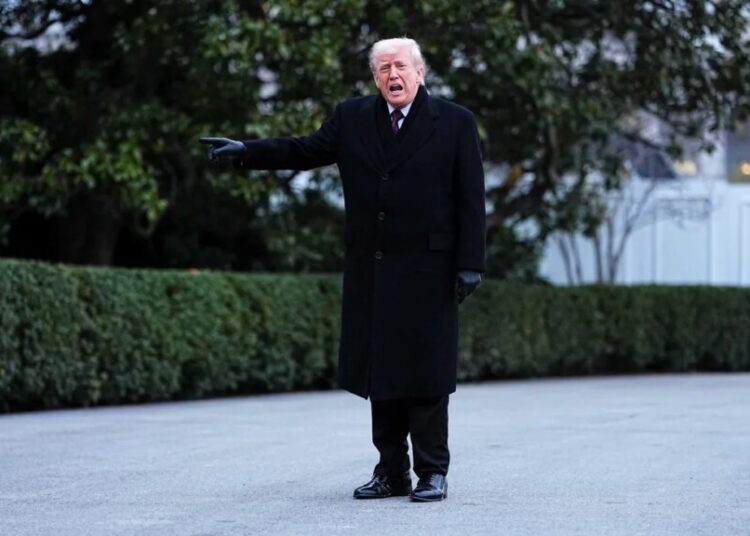
In Washington and on Wall Street, the biggest question as we head into 2026 is whom President Donald Trump will choose to succeed Jerome H. Powell as the chair of the Federal Reserve. Far more is at stake than the usual scramble for power and prestige. Trump has been clear that he wants the Fed to be another tool in the White House’s arsenal, or, as he saidon Truth Social in November, the Fed “must lower the RATE, BIG, right now.” In his choice, the world will see a signal that the Fed’s much vaunted and much discussed independence — the idea that it is staffed by credentialed experts who follow only the data and float above the scrum of politics — is either dead or alive.
Powell himself has repeatedly defended and stressed the importance of the Fed’s independence. “Independence is essential to our ability to serve the public,” he said last year. “We recognize that we need to continually earn this grant of independence, and we do so by carrying out our work with technical competence and objectivity, in a transparent and accountable manner, and by sticking to our knitting.”
But in truth, it is not clear that the Fed was ever as insulated from politics as it claims to be. A paper by Andrea Pagliuca, a second-year PhD candidate in finance at the London Business School, shows that when members of the Federal Open Market Committee — which sets the Fed’s benchmark interest rate — are politically aligned with the incumbent president, they become more optimistic about economic growth, less concerned about unemployment and more inclined toward easier monetary policy. “Higher political alignment lowers the federal funds rate by roughly 25 basis points relative to the Fed staff’s benchmark recommendation,” Pagliuca wrote.
So if Fed independence isn’t real, does it matter if Trump eviscerates it?
The notion of Fed independence has existed since the beginning. The goal, wrote Sen. Carter Glass, the chief author of the Federal Reserve Act of 1913, was to create an organization that was “free from political or sectional control.” Even today, although our legal system has allowed Trump to gut other supposedly independent agencies, the courts have held firm that the Fed is different — a “uniquely structured, quasi-private entity,” the Supreme Court wrote in May.
There is near unanimity among economists and Wall Streeters that the Fed’s independence is absolutely critical, because short-term political pressures to juice the economy via monetary policy can lead to devastating outcomes, such as catastrophic inflation and worse. “It’s very abstract to ordinary people, but the consequences can be very severe,” said Lev Menand, a law professor at Columbia University and the author of “The Fed Unbound: Central Banking in a Time of Crisis.” He added: “When monetary policy gets messed up, people can lose a lot of money, lose livelihoods, lose homes. It can have incredibly negative effects on social cohesion.”
The paradox is that the Fed’s very importance also makes it an irresistible target — so independence is always a battle, not a given. “The Fed is a powerful organization with an important mission, and its tools have incredible impact,” Menand said. “So, obviously, lots of different people want to influence how Fed policy is made. Throughout its history that has included treasury secretaries and presidents and members of Congress and very much banks and Wall Street firms.”
One prominent example is in the 1970s, when President Richard M. Nixon was exerting pressure on Federal Reserve Chair Arthur Burns ahead of the 1972 election to keep interest rates low even as inflation spiked. Burns obliged. He later blamed the destabilizing inflation of that decade on the Fed’s unwillingness to frustrate the “will of the Congress to which it was responsible” — which some argued was a convenient excuse. But economist Charles Weise, who is now chair of the public policy program at Gettysburg College, found that Burns was telling the truth.
“Members of the FOMC understood that a serious attempt to tackle inflation would generate opposition from Congress and the executive branch,” he wrote in a 2012 paper. “Political considerations contributed to delays in monetary tightening, insufficiently aggressive anti-inflation policies, and the premature abandonment of attempts at disinflation.”
The sins of that era were expiated not just by repudiation, but also by Chair Paul Volcker’s brutal interest rate hikes, which succeeded both practically speaking and in underpinning the nearly mythical status of Fed independence. But it is worth noting that while Presidents Jimmy Carter and Ronald Reagan weren’t always happy with Volcker, they were willing to tolerate the pain. Volcker didn’t get fired.
Still, the question of the Fed’s independence mostly — but not entirely — went away. In the 1990s, Duke economist Thomas Havrilesky combed through decades of public statements by elected officials and political appointees to see whether their views showed up in monetary policy outcomes. They did. In congressional testimonyin 1995, Havrilesky said he found “about 15 ways to Sunday” that short-term interest rates responded within three weeks to administration signals. With limited exceptions, he argued, every Fed chair over a quarter-century had showed periods of responsiveness, particularly when political pressure aligned with partisan loyalties.
Maybe Havrilesky’s methods were too messy to be acceptable in an economics profession that increasingly prided itself on mathematical models. At any rate, the idea that political pressure ever mattered has been resoundingly dismissed by recent Fed chairs. “It happens, and it doesn’t work. … I don’t know of any single case in which they succeeded,” Alan Greenspan said in 2009.
The intervening years made it easier to say that the Fed was insulated from political pressure, partly because inflation stayed muted and partly because dissents — when a voting member of the FOMC formally disagrees with the majority — nearly vanished. So from the outside, the Fed could look like a purely data-driven entity that used scientific rigor to transcend normal human messiness. But that was orchestrated by Greenspan, who pushed hard to get rid of dissents, accordingto a paper in the Journal of Macroeconomics.
“The governors wanted to make sure that the Fed was not perceived as a place with a lot of partisan infighting,” says Elisabeth Kempf, a finance professor at Harvard, who presented Pagliuca’s paper at a recent conference.
Enter Pagliuca, who used large language models to go through transcripts of the Fed’s meetings. He found that political alignment does affect how FOMC members assess the economy — which is all the more important now, in our incredibly partisan times, because even the Fed is becoming more partisan. He points out that appointments of Fed governors have become far more polarized in recent years, with nominations — such as Lisa Cook in 2022 and Stephen Miran in 2025 — increasingly passing along near-party-line votes. His concern is that we could see more effects of politicization, not less.
“In a less polarized world, there are many incentives to be independent, but when society polarizes, the incentives [in terms of public appointments, or even just keeping your job] are much stronger to behave in a partisan way,” he said.
Pagliuca’s work and observations provide a possible explanation for what is happening today. Economics commentator Matt Klein wrote that even though Federal Reserve officials are just as worried about inflation now as they were six months ago, the median official still expects that short-term interest rates “under appropriate monetary policy” will be lower than what was previously expected. It doesn’t make sense. The “plausible explanation,” wrote Klein, is that a “small but growing cadre of Fed officials have been reinforcing the pressure from administration officials for larger and faster reductions in interest rates.”
While the trend toward consensus may not have been entirely real, the alternative might have its dangers, too. “The visible disagreements make it harder to maintain this image that monetary policy isn’t driven by politics and instead is driven by models and data,” Kempf said. “It’ll be really interesting to see what this does to views of Fed independence. I haven’t seen any study linking dissents being more visible to how the Fed is perceived. But it likely could have a meaningful impact.”
Even if independence isn’t entirely real, even if there is a gap between the myth and the reality, the answer is not to totally decimate it. Just as with a sports referee, who sometimes makes mistakes in calls because of human fallibility, the perception that there is an effort to be fair matters. If the world were to believe that America’s central bank was completely guided by politics, faith in the dollar and in America would probably crumble.
There is also a difference between imperfect independence and overt subservience of the kind that Trump, who has floated a rate cut of up to 300 basis points, seems to want. “Trump is trying to achieve very specific political goals by lowering interest rates,” Menand said. “He wants to give the economy a hit of some jet fuel to make up for contractionary effects of all of his other policies. That would put the economy on a sugar high — and sugar highs lead to crashes.”
The best answer might be the one Havrilesky proposed many years ago, which is more transparency. “If people are watching, then there could be natural enforcement to argue not for political reasons, but to argue for policy reasons,” Pagliuca said. Or, to put it differently, if we all know that the Fed may not always act in ways that are completely independent, that might actually make it more independent.
The post Is the Federal Reserve truly independent? appeared first on Washington Post.