Top Nigerian officials said Friday that U.S. attacks in the country on what President Donald Trump called “ISIS Terrorist Scum” could mark the opening salvo in a campaign against militant groups there. But security analysts warned that Trump administration officials appeared to be stepping into a complex, long-running conflict that they may not fully understand.
Trump has in recent months repeatedly warned that he would intervene in Nigeria — which is afflicted by widespread violence — if the killing of Christians does not stop. He made good on that promise Thursday, announcing “numerous perfect strikes” on Christmas night and promising more if the “slaughter of Christians continues.”
Western and Nigerian security analysts said the attacks marked the first time in decades that the United States had launched such strikes in Nigeria, a country of more than 230 million people split about equally between Muslims and Christians. The analysts said that violence, particularly by Islamist militants in the north, has sometimes targeted Christians but that Muslims have also been affected.
Neither Trump nor the U.S. Africa Command (AFRICOM) specified exactly who was killed in the strikes, which both the U.S. and Nigeria’s government said were conducted with the approval of Nigeria’s government. Daniel Bwala, an adviser to Nigeria’s President Bola Ahmed Tinubu, said the strikes on Thursday marked only the beginning. Nigerian Foreign Affairs Minister Yusuf Tuggar told Nigerian broadcaster Channels Television that his country provided intelligence to the U.S. for the strikes and that cooperation was ongoing.
“There will be more, I can assure you of that,” he told The Washington Post in an interview Friday. “This is part of our struggle against insecurity.”
Trump, as he has done repeatedly in recent months, specifically cited violence against Christians in his Christmas night post on Truth Social, declaring that he had previously warned “these terrorists that if they did not stop the slaughtering of Christians, there would be hell to pay.”
Bwala said that while Nigeria welcomed the U.S. assistance, the government disputed Trump’s claim that Christians were being disproportionately targeted. Sokoto State, where the strikes took place, is a primarily Muslim area.
Analysts said the violence in northwest Nigeria is carried out by a combination of Islamist militants and bandits. Much of the violence in Sokoto in recent years, according to Armed Conflict Location and Event Data Project (ACLED), is attributable to a group called Lakurawa. Some analysts, including those with ACLED, link that group to the Islamic State, while others say Lakurawa is affiliated with the rival al-Qaeda affiliate Jama’at Nusrat al-Islam wal-Muslimin (JNIM).
Analysts said that U.S. officials seem more focused on their preferred narrative in Washington than on the complex reality on the ground.
“It’s politically convenient,” said Mustapha Alhassan, a security analyst who has worked extensively in northwest Nigeria, referring to Trump’s framing of the strikes. He said that while it is clear there is increasing violence by Lakurawa, the group is more likely linked to al-Qaeda than the Islamic State.
“Nigerians would welcome the help if it was hitting precise targets,” he said. “But that doesn’t seem to be what is happening. All of this is to what end?”
James Barnett, a Nigeria specialist based between Lagos and Britain, said that much remains uncertain about the impact of the strikes and the future of military cooperation between the United States and Nigeria.
“If this is the start of a shift in U.S. policy toward Nigeria, there are a lot of potential challenges and risks, including in terms of how these operations are framed,” he said. “The symbolism of Christmas is hard to miss … there is a clear political angle to it.”
He said it was significant, though unsurprising, that it was Trump, rather than Nigerian officials, who first announced the strikes. Historically, he noted, Nigeria’s government has not welcomed U.S. strikes because of concerns about the country’s sovereignty.
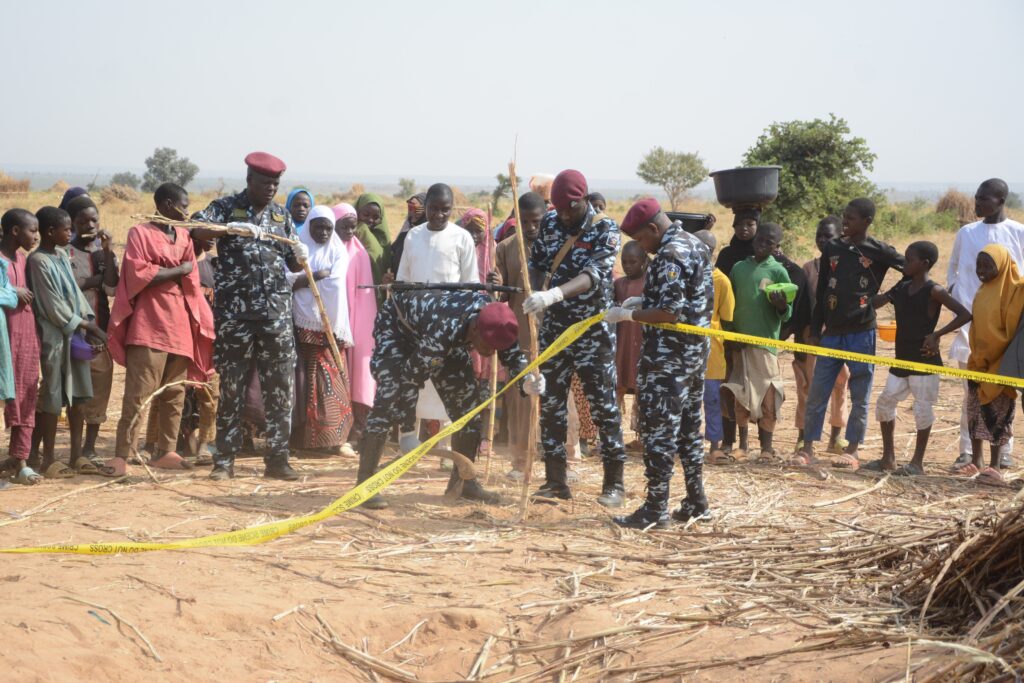
In the typically quiet village of Jabo in northwest Nigeria, three residents said in interviews Friday they were left confused by a strike in their area, which they said had not been especially affected by violence.
“We don’t have any bandits’ camp near our area,” said Sama’ila Mustapha.
He recounted seeing a light and then hearing a loud bang late on Thursday night. Mustapha said he then followed a crowd of people to an onion field just outside of town near a hospital. He and two other residents said there were no casualties.
“We thought it’s a missile or an aircraft,” said another resident, Abdulrahman Mainasara. “God was so kind it landed on the outskirts, in an open place.”
The post With airstrike in Nigeria, Trump inserts U.S. into long-running turmoil appeared first on Washington Post.