Subscribe here: Apple Podcasts | Spotify | YouTube
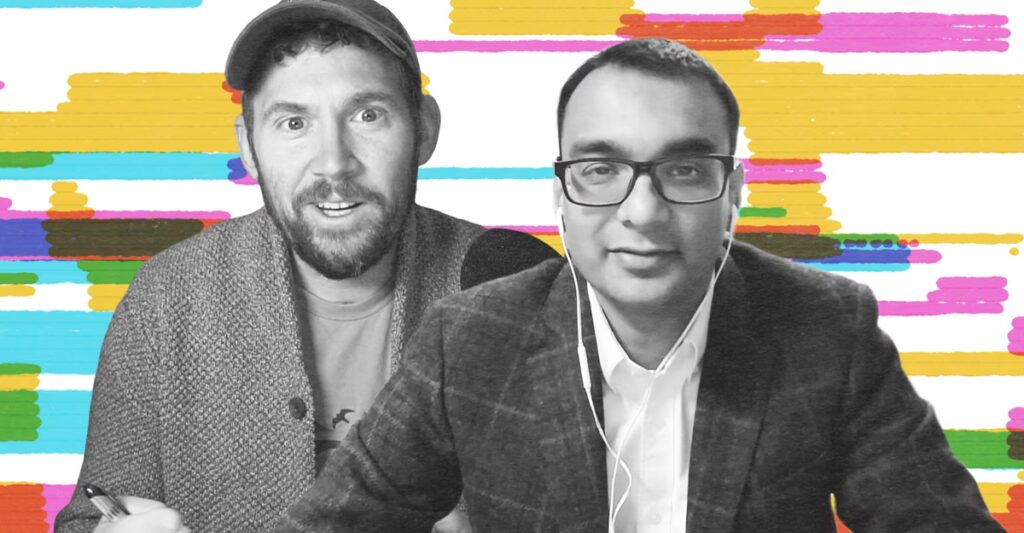
Are your parents addicted to their phone? In this episode of Galaxy Brain, Charlie Warzel explores how technology is affecting an older generation of adults. Instead of a phone-based childhood, Warzel suggests, we may be witnessing the emergence of a phone-based retirement—one shaped by isolation, algorithmic feeds, and platforms never designed with aging users in mind.
To untangle whether this is a genuine crisis or a misplaced moral panic, Warzel speaks with Ipsit Vahia, chief of geriatric psychiatry at Mass General Brigham’s McLean Hospital in Massachusetts and a leading researcher on technology and aging. Vahia emphasizes that older adults are anything but a single category, and that screen use can be both protective and harmful, depending on context. The key, Vahia argues, is resisting reflexive judgment. Ultimately, this is an issue not of screens versus humans, but of how families navigate connection in a world where attention is mediated by devices in every age group.
The following is a transcript of the episode:
Ipsit Vahia: Don’t go, You’re spending too much time on the phone. Instead, perhaps ask, What are you watching on your phone? What apps are you into? This is what I do with my phone. You could use their phone use as a conversation starter, as a way to meet them where they are, as a way to perhaps enter their world rather than expecting them to jump straight into your world. And, you know, it can just be the basis of strengthening connection rather than breaking it.
Charlie Warzel: I am Charlie Warzel, and this is Galaxy Brain. About a year ago, around the holidays, I began to hear a similar complaint. People were heading home, often with their kids in tow, to be with family. It was there that they noticed that their parents, or grandparents, or older relatives were behaving differently.
Broadly, the complaint was that their older loved ones seemed consumed by their devices—constantly on TikTok or Instagram or Facebook, watching vertical-reel videos. Sometimes they said they found it hard to hold a conversation. In multiple instances, people reported that some of these adults seemed to not pay much attention to their grandchildren.
Most of the people that I spoke to recognized it pretty quickly. It was the same thing they’d seen in their own kids: a screen-time problem. So, naturally I was curious. I wanted to get a sense of the scale of this. So I asked around on social media. I got dozens of responses over the year. From young people, from older people. Lots, lots of people.
Some older folks, they wrote in to tell me that they felt bad about how much time they were beginning to spend on social media. Others told me they’d found joy in the process and that there was no problem and I was over-hyping it. But many confirmed the anecdotes. Some feared that their loved ones were growing depressed or anxious as a result of a problematic relationship with their screens.
Others worried about older relatives falling victim to scams. Almost all of them, though, stressed that this felt like an emergent phenomenon—something that had popped up since the pandemic. I heard stories like this one from Josh.
Josh: It’s super interesting to watch my kids and my dad interact in the same space. With my kids, they love screens. They’ll spend an hour most mornings watching Bluey or Sesame Street or something. But when it’s off, they generally switch gears. They’ll go bike, they’ll do gymnastics, they’ll play board games. They engage with the world around them. My dad, on the other hand, is constantly glued to his screen.
He’s reading the news; he’s scrolling through his email. With my dad, there is no off switch. When we look at photos from his trips to see us, they show the kids engaging with their grandma, playing games, being silly, while grandpa’s in the background playing a game on his iPad.
Warzel: Or this one from Kim.
Kim: I’m 55. I have tween twin girls. I worry a lot and spend a lot of time controlling their screen time. And it’s kind of a joke, because if they saw the amount of screen time that I have in a day, it is way more.
Warzel: Kyle worries about what his parents are seeing.
Kyle: It’s really tricky to talk to my parents about anything news-related.
My parents are both, you know—they’re very intelligent, they’re thoughtful people. But media literacy is a problem for them in a way that it isn’t for my teenage kids who were kind of raised with an understanding of the dynamics of digital content. I mean, we all spend our days staring at screens. But the screens that my parents are staring at is this really toxic combination of Facebook and Fox News.
So it gives them these distorted views of things. You know, like: Portland is violent; New York City is super dangerous; immigrants are selling fentanyl to schoolkids; isn’t [Zohran] Mamdani anti-Semitic? You know, that kind of thing. And it’s hard to break through that information bubble. I’ll call my mom out sometimes for sharing disinformation online. But like, how do you tell your mom she’s participating in a Russian disinformation campaign? I sound like the crazy person in that conversation.
Warzel: But perhaps the most affecting one came from a nurse in the United Kingdom
who told me what she sees in her ward.
Nurse: I’m a nurse in the U.K., working in an inpatient ward. Most of our patients are in the 50-plus age group, and the majority have smartphones or iPads. When you’re stuck as a patient in the hospital, a lot of the time you’re bored or lonely or both. That can mean loads of really excessive screen time. It’s probably the 50-to-75 age group I’m most worried about, because they’re tech savvy enough to be where they want to be online, but they’re not necessarily media literate.
They might not recognize harms or understand how algorithms funnel consumption in certain directions. Some of it is fairly benign, like being obsessed with fake-AI animal stuff or compilation videos of babies. And sometimes it’s actually been pretty funny, like when folk end up in an autoplay cul-de-sac of Chinese-language videos.
But I do think the negative effects of excessive scrolling are bleeding through more, mostly in the anti-immigration stuff we hear. And the conspiracy thinking, medical distrust too.
Warzel: These testimonies struck me in part because they sound quite a lot like the concerns voiced for years by parents about children and devices. In the last decade-plus, there have been endless panics—many warranted, and others less borne out by the evidence—about children and screens. That their young minds are being influenced or warped by devices designed to take advantage of them. In most cases, screen panics position children as defenseless, even agentless.
They’re confronting this force that’s powerful enough to cause problematic behaviors among their underdeveloped minds. But now it seems the problem exists on the opposite side of the age spectrum. Data suggest there’s a reason people might be noticing this more now, because more people are aging into a retirement era with more fluency with smartphones and tablets and social media. On YouTube, for example older people are among the platform’s fastest-growing demographic. It’s possible that the pandemic and the attendant isolation accelerated all this adoption, from rideshare apps to Zoom. The confluence here seems very real. Older individuals may have extra time, and they may be more socially isolated than other demographics—and they’re seeing their retirement era just collide with this extremely powerful algorithmic world of social networks, apps, on-demand streaming services, and even the arrival of generative AI.
These are things that confound people of all age groups. But older people are not by any means a monolith, and technological tools are very clearly lifelines for aging people. As well as tools that can bring great joy, information—help them live full and creative lives. This is a really complicated issue, and so I wanted to speak with an expert and find the perfect guest here.
Dr. Ipsit Vahia is the chief of geriatric psychiatry at Mass General’s McLean Hospital. He’s the director of its technology and aging laboratory, and he’s been studying this phenomenon—and more importantly, working with patients in clinical settings. He joins me now to talk about all of this.
Dr. Vahia, welcome to Galaxy Brain.
Vahia: Thank you for having me. Delighted to be here.
Warzel: So you head up the technology and aging laboratory at McLean Hospital. Can you tell me what you all do there?
Vahia: Sure. So it’s a clinical-research laboratory that’s focused on understanding the way older adults use technology, and then also leveraging technology in a clinical setting with older adults with dementia or other mental-health challenges.
So we have a broad range of areas in which we do research. This includes early diagnostics, technologies for monitoring and supporting clinical decision making. But they’re also developing interventions using tech.
Warzel: So how did you get into this line of work, especially working with people on the furthest side of the age spectrum there?
Vahia: There’s actually an origin story there. When I was a trainee, it was when smartphones first came about, and I think I remember this incident very specifically. It was the year 2009. I was a trainee in California, and my wife and I were out for dinner with friends, and we had a 4-year-old child in tow. And he was doing what 4-year-olds do. He was boisterous, and I saw a simple thing. Again—this is circa 2009, so this is quite common now.
But in 2009, I had never seen this before, where my friend took out his smartphone and gave it to his child. And the child was engaged with it, and we didn’t hear a peep from him. We made it through four courses of dinner. Glass of wine, even.
Warzel: Very common now.
Vahia: Now it’s default. But back then, the thing that it really made me think about was that: If this engagement with the screen could sort of stabilize the behavior of a child, could it do the same for someone that was, you know, functioning at the level of a child? Which is to say: someone with dementia. Could we use these devices to engage them? Could we use these devices to reduce agitation?
A little after that, when iPads came out, there was a different incident. So when I was working on the inpatient unit, we had a routine. And the routine would be that every morning started out with everyone gathering in the community area. And we would just read from the newspaper. And this was intended to sort of create the sense of community. A shared activity that brought everyone together. It also let us assess how people did in that group setting, because it’s a predictor of how they might do when they were on the outside. Now, on the morning that I was supposed to lead the meeting, the newspaper never showed up.
It was stolen, lost; we don’t know. But this was when iPads had just come out, and I happened to have a personal iPad with me. And an interesting thing happened that morning where, in the absence of the newspaper, I was able to pull out the newspaper’s website on the iPad. And we kind of went through the same exercise, but now it was digital.
And what happened was someone raised their hand and asked me—can you access only The San Diego Union-Tribune? I was training at UC San Diego, so that was the local paper. And I said, well, no, I can access any newspaper that has a website. Now, this was a Monday morning, and it was a very specific question. He said, “I’m from Pittsburgh. Can you tell me what they’re saying about the Steelers game last evening?” And so I did. I was able to pull up the column, and we talked about that when this happened. Another person raised their hand, and he’s like, “Well, that’s great. I’m from St. Louis. Can you find out what they’re saying about the Rams last evening?” And so I was able to do that.
And now, suddenly everyone was asking not for this one-size-fits-all newspaper reading, but they were able to get what was most important to them. And that was sort of the other big moment where I realized that you could, you know—with this device that we already had figured out engages people—we could also personalize the intervention.
And in many ways it was not about the tech at all. It was about what the tech made possible. And there’s a difference, because I think, to this day, some of the way we think about this is about the tech. But I’ve always thought about technology as a conduit to problem-solving and an intervention.
So as a clinician, the thing that we anchor our work around is: What is the patient need? Or, what is the clinical problem? And then think about—is the technology we have before us able to solve some of these?, And that served us well. I think that served us well.
Warzel: So tell me a little bit about—you work with this elderly population; you’re working on these types of interventions.
You’re also deeply attuned to the way that they use and interact with technology. Broadly speaking, how would you classify how people on this side of the age spectrum are using technology? Are they a monolith? Are they extremely different and varied? Like, how would you describe, you know, the elderly’s interactions with technology?
Vahia: Thanks for that question. I think that’s the question that really gets at the heart of it all. So, I think if our listeners learn exactly one thing from this entire podcast, it should be that. Older adults are probably the most heterogeneous group of all the age groups. And we don’t always think of it that way, right?
We think of the elderly as this one monolithic entity. I love your use of that word. And nothing could be farther from the truth. So if you pause and just think about this for a second. We think of everyone over 65 as part of this one block, right? We have infants, and then we have toddlers, and then we have pre-K kids, and then we have elementary school. And we are quite sophisticated in the way we compartmentalize people across the age span.
But then we get to age about 65, and they’re all seen as this one block.
So. In the “elderly” group, if we consider people in their 90s and people in their 60s, these people are 30 years apart. If you’ve seen and understood one older adult’s use of technology, you’ve really seen and understood one older adult’s use of technology.
Yeah, and I think this overgeneralization does not serve us well. Which is not to say that there is not truth in the data. I think older adults, as a whole, do use less technology, but it varies quite a bit by. age cohort. So, you know, 80-year-olds may not be quite as digitally literate around apps or mobile phones, but 60-year-olds assuredly are very proficient as a group. Now there’s exceptions, obviously, on both ends.
Warzel: Well, that makes a lot of sense. Right? You would expect that between a 65-year-old and a 95-year-old, there’s 30 years there—there’s a lot of life and context experience. And I think you’re right that we do paint people in a lot of age brackets, but especially the elderly, with this really broad brush.
But I am curious from what you are seeing—and this will contextualize a little bit of what I want to dig into in this conversation—but do you notice that there is a different effect on older generations in terms of the way that they are using technology than, say, younger generations?
Like, if you were taking the bucket of zero to 10 versus, let’s say, like 75 to 85. Do older generations use—like, is the effective technology different than what you see on younger generations?
Vahia: It is, again, with the understanding that one size does not fit all. Older adults as a whole—they’re slower to take up new technology, and they’re much more methodical about it. So I think older adults as a whole are less likely to just experiment or play with tech. They adopt technology when it serves a clear and defined purpose in their lives on the whole. So a great example was what we found during the COVID-19 pandemic and lockdown, right? Among older adults, being tech proficient actually predicted better mental health—and that’s because most of them use technology or newly adopted technology to stay connected. I’ll give you an example from our own work. We, like most health-care systems, sort of had this en-masse migration to telemedicine through Zoom or whatever. And we found that most of our patients were not already using this technology, and so we had to train them on how to use it.
And an interesting thing happened. We found that, of the people who were the majority that figured out how to use telemedicine through phones, et cetera, the ones who did best were the ones that learned Zoom. Not to keep their doctor’s appointments, but it was because their church started doing services virtually, or their family started having gatherings virtually. And then, once they learned it, they were using it way better and way more regularly and effectively than, say, younger populations. So the data are fascinating, because they find that high technology use in teenagers and adolescents is associated with worse mental health and is a predictor of sort of more isolation and loneliness, even depression. Whereas in older adults, engaging in technology seems to be protecting them from isolation and loneliness, and it seems to be enhancing connectivity. Now this finding might evolve over time, but broadly I think tech use and tech engagement is a positive for older adults, when broadly it’s more of a negative for younger adults.
Warzel: So that’s really fascinating and I think helpful in grounding what I want to get into here. Because there is a, I guess you’d call it like a meme online. But this is really just a whole bunch of anecdotal evidence that suggests that—I’ll put it this way—I have done a lot of reporting, talking to different people about elderly people and screen-time use. And a lot of what I’ve seen is these anecdotes from younger people. They go home for the holidays; they see that their loved ones who are older are kind of deeply engaged with their phones, with their iPads, with social media. In a way that younger people are recognizing—it’s potentially problematic. Or at least it makes them uncomfortable, right?
They come home; they say, I brought my kids over, you know, grandma and grandpa. Or Mom and Dad weren’t paying as much attention, right. They were just kind of stuck in their devices. This is really worrisome. And I have so many of these anecdotes that have piled up. Or you go on places like Reddit, and you see this “Help; my mom or dad has this screen-time problem.” And there is this developing feeling. I think you’re starting to see some news articles, and things like that, that say we associate screen-time problems with younger generations. We’re always worried about adolescents. And what they’re seeing—perhaps there is also this problem on the other side of the age spectrum.
I am curious: What is your reaction to all of that anecdotal evidence? Like, are you seeing this too? This idea that, where also technology may be beneficial, but are you seeing a screen-time problem forming generationally?
Vahia: So that is so interesting. Because I think the answer is yes. And I think we are seeing increased screen time among older adults as a whole. I think this is definitely true. But there’s a lot of nuance there. Because, I’ll preface it by saying that younger generations—you know, people are more similar to each other in the routines of their lives than not, right? Everyone goes to school. So there is sort of these like activities and routines that extend across the community.
And then, once we get older, you know, elementary-school kids are more like each other than middle-school kids. And middle-school kids are probably a little bit more like each other than high-school kids. And college kids are not quite as like each other. And then, you just continue to separate out. So as you get into late life, people have just had unique life experiences. And while there are similarities, I think there’s also a lot of differences in that life experience. And I think why that is relevant is—we have fewer sorts of ways to determine what constitutes problematic screen use.
So yes, there is increase in screen time; there is increase in screen use. But when that becomes problematic, you really kind of need to get into the weeds with each person to sort of decide if this is a good thing, if it is just what it is, or if it is a problem. To the example of people seeing their older loved ones at the holidays and finding out that they’re spending a lot more time with their phone than they used to. I hear that story in my clinic. I actually see that in my family—like, that’s probably familiar to a lot of people. And the way I think about it is, I mean, yes—you observe it when you meet them during the holidays. The problem is, you’re not there the rest of the time. And what are they doing with their lives the rest of their time? And is this a habit that formed because they just didn’t have all that much going on? And so, now their life is running more through their phone, through their perspective. Is it possible that they have a nice routine? Their phone is a big part of it, for better or worse. And your arrival is actually the disruption. Which is not—
Warzel: That’s so important though, right? Because there is this idea that you are dropping in to getting this window into their lives. Right? And when we talk about some of the issues, especially with people who are much older. Being isolated, being untethered from reality. Real life, right? Like, like civic life, right? If you can’t drive; if you’re in a rural or a remote location. And I think that’s a really helpful observation that this influx of people, or, you know, around the holidays or something is actually like aberrant is, is abnormal.
And the rest of the time these devices could be serving a really smart purpose. Or a really helpful purpose, rather. I wonder, though, when it comes to some of what is being seen—this is a separate part of this. It’s not just that when I hear these anecdotes that are reported that I am, or that they’re coming home and watching their loved ones be deeply embedded in their devices. A lot of the worry, too, is around what they are looking at, right?
This notion that they are scrolling on Facebook, you know, what me and my colleagues are calling “reel slop,” right? Like r-e-e-l. Where they’re seeing these AI-generated videos of things that are either, you know, misinforming them, or just strange and kind of detached from reality. And, like, really low quality, right?
Like, these aren’t the mitigations that you are talking about, where it’s allowing someone to play puzzle games that are sort of, you know, keeping their brain elastic. This is, like—kind of tuning everything out and just being washed over with low-quality slop content.
Is that a worry? This idea that the phones are helpful—and the connection is helpful and the tether is helpful—but what they’re seeing is potentially harmful, because it’s really low quality?
Vahia: It is a worry. And I think it’s real, and it’s consequential. So, the dark side to all of this screen news has a few different dimensions. I actually think the biggest one is that as older adults are spending more time on the phone, it’s getting easier for scammers to target them. And I think the screen-based scam targeting older adults—I think that is a real problem and a real threat. And with AI, it’s becoming even more sophisticated, because sometimes these scam tools can be really quite hard to distinguish from humans. Especially when the AI is talking to people. So I think that’s a risk. The slop is a risk too. Much has been said and written about misinformation in general, and older adults I think do tend to be a little bit more trusting of a technology that they adopt. I think that that innate skepticism isn’t always there.
And, again, the devil’s always in the details, right? If someone’s just scrolling through a social-media feed where they’re watching a video after the other, that’s a little bit different than two people forwarding content to each other. Or on a chat group, where there’s also communication and correspondence.
I think one of those things is—neither of them is great, but one of those is slightly better than the other. Because one of them involves interaction and communication, and the other one is just much more passive, which is less ideal.
Vahia: Correct.
Warzel: You know, participating in the same way, having sort of a panoply of options.
If you talk to younger people about their phones—and by younger people, I mean all the way up to, let’s say, 55, right? They’ll tend to complain about their use. They’ll talk about their doomscrolling, or I wanna get off this, or, It’s not helping me live my best life. But what are you hearing from older people that you meet with in terms of self-reporting? Are they worried about the time that they’re spending on their devices? Are they okay with it? How do people seem to feel about it?
Vahia: In preparation for this conversation, I kind of polled my colleagues. I work in a team with nine other aging and mental-health specialists. And I just told our team that, Have you seen this? Has anyone brought this up?
And the answer surprised me. That no one’s actually had any of their patients—and we see several hundred people—no one could really acknowledge or remember someone coming to them with problematic screen use as something to address. I think they were there for other things, and you sometimes uncovered a lot of screen use. But unlike, say, you know, substance use or alcohol use, or even things like gambling, we haven’t come across yet the issue of too much screen time as a bona fide problem that requires a mental-health professional. Others may have. So I think I’ll be watching the response to this to see if anyone can share a story. But we are seeing clear reports of more time being spent on the screen.
So, where my head’s at is—we are seeing people spending more time on their phone. But it’s not necessarily being thought of as a problem. And that’s interesting, isn’t it? Because if you’re spending way too much time doing something, you usually know when it’s a problem, versus when it’s not. And I see that as a signal that it’s probably got at least some benefits, or some positives.
Warzel: But do you think there’s also a literacy quality there? And what I mean by that is: Something I see from, especially, people in a younger generation than me—Gen Z, Gen Alpha—there is a real understanding, innately, having grown up around this technology, that they know they’re being manipulated at all times.
They know they’re being pushed by these algorithms into this thing. And there’s a frustration there, I think, because of just the understanding of the technology. It being so innate. Do you feel like maybe a little of this—maybe the lack of what you’re hearing on the end of the older people—comes from maybe not having that same media literacy? Understanding of the ways that the technologies work?
Vahia: I do think that that’s a part of it. But I also think it’s specific to this moment in time, and that digital literacy just takes time to trickle up the lifespan. So I think we are starting to see this shift. But these things are always going to start at the younger, more hyper-connected, more tech-literate generations, and then trickle up the age span.
There’s also the kinds of tech that older adults use. They tend to trust more mature, more subtle technologies rather than the latest, greatest thing. So, you know, most people are still happier about something like Facebook—which at this point counts as mature technology or at least a mature platform—and they’re less prone to whatever the newest ones are. Snapchat. We are paying attention to ChatGPT and sort of the new generative-AI models. I think a lot of people have their eyes on this, because every now and then we kinda see these leaps in tech adoption. So older adults historically were less prone to using computers. And by computers, I mean the classic desktops.
And then they were also—they used laptops a little bit more. But they were behind when cell phones emerged; they were not as quick to adopt cell phones. They were also slower to adopt smartphones. And then the tablets arrived, and that just seemed to mark this whole en masse onboarding of the technology because—it’s that Goldilocks phenomenon. iPads were just right. I think the screen was larger. The keys were larger. So just easier to type for people with sensory impairment or visual impairment. But also, they were so easy to use. You didn’t need to upload software; you didn’t need to download software. It was all kind of right there. You had to tap it. It was easy. So I think you see these generational leaps around ease and efficiency of use. And a lot of us believe that as these generative AI has gotten more—you know, as we’ve moved from typing to speaking, that’s marking a shift. It’s just so easy now, where you have a device and you tap in, and something is talking to you. And it talks back, and you can have a conversation.
So I think you have these like leaps every few generations of technology, and just simplicity of use. So I think we’re on the threshold of seeing a lot of change, as these voice-based AIs become commonplace.
Warzel: Are you seeing a lot of—just anecdotally—a lot of adoption of the voice-based AI?
Vahia: We are. We are. And, you know, it’s anxiety-provoking. Because I think it really brings all of the things that we’ve talked about to a head. That—I think it creates huge opportunities, but it also creates massive risks.
Warzel: Right. We recently had Kasmir Hill, a New York Times reporter, on the podcast, who’s done a lot of reporting around what people are informally calling “AI psychosis.” That’s not a medical definition, obviously, but this idea of problematic behaviors with chatbots. And something that she has noted, in the reporting that we talked a lot about, was this idea of the ways that these chatbots are so engaging, right? It’s not just that they mimic human nature and that they are conversing. Which I think—with someone who may be more isolated in general, or feeling like that—that is extremely attractive as a proposition.
But also this idea that they are prompting you to continue to engage, right? They are also sort of asking questions at the end of it. Wanting you to go further. And the more that people do engage, the higher the likelihood that you start to lose touch with what it is you are.
And this goes to people who are younger, too. This is happening sort of everywhere. The sooner you might lose touch with, Oh, I’m talking to a large language model, not a person, not a thing. Are you seeing any problematic examples of those interactions with chatbots? With some of the people that you’re seeing in the clinic?
Vahia: So personally, not yet. But it’s a matter of time. Because the thing that I’m nervous about is that bots—it’s that validation function. They rarely contradict during conversation. It’s more, it’s what you said. Like they’re designed to be facilitating, but they’re also designed to be validating. So a bot will not say no. A bot will say yes, but also if it wants to contradict.
And I think there’s a real risk there—that if someone has a question about something, and it’s risky. I’ll make up a ridiculous example. But, say, if an older adult were to ask their daughter, Should I send my bank-account information to this Nigerian prince? Their daughter would be, No. A bot might say, Well, that’s an interesting question. Here’s what you should know about this—that there is a scam like this, that maybe you should do this. Maybe you should do this. Maybe you should do that. And there’s a difference, qualitatively. Because one puts an end to a risky conversation, and the other may not put it quite as … sorry. One puts an end to the risky conversation, and the other may continue that conversation because it is designed to engage. And I think that is risky. Because that validation function, right? The bot rarely makes you feel bad by telling you you’re wrong. Even when it tells you you are wrong, it offers alternatives or other ways to continue the discussion.
Warzel: Well—and I think we, you know, should be clear here—or these purposes, that’s hypothetical. You know, it is possible these chatbots will—or that in some cases when you prompt them—will caution people against sending money to, you know, the theoretical Nigerian prince. But I get what you’re saying. Something you said earlier too, I think is very striking to this phenomenon. You know, I mentioned this, you know, short-form video-slop stuff that has historically been very prevalent on Facebook, and also Instagram. You mentioned that older people tend to adopt these more mature technologies, right? Like a Facebook. And I think what’s interesting as a technology reporter is that some of these younger, newer social platforms—they struggle with all kinds of emergent problems, but they’re also iterating out of them a little bit faster. Right? They’re sort of pushing the boundaries a little bit.
It’s interesting to me that you have these people who are on a platform like Facebook, that isn’t updating in the same way, right? Like it is happy to kind of keep that engagement. To not have those rules against, you know, these types of fake AI-slop images. And it feels, to me, like a danger that is not talked about enough potentially. That by not sort of evolving out of the platforms—like a Gen Z person might do—or being on the newest, latest, greatest thing that there is actually a little bit of this. Yeah, there is a danger of using an older platform that is not evolving in the same ways. Because then they get trapped with the lower-quality content. And I think that’s super fascinating.
Warzel: So one of the things that you’ve brought up here—that I think is one of the most salient points for people listening at home who may be dealing with an elderly relative or a loved one who they feel has a problematic relationship with some of their technology—is this idea that it can be really positive. That we should stop, pause, think about what role this is serving in their life.
You are in a clinic with people. You are using this technology in a way that is supposed to have positive interventions. Talk to me about some of the positives you’re seeing here with elders and technology use.
Vahia: So there’s many levels of it, right? The one thing I really try and emphasize is that you don’t have to always be using the most state-of-the-art, high-tech, fresh-off-the-lab tech.
There’s a strong case to be made for just teaching people to use well-established stuff. Properly. A very simple example is: I have people on our team whose job is to teach older adults how to use Uber and Lyft. Why? Because many of them don’t drive. Many of them are isolated. They’re used to calling a car service, or they’re used to calling for the ride. And of course these are benefits, not things they paid for. But, I mean, if I had a dollar for every time we showed someone how easy it is to call a car service that will take you anywhere. It can transform lives, food deliveries, and other examples.
So, you know, is it or is it not “technology” to teach someone how to use a widespread app? I would argue it is, because you are enhancing digital literacy, but you’re doing it around specific function. So some of it is just—people’s mood improves, people’s anxiety goes down. If you can simplify everyday functions that may be a challenge for them.
Warzel: What about in general? I mean, like, there’s those apps that help. But I think, you know, are you seeing positive effects with the social-media use?
Vahia: We can. But it depends on which social-media use. So, a big one is just text messaging, or things like WhatsApp or the Messenger apps. Why? Because if people’s social-media uses anchored around interaction and communication—rather than just the passive consumption of content—that’s a different thing. It’s sort of what I alluded to earlier. That in my family, I have people that—it’s actually quite specific to WhatsApp, that there are people on multiple WhatsApp groups just forwarding what you might consider slop. But it’s one thing to scroll by yourself in your room to watch slop. And it’s another thing to forward slop to each other. And then talk about that slop—whether it be “Is this real?” or “This is so stupid; what do you think?” So there is almost always value in interaction and communication.
I think in-person’s better … but in-person is not always an option, right? And so, you know, slop—when consumed in isolation—I think is almost universally a problem. Slop as giving people a common thing to talk about, that might not have too many common things to talk about? Now that’s a little more nuance, isn’t it?
That’s a little more positive. We know art therapy works. We know music therapy works. But very few people can play an instrument or draw. But if you give them an app that’s equalized artistic talent or musical skill, that’s a positive. So it’s not really about the tech; it’s about how you use it and how you apply it. And I think the art of digital medicine lies in that. The art of digital medicine, the art of digitally based psychiatry, the art of AI use lies in that. I’ll give you an example from an ongoing study, where we have a project where we are comparing a human geriatric-care manager versus an app that is trained on working with caregivers.
And this is all specific to dementia. Which is—it’s a very simple question. We generated, you know, a list of common caregiver questions. And we asked the same question to an AI chatbot and to a human geriatric-care manager. And then we did a third thing. We gave the human care manager access to the bot to see if they could come up with a hybrid answer.
And we compared differences.
But before we even get into what we found, the biggest finding was that it took our human six weeks to answer all the questions and compose their responses. It took the bot 13 minutes. And a lot of us sort of picked up on the fact that—even though we would not really question that you want a human resource, you want someone to help really work through whatever it is that ails you—the truth is, our human is not going to be available for a three-hour conversation at 11:30 in the night. AI is.
And AI is close enough to the … it’s not perfect, but there is something to be said for efficiency and access. I’m not saying it’s right. I’m saying you can’t discount it.
Warzel: All of that is so conflicting to me.
It’s right, because in one sense, I was kind of laughing earlier. Because of this notion of art therapy, music therapy … and then slop therapy, right? Like, sending it around to others and being connected. And I think that’s important, because it adds a rub to, you know, we look at somebody sort of canonically. There’s this … I don’t know if you’ve heard of Shrimp Jesus. Have you heard of Shrimp Jesus?
Vahia: I don’t think I’ve heard of Shrimp Jesus.
Warzel: Okay. It’s an AI-slop representation of this Christlike figure, but it’s a shrimp. And it was one of the early versions of AI slop that was very popular. And it seemed like … it was not fooling, but sort of bewildering, a lot of elderly Facebook users. Something like that. Anyway, those things are always presented as awful, right? That there’s somebody, they’re like brain rotting instead of generative in any way.
And I think that we have reflexively—especially someone like myself, a technology reporter—have classified something like slop as bad, right? You’re not gaining anything from it. And yet, what you’re asking people to consider is that, just as a meme—as a thing to trade back and forth, a building block of conversation, however silly it may be—or in general, if it’s fostering that kind of tether and that connection, I think that it’s important. And so that’s kind of confounding to think about. Something I wanted to ask you is: I feel like there is this idea that the technology is very helpful to people when it tethers them to reality, right?
Isolation. Loneliness. But I think what we’re also seeing, at the same time, is some of this tech, some of what they’re consuming is actually distancing them from reality. It’s blurring the lines of what is real. So you have this thing, it feels like two things are happening at once, right? Almost at the exact same time. Do you agree with that?
Vahia: I do. I do. And I think that conflict that you’re feeling, that confusion. That asking of, Well, which is it? Is it good or is it bad?
Warzel: I know.
Vahia: That’s actually the appropriate response, because nobody knows. But I think there are some guardrails to this, because the real answer is not, “Nobody knows.” But the real answer is, “It depends.” It depends on the person; it depends on the situation; it depends on the circumstance. I get asked all the time—you know, we now have therapy chatbots. And I get asked all the time—am I worried that these things are going to take away human jobs? And I don’t think so. In fact, I think it’s really sharpening the human effect. And I think it’s very close to what you said. That on the one hand, people value technology that tethers them to reality. But there’s also an untethering. And that’s exactly right, isn’t it? I think that the human function there is to then find the tethering, and to prevent that disconnection and that confusion.
And sometimes it’s as simple as acknowledging the confusion to begin with. We react poorly to ambiguity. I think there is this preference for clarity, and sometimes all we have to do is help people hold their ambiguity. But then do it while giving them some tools around how to then remain connected.
So: brain rot, slop. I think no one would argue … that’s probably not a good thing. But if brain-rot slop is giving you something to talk to people, preferably in the same room and face to face, and if you’re older? If it’s giving you something to laugh at, or something to at least make sure that everyone else is just as puzzled about it as you are? And then maybe it gives you an excuse to call up your grandchild and say, Well, what the hell is this thing? It makes no sense. Then, something positive has sprouted from that slop.
And, I think in many ways, I think there is a certain collective responsibility not to be absorbed by all of this—but to absorb it instead and assimilate AI as a piece that can promote. And this is all very Pollyanna. I’m not saying this is easy. I’m not saying this is how it’s going to go. This is messy, complicated stuff. But there is a reality where this can all be sort of leveraged into a collective positive.
Warzel: Yeah, my concern having covered this for a long time with the social platforms is that I think you’re right. And I would just want to say that I don’t want to paint with too broad a brush on this, and there could be these positive externalities from even the lowest-quality type of content. I think that’s something we all need to keep in mind. Where I worry—where I break a little bit from you is that these companies are generally very poor stewards of the regulations and the rules and the looking out for. And they do optimize for this engagement.
And if you have a segment of the population—be it 11-year-olds, or be it 84-year-olds who are showing signs of deeper and deeper engagement with a certain type of thing—the chances are it’s going to be fed to them at higher and higher rates. Right? And, that, to me is the concern. And that’s not on you, or that’s not on the people who are using this technology. That is, very simply, on people who are in charge of building and designing these platforms not serving their users properly. And that’s distinct from any kind of user behavior.
What I wanted to sort of end on here is: This episode’s going to come out during the holiday season. People are going to be at home. People are probably going to be experiencing this, we’ll call it a “phenomenon,” but just this experience of maybe seeing an older loved one immersed in a device. Maybe feeling a sense of concern. How do you suggest that people breach those conversations? And what should they be saying to someone if they do feel this way?
Vahia: Such a great question. I would say first—if you feel distress, see if you can hold it within you, and resist the temptation to jump to a conclusion about it. So don’t go, You’re spending too much time on the phone. Instead, perhaps ask, What are you watching on your phone?
What apps are you into? This is what I do with my phone. You could use their phone use as a conversation starter, as a way to meet them where they are, as a way to perhaps enter their world rather than expecting them to jump straight into your world. And, it can just be the basis of strengthening connection rather than breaking it.
But who among us responds well to being told whatever it is we are enjoying is wrong? Like, no one enjoys that. So, don’t do that if it bothers you. Fair game. But keep an open mind, and inquire and learn and assess what’s going on—rather than declaring it good or bad.
Warzel: I think it’s so smart that if we are talking about a behavior that seems to be isolating somebody, or seems to be drawing a human disconnect, that the appropriate way to respond to it is to connect with them, right? Not to disengage—or shame them in some way that may draw them further into their device, or further away from the loved ones in their life who they feel like they’re judging.
I think there’s something rather lovely about using this as an opportunity to foster the kind of connection that they may not be feeling. And that may be drawing them into that device.
Vahia: Yeah. It could be a reason to bond, rather than a reason to separate. Because we all bond over things we share in common. For better or worse, too much phone use is something we all share in common these days. Might as well use it.
Warzel: I think that’s a great place to end it. Dr. Vahia, thank you so much for coming on Galaxy Brain.
Vahia: Such a pleasure. Thank you for having me, Charlie, and for focusing on this. It matters.
Warzel: That’s it for us here. Thank you again to my guest, Dr. Vahia. If you liked what you saw here, new episodes of Galaxy Brain drop every Friday, and you can subscribe in The Atlantic’s YouTube page, or on Apple or Spotify, or wherever it is you get your podcasts. And if you enjoyed this, remember, you can support our work and the work of all the journalists at The Atlantic by subscribing to the publication at TheAtlantic.com/Listener.
That’s TheAtlantic.com/Listener. Thanks so much, and I’ll see you on the internet.
The post How About a Little Less Screen Time for the Grown-Ups appeared first on The Atlantic.