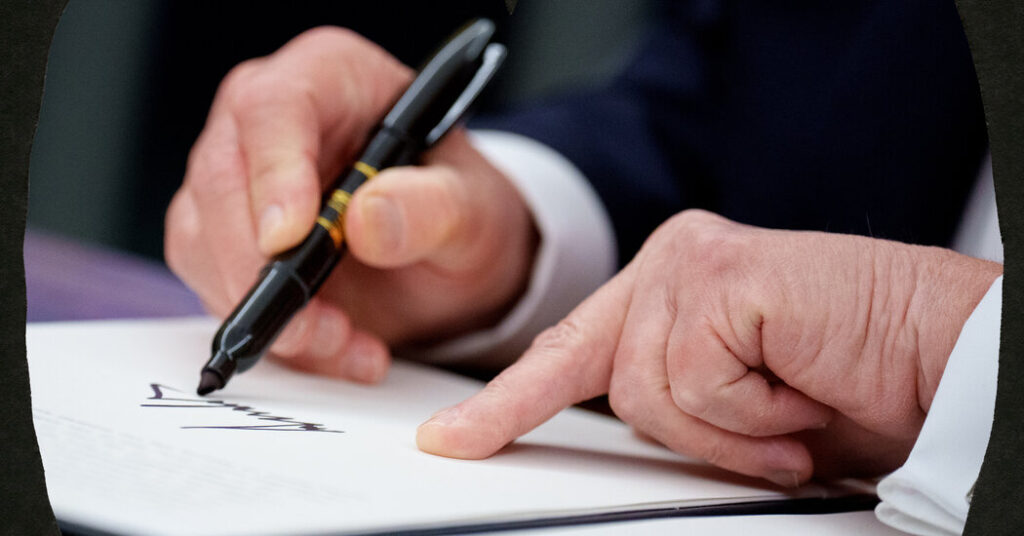
President Trump took pardon abuse to a new level this year with a string of dubious clemencies that together present a unique case study in how this unfettered executive power can be used to degrade, corrupt and politicize the justice system.
The president pardoned one of his supporters, Michele Fiore, a Nevada politician who was convicted of federal charges that she used money from a police memorial fund for personal expenses, including for plastic surgery. He pardoned another supporter, Scott Jenkins, a former sheriff in Virginia who took bribes in exchange for badges. He pardoned Todd and Julie Chrisley, reality TV personalities imprisoned for tax evasion and defrauding banks, whose daughter campaigned for Mr. Trump. He commuted the sentence of Imaad Zuberi, a major donor convicted of a host of crimes including illegal lobbying.
Mr. Trump’s clemencies certainly aren’t the first to raise eyebrows. Both Republican and Democratic presidents have, in certain instances, used their constitutional pardon power for questionable ends: George H.W. Bush pardoned officials embroiled in the Iran-contra scandal; Bill Clinton pardoned the billionaire fugitive Marc Rich; Joe Biden pardoned his son.
But for the most part, they relied on the Justice Department’s pardon attorney — a position I held for nearly three years — to evaluate clemency applications. Even when they acted against their pardon attorney’s advice, they typically did so with the benefit of thorough investigation and analysis prepared by a team of nonpolitical experts. Mr. Trump has flipped the table on the deliberative approach favored by his predecessors. The damage won’t easily be undone.
In my time as the pardon attorney, I led a team of approximately 40 lawyers and others whose sole job was to scrutinize applications for clemency. My tenure began during Mr. Biden’s administration and continued into the early weeks of Mr. Trump’s second term, but almost as soon as he took office, it became clear that my counsel was not wanted.
On Inauguration Day, I read the news that he had pardoned about 1,500 people accused of crimes in connection with the Jan. 6 Capitol riot. Though I had not been consulted, my staff and I were still expected to begin facilitating the releases of all those incarcerated. Over the next three days, 27 more pardons were granted, all without even a nod to the traditional role of the Justice Department in advising the president on pardons.
Ordinarily, pardon applications face an exacting initial review by the Office of the Pardon Attorney. Applying detailed guidelines laid out in the Justice Manual, staff members assess applicants’ past criminal conduct, evidence of atonement, remorse and steps toward rehabilitation, and the reasons that they are seeking a pardon. Cases that clear this initial step then move to the F.B.I., which conducts a full background investigation. Prosecutors, judges and victims are then given an opportunity to weigh in. In four years as president, Mr. Biden granted more than 4,000 commutations (full or partial reductions of sentences) but only 80 pardons.
In March, after being sidelined for weeks, I was dismissed. I was replaced by Ed Martin, an organizer in the Stop the Steal movement who has described his pardon priorities unambiguously: “No MAGA left behind.” On his watch, the traditional application review process has been neutered.
Mr. Trump pardoned Tim Leiweke, a developer accused of bid rigging, after playing a round of golf with one of his lawyers. He pardoned Juan Orlando Hernández, the former president of Honduras and a convicted drug trafficker, who’d written Mr. Trump a letter casting himself as a victim of “political persecution.” And he pardoned Paul Walczak, a former nursing home executive who had pleaded guilty to tax crimes, after his mother attended a Mar-a-Lago dinner.
After pardoning Changpeng Zhao, the billionaire founder of the cryptocurrency exchange Binance convicted of money laundering violations, Mr. Trump told an interviewer, “I don’t know who he is.”
Ignoring a careful, merit-based review of clemency applicants is a dangerous proposition. We have already seen alarming cases of recidivism among the Jan. 6 defendants pardoned on Mr. Trump’s first day in office. Some have been charged with or convicted of offenses involving sexual exploitation of children, threats against public officials, and even a plot to kill federal employees. Several clemency recipients from Mr. Trump’s first term in office — when vetting was similarly casual — have also returned to prison. They include at least two recidivist fraudsters, as well as a drug trafficker subsequently accused of violent assaults.
But instead of forcefully confronting the corrosive effects of Mr. Trump’s reckless pardoning, congressional Republicans have chosen to focus on investigating the pardons issued by his predecessor.
Mr. Biden diminished the legitimacy of the pardon power at the end of his presidency when he issued a slew of last-minute, pre-emptive pardons to family members and allies. Those pardons, like Mr. Trump’s, bypassed ordinary channels of review; in those cases, my office was not consulted.
After pardoning his son, Hunter Biden, Mr. Biden pardoned five other members of his family, none of whom had any obvious criminal exposure. Those pardons sent at least two very damaging messages: First, that the pardon power is the president’s to use for personal gain. Second, that the justice system cannot be relied on to adjudicate cases fairly and dispose of those prosecutions that lack merit. His pre-emptive pardons also proved to be an irresistible enticement to one-upmanship, inviting Mr. Trump to test new and bigger ways to push the limits of the pardon power.
Mr. Biden’s late-term pardons leave an unfortunate legacy. But no cleareyed American could conclude that they justify the current administration’s abuse of this power. Both quantitatively and qualitatively, what Mr. Trump is doing with pardons is far more damaging to the American ideal of delivering justice evenhandedly.
A century ago, the Supreme Court reaffirmed the president’s vast discretion to grant pardons, explaining, “Executive clemency exists to afford relief from undue harshness or evident mistake in the operation or enforcement of the criminal law.” But, the court noted, “our Constitution confers this discretion on the highest officer in the nation in confidence that he will not abuse it.” Evidently, its framers were lacking in imagination, as we are now well past the point of abuse.
Our elected representatives are doing us no favors when they proceed as if what we are witnessing is typical or acceptable. Americans deserve an impartial assessment of all the misuses of the pardon power that we have seen from presidents of both parties. This isn’t — shouldn’t be, at least — a partisan concern. It is an issue that should alarm anyone who cares to live in a safe, fair and free country.
Liz Oyer writes about the rule of law in her newsletter Lawyer Oyer.
The Times is committed to publishing a diversity of letters to the editor. We’d like to hear what you think about this or any of our articles. Here are some tips. And here’s our email: [email protected].
Follow the New York Times Opinion section on Facebook, Instagram, TikTok, Bluesky, WhatsApp and Threads.
The post The Unpardonable Year in Presidential Pardons appeared first on New York Times.


