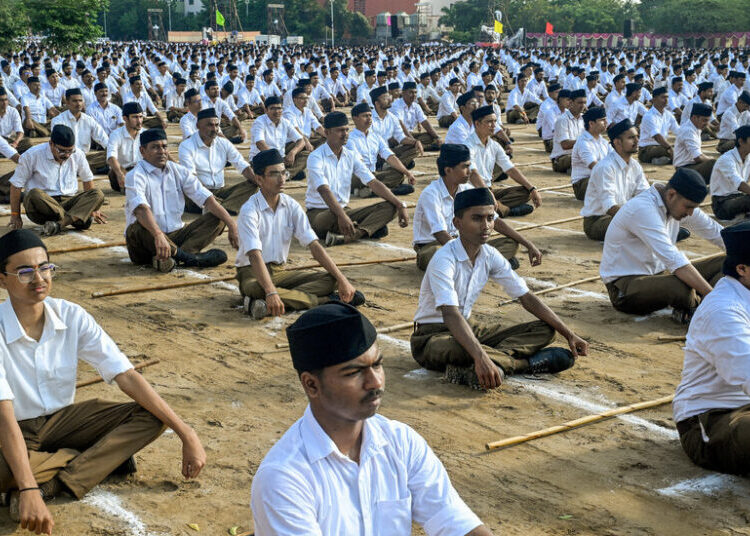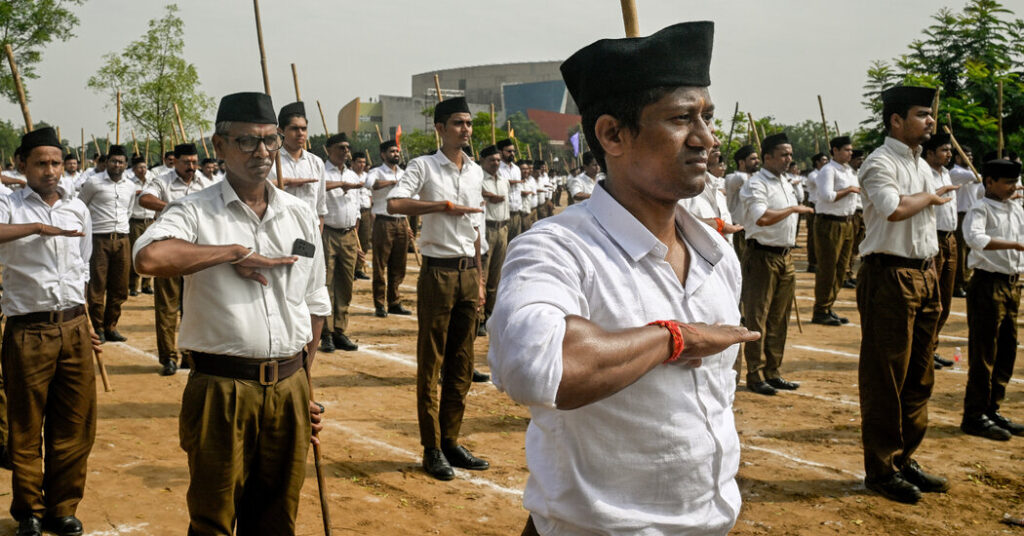
The Hindu right’s vision of a muscular, Hindu-first India was once a far-off dream. But it has now largely become mainstream in the vastly diverse country of 1.4 billion people, as the secular identity of the republic has been greatly transformed over the past decade under Prime Minister Narendra Modi.
The biggest force behind this transformation is a giant organization called the Rashtriya Swayamsevak Sangh, which is marking its centenary this year. It is commonly referred to as the R.S.S.
Through its own organizing, and through a large number of affiliated groups it uses for influence — including Mr. Modi’s ruling Bharatiya Janata Party — it appears in every walk of life, from politics to culture and education. Through them, it is tightening its grip over the future of India.
Here are the key moments in its 100-year rise.
1925: A Hindu Doctor’s Dream
A century ago, just as India’s movement for independence from British colonial rule was gaining momentum, a group of Hindu nationalist ideologues were focused on what they considered a deeper issue — the societal impact of invasive Muslim rulers over previous centuries.
Many among the Indian independence movement had a conservative streak and were uncomfortable with the pluralist vision that leaders like Mohandas K. Gandhi envisioned. Keshav Baliram Hedgewar, a medical doctor, wanted to train a force that worked from the bottom up to organize Hindu society. He started the R.S.S. in the city of Nagpur, and its core organizing principle has remained the same ever since even: tightly knit community groups that come together for morning exercise and lessons of inspiration from Hindu history and mythology, training a sort of boy-scouts-for-life force.
1948: Gandhi’s Assassination
When the departing British partitioned India into two countries, cleaving a large part of it as the new nation of Pakistan for Muslims, the Hindu right was seething. Not only was India’s territory given away, but also what was left was shaped as a secular republic rather than as a Hindu state as they wished.
The target of that anger became Gandhi, who urged restraint and harmony in a moment of intense bloodletting between Hindus and Muslims. Many in the Hindu right saw Gandhi as a traitor who was being overly generous to Muslims. Nathuram Vinayak Godse, a Hindu fanatic, assassinated Gandhi during a prayer meeting, shooting him from a close range.
The R.S.S. tried to distance itself from Mr. Godse, saying he had left the organization before the assassination. But the Indian government clamped down nonetheless, banning the R.S.S. for over a year.
1975: A Crackdown Backfires
In 1975, Prime Minister Indira Gandhi suspended democracy and declared a state of emergency in India as she was about to lose power following questions of irregularities in the election for her parliamentary seat. Mrs. Gandhi arrested opponents and activists en masse and censored the media.
The R.S.S., many of whose leaders were hounded in the crackdown, used the broader fight to restore democracy to shed much of the lingering stigma from the assassination, which Gandhi supporters had fanned.. When Mrs. Gandhi, whose father was close to the slain independence leader, was ousted in 1977, members of the R.S.S.’s political wing became cabinet ministers in the coalition government.
1992: From Mosque to Temple
The R.S.S.’s political wing, the B.J.P., as well as many other affiliates, rallied around a controversy over a mosque to turn the grievances of Hindus into a central pillar of Indian politics beginning in the 1980s.
The Hindu right had long argued that the 16th-century Babri mosque in the north Indian town of Ayodhya had been built on the site of a demolished temple to the Hindu deity Ram. As the dispute made its way through India’s snail-paced judiciary, the R.S.S. turned it into a political platform for mobilizing Hindus and uniting them as a voting bloc for the B.J.P. The party’s president, L.K. Advani, crisscrossed the country on a truck decked out as an ancient chariot, rallying support to demolish the mosque and replace it with a temple.
When mobs of Hindu vigilantes climbed the mosque’s domes in 1992 and razed it to the ground, it ushered in a new era of Indian politics — where the will of majority was the main currency. The political fortunes of the R.S.S. began to soar.
2014: Victory With Modi
The election of Narendra Modi as prime minister in 2014 began an era of peak power for the Hindu right, which has seen many of its wishes finally become reality.
While the R.S.S. had tasted power before — its campaigner Atal Bihari Vajpayee became prime minister in the 1990s — its influence was limited. Mr. Vajpayee was pragmatic and led a coalition government of varying ideologies.
Mr. Modi built an image that combined Hindu strongman with modern state leader. During his decade as prime minister, the lavish temple to the deity Ram was built in Ayodhya. His government implemented another longtime R.S.S. goal by ending the semi-autonomy of India’s only Muslim-majority state, Jammu and Kashmir.
The ruling party has also normalized religious polarization, increasingly treating the country’s religious minorities as second-class citizens.
Mujib Mashal is the South Asia bureau chief for The Times, helping to lead coverage of India and the diverse region around it, including Bangladesh, Sri Lanka, Nepal and Bhutan.
The post 5 Key Moments in the Rise of India’s Hindu-First Powerhouse appeared first on New York Times.