In Prime Minister Narendra Modi’s most important speech of the year, his annual Independence Day address in August, he used the stage to honor the group that changed his life and is remaking India.
That it was Mr. Modi’s most forceful and public nod in his 11 years in office to the Rashtriya Swayamsevak Sangh — the far-right Hindu nationalist group known as the R.S.S., which had molded his personal and professional life since he was a young boy — was a reflection of what a king-making power the group has become as it celebrated its 100th anniversary this year.
The R.S.S. originated as a shadowy cabal for the revival of Hindu pride after a long history of Muslim invasions and colonial rule in India, its early leaders openly drawing inspiration from the nationalist formula of Fascist parties in Europe during the 1930s and 1940s. It has survived repeated bans, including being accused in the assassination of Gandhi, to grow into the largest right-wing juggernaut in the world.
More than a decade of Mr. Modi, one of their most ambitious and capable recruits, at the helm of national power has brought the organization the kind of success and acceptability that many of its leaders say they never dared imagine. While there have at times been tensions with the strongman premier, the R.S.S. is closing in on its dream to rebuild India’s secular republic as a muscular, Hindu-first nation.
The R.S.S. has infiltrated and co-opted India’s institutions to such a degree that its deep roots will ensure it remains a powerful force long after Mr. Modi is gone. It reaches inside India’s society, government, courts, police, media and academic institutions through a vast umbrella of affiliated groups, placing core members into all of them. It makes and breaks political careers. It commands loyalty across the nation by offering young men a path to relevance and influence in their communities through Hindu-nationalist activism
Though the R.S.S. still cultivates an air as a secret society, it has been proudly more public in recent years. Its members and its influence are everywhere.
When you see Mr. Modi’s Bharatiya Janata Party dominate critical elections, you are seeing the R.S.S.’s political machine at work, with the central group shaping the fates and fortunes of the party’s candidates. And when you see Hindu vigilantes parading through Muslim neighborhoods or ransacking churches, you are seeing the R.S.S. affiliates exercising their vision of supremacy.
The group’s political dominance has divided India, a country of 1.4 billion people, along religious fault lines more than ever. Its philosophy casts India’s 200 million Muslims and Christians as descendants of foreign invaders who need to be put in their place.
Mr. Modi, who was deputized to the R.S.S.’s political wing in the 1980s after he made a name for himself as an organizer, has described the organization as a giant river, with dozens of streams flowing from it that touch every aspect of life in India. He has lauded it for championing traditional values through difficult times when Indian society has been in flux.
“Service, dedication, organization, and unmatched discipline — these have been its hallmarks,” he said in his rain-soaked Independence Day address at the Red Fort.
On its surface, the R.S.S. is a vast social services organization. The movement’s organizing principles are built around neighborhood groups, training tightly knit classes of boy-scouts-for-life through exercise classes and spiritual reflection. This is the R.S.S.’s recruiting pool, and its enforcement squad for reshaping the societal fabric. It is also where the organization systematically builds its influence in every walk of life.
Besides Mr. Modi’s B.J.P. — which describes itself as the world’s largest political party, with more than 100 million members — the group’s many arms include a large student wing, trade unions, farmers unions, networks of professionals, religious outfits and charity organizations. The affiliates, which hold regular coordinating meetings, push the R.S.S.’s Hindu agenda to amass political heft as the surest bet for irreversibly entrenching their vision of India.
“If we have power, everything will fall in line,” said Durga Nand Jha, an academic who is a longtime R.S.S. associate and leads a think tank affiliated with the organization.
Yet, shaped by past crackdowns over pursuing a society at odds with the founding secular outlook, the organization that commands enormous sway over the world’s most populous nation does so with little transparency or accountability. It operates without maintaining detailed records. It has accumulated vast riches that are spread through a multitude of small, independent outfits and trusts.
“Nothing is owned by the R.S.S.,” said Dr. Nishith Bhandarkar, a leader of the organization in India’s sprawling financial capital of Mumbai. “We just have the people.”
To understand the organization, The New York Times spoke to the group’s leaders, attended its conclaves and met grass-roots units to report this account of its rise and what it wants for India’s future.
The R.S.S.’s leaders have taken a nuanced public stance in recent years, presenting a more inclusive idea of majoritarian rule for the country. But on the streets that nuance is often lost. A new generation of more extreme right-wing leaders compete for attention, their rhetoric amplified by social media, often normalizing violence against minorities.
Vigilantes who proudly identify as members of R.S.S. affiliates police public life along religious lines, frequently enforcing economic boycotts of Muslim businesses. They have turned Hindu celebrations into public shows of force. They have ransacked churches over accusations of forced conversions to Christianity, rampaged through Christmas celebrations, and dug up Muslim graves. They have dragged couples from trains on suspicion of interreligious relationships, and lynched men on allegations of carrying beef, which many Hindus do not eat, as they consider cows sacred.
Its ideas deeply permeate India, from the pages of history textbooks to WhatsApp chat groups, screaming television debates, and even in the country’s courtrooms — long seen as protectors of India’s secularism.
Last December, one of the R.S.S.’s most hard-line affiliate groups held a seminar on the campus of Allahabad High Court, one of the country’s largest and oldest courts. In his keynote address, Justice Shekhar Kumar Yadav said that Hindu society had fixed its shortcomings while listing everything he saw as wrong with “these people,” a subtle reference later made clear when he used a derogatory term to describe Muslims.
“I feel no hesitation in saying that this is India and it will run as per the wishes of its majority,” the judge said.
Building Blocks
Early one August morning in Mumbai, about a dozen men trickled into a local park in the dark, braving the rain. Among them were property dealers, advertising agents and a retired navy officer. Their time in the R.S.S. ranged from five to 55 years.
Each paid their respects to a small saffron flag, then nodded to the leader of the group and joined a circle where they sang devotional songs. A drill sergeant blew his whistle, leading them through stretching exercises performed with a well-oiled, military urgency despite their aging steps, and a standing march.
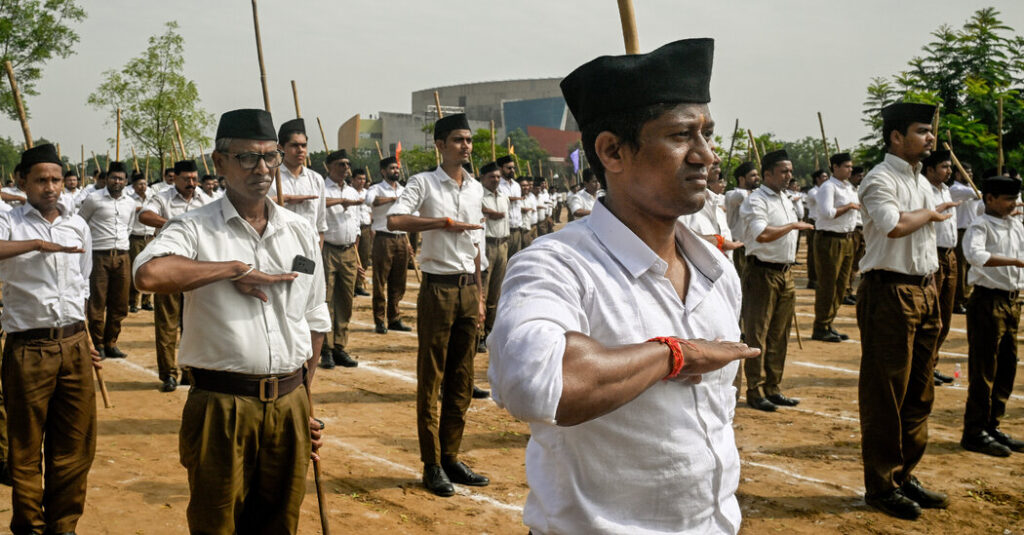
The morning ended, as it does every morning, with the same salutation: the men standing in neat lines, extending their right arms in front of their chests with their palms facing down, bowing their heads to the saffron flag.
These meetings of R.S.S. cells, known as shakhas, have been the organization’s building blocks since its founding by a medical doctor in 1925.
As India struggled for independence from British rule, a group of right-wing ideologues saw a deeper, bigger fight: to revive Hindus after the Muslim invasions of centuries past had broken their spirit and opened the path to other colonial powers. The R.S.S. pursued a bottom-up approach to reorganizing society.
There are now 83,000 shakhas spread across the country, each linked from the neighborhood level to the national through WhatsApp groups. They remain the central pillar of molding the kind of men the R.S.S. wants as the warriors of its vision for India. They build habits and instill ideology through simple daily repetition by leaning into something fundamental — a basic human need for community and camaraderie.
It is in these shakhas that the R.S.S. closely watches for potential and recruits its leaders. (Mr. Modi had started attending as a young boy, before becoming a full-time R.S.S. campaigner in his youth.) These recruits then seed a litany of affiliated organizations that make up the R.S.S.’s vast network.
Researchers at Sciences Po in Paris who studied the R.S.S. have described its mode of operation as “a deliberate process of spawning new organizations to expand the network, while ensuring they remain tied to a central executive.” The researchers found 2,500 organizations with “concrete, traceable, material ties” that make them “tightly networked parts of a single entity.”
“For the past 100 years, our volunteers have consistently sustained this system in all kinds of circumstances,” Mohan Bhagwat, the R.S.S.’s sixth and current chief, said in a recent lecture. His role is at times compared to that of the Roman Catholic pope.
The R.S.S.’s early leaders defined their fight in no uncertain terms: India was to have an exclusively Hindu identity.
In a book published in 1939, M.S. Golwalkar, the group’s second and longest-serving chief, drew on the example of Hitler’s purging of the Jews in Germany to say it was not possible for races and cultures to be assimilated into one united whole.
The only way non-Hindus could remain in India, Mr. Golwalkar argued, was if they “wholly subordinated to the Hindu Nation, claiming nothing, deserving no privileges, far less any preferential treatment — not even citizen’s rights.”
But the conservative streak within India’s independence movement was initially overpowered by a liberal elite that held on to a pluralist vision of India, led by Gandhi, who went on hunger strike to protest religious violence.
After a swath of the country was cleaved off to create the nation of Pakistan for Muslims when the British left in 1947, the Hindu right was furious that the new Indian state had not been given a similarly outright religious identity. The target of their fury was Gandhi, who was later shot dead at an evening public prayer.
The shooter was a right-wing Hindu activist with ties to the R.S.S., which distanced itself by saying he had quit years earlier. Still, the organization was banned and became a pariah for decades.
India’s imagining as a secular republic was a top-down, idealistic project that left unaddressed the open wounds and humiliations of Muslim invasions and colonial rule. It was a fundamental grievance that the R.S.S. tapped into as fuel for expansion.
It began to inch into politics by launching a political wing in the 1950s that later recast itself as today’s ruling B.J.P. It got it’s first big break in 1970s, and it kept building.
Rise to Power
When Indira Gandhi, India’s then prime minister and leader of the Congress party, suspended India’s democracy in 1975 to stay in power after a court had disqualified her election victory, her government’s persecution of the R.S.S. and other groups created a wave of sympathy for them. R.S.S. leaders were arrested in droves, and they began casting themselves as pillars of the effort to save Indian democracy.
“My mother voted for Congress, but my father was with the R.S.S.” S.M. Baghadka, 84, a retired government worker and longtime R.S.S. member, said during a morning exercise session in Nagpur. “After Indira jailed my father, my mother also changed sides.”
A campaign over a contested religious site in the 1990s gave the R.S.S. its second big break and forever changed the course of Indian politics.
A 16th-century mosque in the town of Ayodhya had become a symbolic target of the group, which claimed it had been built on land where a Hindu temple to the deity Ram once stood. The dispute had meandered through India’s judiciary, but the Hindu right had other ideas.
The president of the B.J.P. crisscrossed the country in a truck decked out as a chariot, stirring deadly local tensions as his caravan moved. The movement’s bigger goal was to unite Hinduism’s vast diversity in a way similar to the invading monoliths, R.S.S. leaders said. “Jai shri ram,” or hail to the Lord Ram, became its battle cry.
The buildup culminated in 1992 when mobs that included known R.S.S. affiliates — armed with rods, pickaxes and burning rage — climbed the mosque’s domes and tore it down.
The R.S.S. was banned again. But the formula has remained central to its success ever since: uniting Hindus around grievances from the past and injecting a militant sense of score-settling, right down to the local level, that treats India’s Muslim and Christian citizens as remnants of that past.
The group first tasted significant power in the late 1990s as part of a coalition government.
But it wasn’t until Mr. Modi became prime minister in 2014, with a clear majority, that its agenda was rolled out in earnest.
Mr. Modi moved swiftly to build a lavish Ram temple at Ayodhya after the Supreme Court essentially gave a pass to the mob demolition of the mosque. He also did away with the longtime semi-autonomy of the Muslim-majority state of Jammu and Kashmir to bring it under New Delhi’s direct control.
The R.S.S.’s community presence around the country also doubled over the past decade. Its leaders enjoy the freedoms, and luxuries, that come with unchecked power. They opened a lavish campus in New Delhi, consisting of three 13-floor towers built across 3.7 acres. Mr. Bhagwat travels with a security entourage close to the size of Mr. Modi’s.
“The society listens to us,” Mr. Bhagwat said.
It hasn’t all been smooth. Some R.S.S. leaders feel Mr. Modi has grown so powerful that he overshadows the organization’s culture of community. They say Mr. Bhagwat has had to find subtle ways, especially in areas like education and culture that are a prime focus for the R.S.S., to work with Mr. Modi’s penchant for doing everything in his name and his image.
Publicly, Mr. Bhagwat has pushed back against reports of quarrels between the mother ship and its political arm.
“There is struggle,” he said. “But not quarrel.”
For the R.S.S.’s vast networks, Mr. Modi’s symbolic value is immense, connecting their daily work to the height of power.
Alhad Sadachar, 49, a human resources consultant who has been an R.S.S. volunteer in Nagpur since childhood, said Mr. Modi “has come from this ground level, so he understands better.”
“Every House, Every Street”
As the R.S.S.’s centenary celebrations got underway in October, there was no sign of any past stigma.
Television channels ran wall to wall coverage. Powerful politicians stood for the R.S.S.’s trademark salute, wearing the uniform of brown pants, white shirt and black cap. Congratulatory messages poured in from Bollywood celebrities to the Dalai Lama.
In Nagpur, where the R. S. S was founded and is headquartered, Mr. Bhagwat watched thousands of uniformed volunteers perform drills, songs, and yoga poses before a crowd of about 10,000, including dozens of foreign diplomats.
When the chief ideologue got up for a culminating speech, his vision was clear: The R.S.S. must expand until it covers “every house, every street.”
But, like many speeches of R.S.S. leaders, the mission was muddied by double speak and the contradictions between what he says and how his affiliates rule on the ground.
The mustachioed chief is credited with moving the needle on issues the R.S.S. has been slow on, including trying to reduce the hold of India’s rigid caste system to create an “exploitation free” society. He has criticized vigilantes and said the R.S.S. did not support the dismantling of mosques and building of temples (besides the one in Ayodhya.)
But he added: The R.S.S. will not object to members participating in such movements in their own capacity.
The R.S.S.’s ultimate goal is the creation of a “Hindu rashtra,” an all-encompassing system that is often simplified as turning India’s secular republic into a Hindu state. Mr. Bhagwat said that the term had been misunderstood — that what they really mean is the consolidation of the Hindu nation. Their definition is a cultural one, and they consider everyone living in India as Hindu, he said.
But throughout his recent talks Mr. Bhagwat has also referred to “other communities,” a euphemism for religious minorities. At one point, he recommended having three children because the Hindu birthrate is declining faster than “other communities.”
In the centenary speech in Nagpur, he spoke of embracing those who follow religions that came with the foreigners and called for “harmonious and respectful” treatment of their places of worship. He discouraged “engaging in hooliganism” and incitement of violence.
Then, as he often does, he left the door ajar.
“However, the good people of the society and the younger generation also needs to be vigilant and organized,” he said. “They will also have to intervene if necessary.”
To see how this kind of gray doublespeak plays out, look to India’s largest state of Uttar Pradesh, with over 200 million people. The state’s powerful B.J.P. chief minister, Yogi Adityanath is often spoken of as a potential successor for Mr. Modi.
Mr. Adityanath frequently attends large Hindu events and rides helicopters to shower flowers on processions of Hindu pilgrims. But when his state’s police clamp down on public displays of religiosity by Muslims, he has justified it by saying India is a secular state and that Muslims should practice their religion in private.
“Faith is not something to be displayed at roundabouts,” Mr. Adityanath, a trained Hindu monk who carries out his duties in a saffron robe, said.
As Mr. Adityanath was lauding the R.S.S. for its centenary, swaths of his state had been on the boil for days and his government had shut the internet.
Tensions flared after police arrested a man who had displayed a large sign of “I  Muhammad” on the birthday of Islam’s prophet. When Muslims held large protests to express outrage at the arrest, Mr. Adityanath unleashed more police, who used clubs to break up rallies, arrested dozens and brought criminal charges against more than 1,000 people.
His authorities brought in bulldozers to demolish the homes of the protest leaders, an act that has earned him the nickname “Bulldozer Baba.”
There was no similar show of police force when his Hindu supporters took to the streets in large numbers, in an equally religiously charged demonstration of support for his clampdown. They carried signs that declared “I Mahadev,” in reference to a Hindu deity, but also “I Yogi” and “I Bulldozer.”
Suhasini Raj contributed reporting from Bengaluru and Pragati K.B. from New Delhi.
Mujib Mashal is the South Asia bureau chief for The Times, helping to lead coverage of India and the diverse region around it, including Bangladesh, Sri Lanka, Nepal and Bhutan.
The post From Pariah to Power: The Hindu Right’s 100-Year Quest to Reshape India appeared first on New York Times.