When she hears explosions, Tetiana Rybak does the only thing she can: She lies in her bed and waits. Ms. Rybak cannot walk, cannot go to the shelter. Recently, she asked a social worker to tape over the windows of her apartment with festive red gift wrap, old military posters and a version of the Lord’s Prayer.
That way, she no longer has to see the Russian drones flying past.
For the past two weeks, Russia has focused its military might on pounding her hometown, Odesa, the largest port in Ukraine, repeatedly hitting it with drones and missiles in the city’s worst shelling through almost four years of war.
Ms. Rybak has not had electricity for at least nine days this month. For four of those, she had no heat and no water. A social worker needed to lug bottles of water to her up seven flights of stairs. Ms. Rybak, who has been disabled for years, dressed in two pairs of socks, two pairs of warm pants, a sweater and a thick terry-cloth bathrobe. She then slid under two blankets.
“Psychologically, no one can withstand this anymore,” said Ms. Rybak, 64, sitting in her bed during a recent visit with social workers. “My nervous system is completely shattered. Just last night, when the power went out and the shelling started — the air raid sirens — it was terrifyingly loud. But even more frightening was the blast wave. My doors and windows were shaking — thud, thud, thud — and I was lying there, unable to run anywhere, with nowhere to go.”
Ukrainians speculate that Moscow has been attacking Odesa, perched on the Black Sea, in retaliation for Ukraine’s recent attacks on the “shadow fleet” that Russia uses to transport its oil and evade sanctions. While major Ukrainian cities commonly experience bursts of intense Russian bombardment followed by quieter periods, Odesa has been under nearly constant attack since the early morning hours of Dec. 12. Russia has mostly targeted the city’s ports and its power infrastructure. At least nine people have been killed.
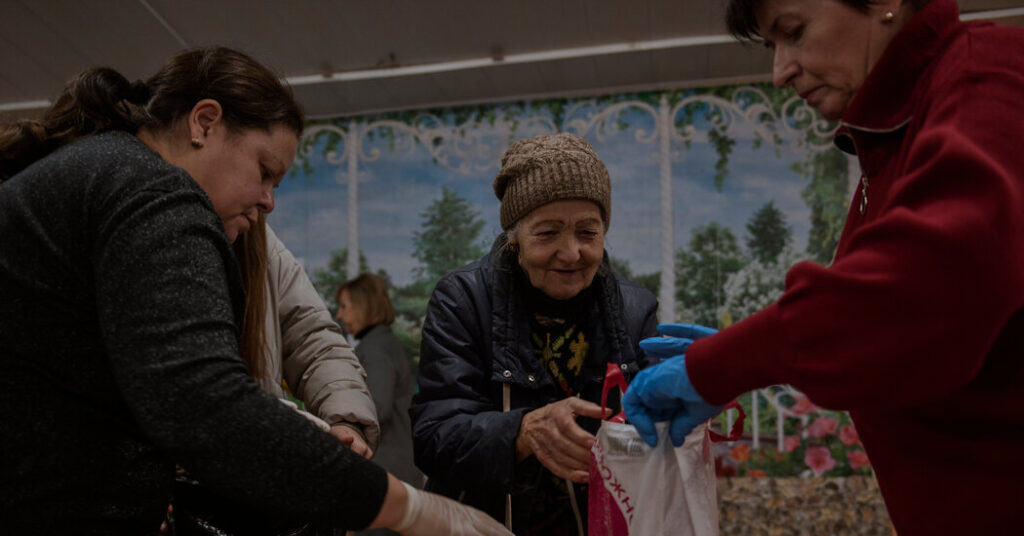
With electricity, gas and water out for days at a time, residents resort to charging their phones and computers at government relief centers or grocery stores, and to cooking their meals on makeshift stoves outside. They put plastic bags of milk, eggs and sour cream on windowsills to keep them cold. Some have set up large generators in yards so neighbors can get power.
One man attached clamps to his car battery and strung the cord to his apartment to power his refrigerator and his washing machine. One couple documented their date at a seafood restaurant to the pop-pop-pop soundtrack of air defense rifles targeting Russian drones. Dozens of Tesla drivers waited for hours at the only charging point that still worked.
Ever since Russian troops invaded in February 2022, Ukrainians have rallied. Their resilience has been so celebrated that it’s almost a cliché. Oleksii Kolodchuk, 83, said the power and heat outages were not a big deal for him. His biggest regret: He forgot to put his borscht outside in the cold, and it went sour well before it should have.
He also said he wished he could give a message to President Vladimir V. Putin of Russia.
“Sometimes I think, if I could go up to Putin with a stick, I’d give him a good knock on the head — maybe it would knock some sense into him, because clearly something is very wrong there,” Mr. Kolodchuk said.
.css-1mxer6r{max-width:600px;width:calc(100% – 40px);margin:1.5rem auto 1.75rem;height:auto;margin-left:auto;margin-right:auto;font-family:nyt-franklin;color:var(–color-content-secondary,#363636);border-top:1px solid var(–color-stroke-quaternary,#DFDFDF);border-bottom:1px solid var(–color-stroke-quaternary,#DFDFDF);padding-top:20px;padding-bottom:20px;}@media only screen and (min-width:1024px){.css-1mxer6r{width:600px;}}.css-1medn6k{font-family:nyt-franklin,helvetica,arial,sans-serif;font-weight:500;font-size:1.0625rem;line-height:1.5rem;}@media only screen and (max-width:480px){.css-1medn6k{font-size:1rem;line-height:1.375rem;}}.css-1f84s5v{font-weight:700;font-size:1.0625rem;}@media only screen and (max-width:480px){.css-1f84s5v{font-size:1rem;}}.css-1f84s5v a{color:var(–color-signal-editorial,#326891);-webkit-text-decoration:underline;text-decoration:underline;}.css-1f84s5v a:hover{-webkit-text-decoration:none;text-decoration:none;}.css-1hvpcve{font-size:17px;font-weight:300;line-height:25px;}.css-1hvpcve em{font-style:italic;}.css-1hvpcve strong{font-weight:bold;}.css-1hvpcve a{font-weight:500;color:var(–color-content-secondary,#363636);}.css-214jt4{margin-top:15px;margin-bottom:9px;}@media only screen and (max-width:480px){.css-214jt4{font-size:14px;margin-top:15px;margin-bottom:10px;}}.css-214jt4 a{color:var(–color-signal-editorial,#326891);-webkit-text-decoration:underline;text-decoration:underline;font-weight:500;font-size:16px;}@media only screen and (max-width:480px){.css-214jt4 a{font-size:13px;}}.css-214jt4 a:hover{-webkit-text-decoration:none;text-decoration:none;}.css-1mxer6r{max-width:600px;width:calc(100% – 40px);margin:1.5rem auto 1.75rem;height:auto;margin-left:auto;margin-right:auto;font-family:nyt-franklin;color:var(–color-content-secondary,#363636);border-top:1px solid var(–color-stroke-quaternary,#DFDFDF);border-bottom:1px solid var(–color-stroke-quaternary,#DFDFDF);padding-top:20px;padding-bottom:20px;}@media only screen and (min-width:1024px){.css-1mxer6r{width:600px;}}.css-1medn6k{font-family:nyt-franklin,helvetica,arial,sans-serif;font-weight:500;font-size:1.0625rem;line-height:1.5rem;}@media only screen and (max-width:480px){.css-1medn6k{font-size:1rem;line-height:1.375rem;}}.css-1f84s5v{font-weight:700;font-size:1.0625rem;}@media only screen and (max-width:480px){.css-1f84s5v{font-size:1rem;}}.css-1f84s5v a{color:var(–color-signal-editorial,#326891);-webkit-text-decoration:underline;text-decoration:underline;}.css-1f84s5v a:hover{-webkit-text-decoration:none;text-decoration:none;}.css-1hvpcve{font-size:17px;font-weight:300;line-height:25px;}.css-1hvpcve em{font-style:italic;}.css-1hvpcve strong{font-weight:bold;}.css-1hvpcve a{font-weight:500;color:var(–color-content-secondary,#363636);}.css-214jt4{margin-top:15px;margin-bottom:9px;}@media only screen and (max-width:480px){.css-214jt4{font-size:14px;margin-top:15px;margin-bottom:10px;}}.css-214jt4 a{color:var(–color-signal-editorial,#326891);-webkit-text-decoration:underline;text-decoration:underline;font-weight:500;font-size:16px;}@media only screen and (max-width:480px){.css-214jt4 a{font-size:13px;}}.css-214jt4 a:hover{-webkit-text-decoration:none;text-decoration:none;}
Got a confidential news tip? The New York Times would like to hear from readers who want to share messages and materials with our journalists.
See how to send a secure message at nytimes.com/tips
But after almost a week without power, some Odesa residents were running out of patience. They staged a protest. For some older people, dealing with these hardships just before Christmas and New Year’s made optimism hard to find.
The only thing that brings joy to Valentyna Avdiienko, 72, is her 3-year-old grandson, Denys. He is a cheerful chatterbox no matter what happens. Whenever the air raid alerts go off, he shouts, “Ballistics, ballistics,” mimicking what he’s heard adults say.
Recently, she limped down the street in the dark toward her home, balancing on a cane in her left hand and a small shopping cart in her right.
“I just want this madness to end,” she said. “We are so tired. When will this finally be over?”
For older people who remember life under the Soviet Union, this war is even more galling, pitting Ukrainians against the Russians they once considered brothers.
For 25 years, Mahadan Farkhiiev, 73, served in the Soviet Army with both Ukrainians and Russians. He fought in Afghanistan, where he was shot in his lower right leg. He keeps a photo of himself in uniform, his chest covered in Soviet medals, on a desk in his living room. But he no longer speaks to his brother or sister, who live in Russia.
Olha Demydova, 43, a social worker with Culture of Democracy, a Ukrainian charity, visited Mr. Farkhiiev recently to see what his family needed. He sat on his couch with his wife, Anastasiia, and their son, Andrii, who is 42 and has cerebral palsy. He cannot talk or walk. He can swallow only mashed-up food. His parents must change his diapers about four times a day.
When the shelling is bad, Mr. Farkhiiev and his wife put Andrii in a commode chair with wheels and move into the hallway. Then their son clenches his hands into fists and scrunches up his eyes until the explosions are over.
“Because God forbid — where would we run with him?” Mr. Farkhiiev asked.
Ms. Demydova said that much of her job recently had been cheering up clients like Mr. Farkhiiev. Sometimes it’s enough to just show up and ask them about their lives when they were younger.
“When there is no electricity, no heating, no water, a kind of apathy sets in,” she said. “You think, that’s it, it’s the end. And then you realize — no. Absolutely not. You cannot give up. You have to keep going. You have to live through this. To endure it. It will get better.”
For Ms. Rybak, the woman confined to her bed in her seventh-floor apartment, this was not the way things were supposed to go for her. She once cared for vulnerable people as a social worker herself, and once thought she was prepared for anything that could go wrong.
But after having been disabled for years, she lost much of the use of her legs in 2023 after a difficult kidney surgery.
She always thought her three sons — the oldest is 45, the twins 35 — and her daughter could help in her old age. She rarely sees her three sons, however. They are all fighting on the front lines. And last year, Ms. Rybak’s daughter fled Ukraine, because the stress had gotten to be too much.
Ms. Rybak used to be able to sleep during air raid alarms, but she no longer can. The alarms sometimes last as long as 10 hours.
“All I want now is some kind of peace, even a small measure of it,” she said. “My health is simply collapsing. It feels like my strength is down to zero. There is no strength left.”
Alla Didur contributed reporting.
Kim Barker is a Times reporter writing in-depth stories about the war in Ukraine.
The post No Power, No Heat, No Water: Odesa’s Days of Hell Under Russian Fire appeared first on New York Times.