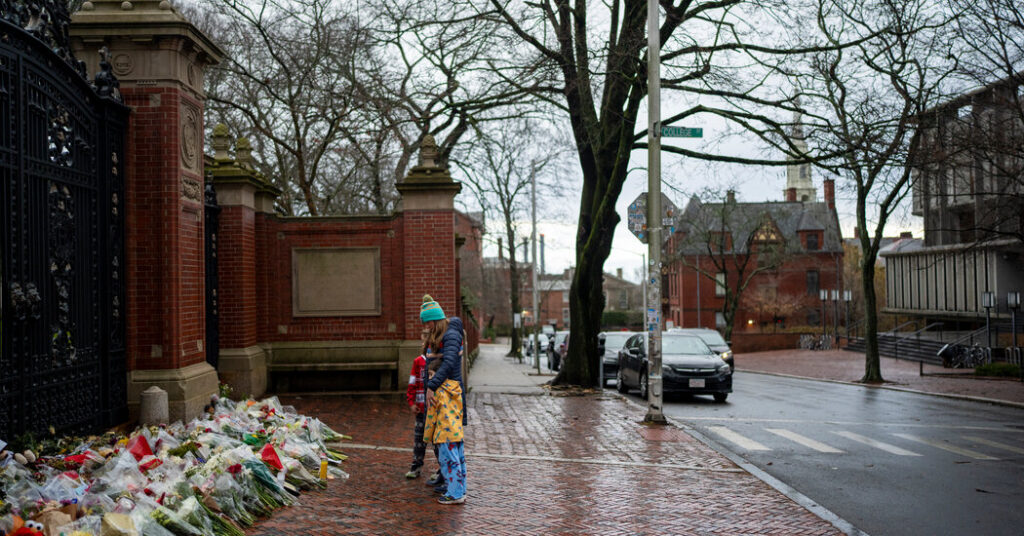
Rumors flew in the hours after a shooting at Brown University killed two students on Dec. 13. One falsehood had it that one of the victims, a leader of the college Republican Club, was “targeted for her conservative beliefs, hunted, and killed in cold blood.”
Another was that it had been a terrorist attack, a claim that made the rounds when a Palestinian student was identified as a possible suspect two days later and hounded on the internet.
A churn of disinformation after a major news event is hardly a surprise anymore, but its spread after the Brown killings was not limited to the dark fringes of the internet. It was fueled by prominent figures in business and government whose false statements or politically charged innuendo compounded public anger and anxiety.
That has raised new alarms about the nature and quality of public discourse — and whether there is any consequence for those who degrade it or for the social media platforms that reward it.
Renee DiResta, an associate research professor at Georgetown University, referred to the attacks on the falsely accused student as “an internet witch hunt,” where the rumor mill intersected with a political propaganda machine.
“Political leaders, statesmen, who once served as a firebreak against baser instincts increasingly see an opportunity to look receptive to the base — so they add kindling instead,” she wrote in a newsletter on Substack on Tuesday.
Those who spread rumors about the motives behind the shooting included at least two members of Congress, Senator Tommy Tuberville of Alabama and Representative Anna Paulina Luna of Florida, both Republicans. The assistant attorney general for civil rights at the Justice Department, Harmeet Dhillon, called the falsely accused student’s political activism “concerning.”
Bill Ackman, the billionaire owner of the Pershing Square hedge fund, amplified that narrative, as did Shaun Maguire, a partner at Sequoia Capital who has drawn attention recently for public statements about Islam.
“Our elite universities have become terror breeding grounds,” Mr. Maguire wrote, only days before the state police identified the attacker not as a terrorist but as a disgruntled scientist from Portugal. He was found dead last Thursday in a storage unit in New Hampshire, according to the authorities.
The fevered, baseless speculation became so intense that police officials warned that it was disrupting their work.
“The endless barrage of misinformation, disinformation, rumors, leaks and clickbait were not helpful in this investigation,” the superintendent of the Rhode Island State Police, Colonel Darnell S. Weaver, said after the student’s name spread online. “Distractions and unfounded criticisms do not support this work. They complicate it.”
Today’s algorithmically driven, attention-hungry information ecosystem does more than distort reality. It also stokes anger that divides society along political or social lines. The terrorist attack on Bondi Beach in Sydney, Australia, a day after the Brown shooting prompted a similar torrent of disinformation.
For those caught in the vortex of an internet storm — fairly or not — the experience can be traumatic. The Brown student, who did not immediately respond to a request for an interview, described the experience as “an unimaginable nightmare” in a statement released by lawyers now representing him. The statement said he had received “nonstop” death threats and hate speech.
The student’s name appears to have first surfaced on Dec. 15, according to a fact-check by Agence France-Presse. An anonymous account on X run by a group of users calling themselves the Dindu Crew posted a photograph released by the police alongside one of the student, apparently from news coverage of protests on campus.
More photographs followed, and soon other accounts piled on. Nearly 5,000 different posts appeared with his name over the next four days, spiking on Dec. 17, according to Tweet Binder, a company that analyzes content on X. Those were reposted 130,000 times.
According to the statement by the student’s lawyers, the police contacted them after the posts appeared, which “likely distracted law enforcement from pursuing legitimate leads.”
With the baseless speculation spreading online, the university began removing references to the student online, which the lawyers said was a standard precaution “to ensure the personal safety of any individual who has been doxxed.”
That fueled more baseless rumors that the university was involved in some kind of coverup, including one aired by Representative Luna.
“I find it very suspicious that information has been removed from Brown University’s website following the tragic shooting,” she wrote in a post that, according to X, was viewed more than 300,000 times.
Senator Tuberville told the podcaster Benny Johnson on Dec. 16 that he was certain the shooting had been a political attack targeting one of the students killed, Ella Cobbs Cook, who was from Alabama. (Mr. Johnson also took to X to question why references to the student were taken off Brown’s websites.)
Ms. Luna and Mr. Tuberville did not respond to questions about their statements.
Imran Ahmed, the chief executive of the Center for Countering Digital Hate, an organization that monitors harmful content online, compared the information ecosystem to the philosopher Thomas Hobbes’s view that life without government would be “solitary, poor, nasty, brutish and short.”
Social media “provides this sort of Hobbesian lens on the world where no one can be trusted,” he said. “You can’t trust your authorities or the government. You can’t trust your neighbor.”
Mr. Ahmed spoke in an interview before the State Department announced on Tuesday that it would bar him and four other prominent Europeans from traveling to the United States. Secretary of State Marco Rubio accused them of trying “to coerce American platforms to censor, demonetize and suppress American viewpoints they oppose,” a claim they have disputed.
From President Trump down, administration officials have embraced the meme culture of social media to communicate their message. At times, they have done so effectively. At other times, the cost has been truthfulness.
Ms. Dhillon, like most of those who misidentified the motive of the attack, appears to have made no effort to set the record straight.
The Justice Department did not respond to a request to ask her about her post.
Mr. Ackman, who has used X to turn himself into a celebrity far beyond the investment world, declined through a spokeswoman to comment about sharing posts that amplified false claims. Mr. Maguire did not respond to request for comment.
Only the original poster acknowledged that the student was not a suspect, though the user showed little remorse. Contacted through a website linked to the group, the account replied on X: “I said he fit the description. After they said its not him I publicly stated good enough for me.”
Mr. Ahmed noted that there was little consequence for being wrong. On the contrary, the business model of social media rewards those whose content spreads widely, encouraging more sensational or provocative content.
“We’re being warned again and again, and we are not listening to what we are being told, which is that we are no longer in control of our information ecosystem,” he said. “That can lead to serious civic unrest that might lead to the mass loss of lives.”
Steven Lee Myers covers misinformation and disinformation from San Francisco. Since joining The Times in 1989, he has reported from around the world, including Moscow, Baghdad, Beijing and Seoul.
The post Government Officials Once Stopped False Accusations After Violence. Now, Some Join In. appeared first on New York Times.