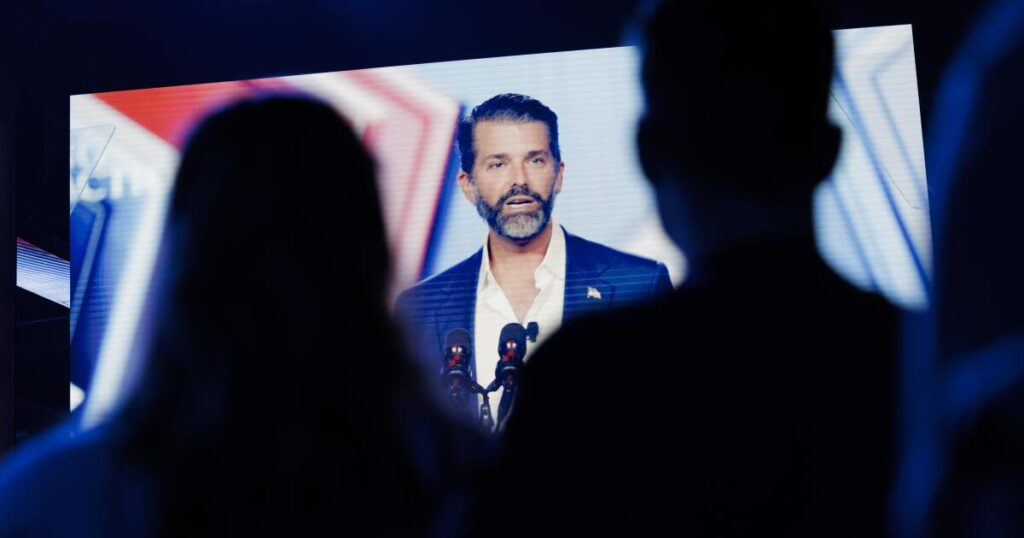
Years of bickering over the meaning of American conservatism and the identity of the American right, which had already escalated in the conspiracy-filled aftermath of coalition lynchpin Charlie Kirk’s horrific assassination, reached a fever pitch at Turning Point USA’s recent AmericaFest conference in Phoenix. The question conservative leaders now confront is straightforward enough: Where do we go from here?
It is imperative — indeed, indispensable — that leaders answer this question correctly and act accordingly.
The conference began, following introductory remarks from Kirk’s widow, Erika, with a tour de force speech from Ben Shapiro. The long-time podcaster, columnist and author condemned the right’s “frauds and grifters,” those “charlatans who claim to speak in the name of principle but actually traffic in conspiracism and dishonesty” and those useful idiots who have refused to take any stand whatsoever amid the explosion of conspiracism because of rank “cowardice.” A number of subsequent speakers, from charlatans like Tucker Carlson to cowards like Megyn Kelly, attempted — in defensive, ham-fisted fashion — to respond to Shapiro’s tone-setting invocation.
The basic case against Shapiro’s appeal — a position I share — was best articulated by Vice President JD Vance in the conference’s closing keynote speech. The veep noted that he “didn’t bring a list of conservatives to denounce or to deplatform” because “Charlie invited all of us here” and “believed that each of us, all of us, had something worth saying.” Therefore, we should not be engaged in “canceling each other.”
True enough. But that’s something of a red herring. No one in the movement, to my knowledge, has called for “deplatforming” or “canceling” Carlson or the antisemitism-peddling podcaster Candace Owens — or even white supremacist Nick Fuentes, for that matter. Between YouTube, Rumble, Instagram and TikTok, video content creators have ample platforms at their disposal. Substack and Elon Musk’s social media free speech haven, X, provide similar myriad opportunities for the dissemination of written content. Given the sordid state of much of the elite institutional press, that is good and as it should be.
So, what, then, is being debated here?
Many on the right seem to have unfortunately misinterpreted and overlearned the relevant lessons of the Big Tech-driven cancelation and deplatforming battles of the late 2010s and early 2020s, which saw many conservatives wrongly “shadow banned” or deplatformed for challenging prevailing orthodoxies on issues such as Covid-19 vaccines and Hunter Biden’s infamous laptop. I have long been an active participant in those debates — I have written about those issues at great length and debated them at many universities. But those debates were about how we ought to think about free speech in an age when the town commons of yesteryear has moved online.
Those conversations had nothing to do with what viewpoints are or are not rightly viewed as being within the conservative fold. That is an entirely separate question, of both principle and prudence, as to which philosophies, viewpoints and individuals ought to be viewed as part of the American right’s noble efforts to protect and preserve the republic from hostile forces, both foreign and domestic. Blithe, lowest-common-denominator appeals against “cancel culture” might garner some plaudits, but in this context they fundamentally miss the mark.
What is called for at this perilous moment for the right’s leaders is not to casually hand-wave away all disagreement as part of the proverbial marketplace of ideas, but to show basic decency and judgment in discerning what is and is not part of the right as it steels itself for the many battles ahead.
In many other contexts, this inquiry is simple. Take infanticide: That’s obviously not part of team civilizational sanity. Should tax dollars go toward sex-reassignment surgeries for minors? Beyond the pale. In no context can these views, and the individuals who espouse them, be considered part of the right’s effort to preserve the United States — and, by extension, the broader West.
Honest leaders must apply the same logic toward viewpoints and individuals that, for their past work or for any other reason, are viewed as “right”-coded. Owens supporting Medieval-style blood libel about Jews and accusing Erika Kirk of complicity in her husband’s assassination? In no sense is such psychotic bigotry and induced brain rot part of the right’s mission. Carlson offering apologia for sharia law and criticizing famed World War II martyr Dietrich Bonhoeffer, a personal hero of Charlie Kirk’s, as a lousy Christian? That is insane — and directly opposed to the solemn task of Western civilization preservation.
It ought to be axiomatic that if one seeks to conserve everything, then he will actually conserve nothing at all. Leaders of any movement dedicated to cultural conservation must therefore be willing and able to exercise judgment in determining what is good and must be conserved, and what is bad and must be discarded. In a Heritage Foundation speech delivered the day before his fusillade in Phoenix, Shapiro referred to this as “ideological border control.” We might also just call it common sense.
Josh Hammer’s latest book is “Israel and Civilization: The Fate of the Jewish Nation and the Destiny of the West.” This article was produced in collaboration with Creators Syndicate. X: @josh_hammer
The post The heart of the American right is on the line appeared first on Los Angeles Times.