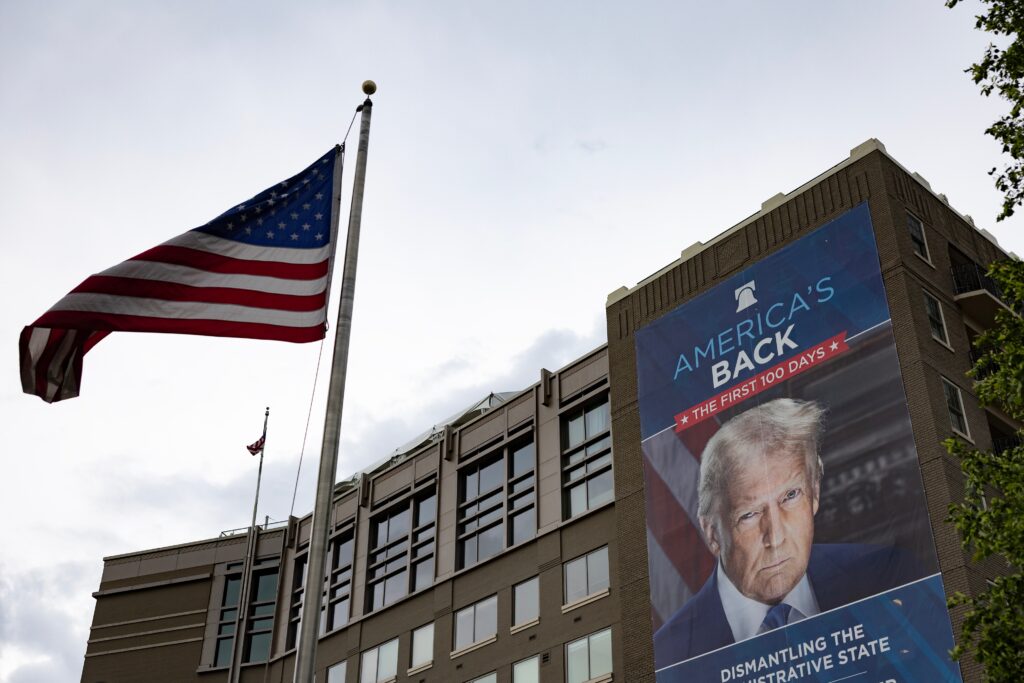
The headline of the Dec. 24 editorial “Without free markets, American conservatism comes apart” was correct, but not the implication that followed: namely, that the Heritage Foundation has become a protectionist bivouac.
Au contraire, Heritage has been, is, and will continue to be a bastion of free-market conservatism. And we will do so while honestly acknowledging when narrowly tailored government interventions are beneficial, including in international trade.
Tuesday’s gross domestic product data showed the economy grew at a robust annualized rate of 4.3 percent in the previous quarter, much faster than even the rosiest forecasts. The tariff-induced cataclysm foretold by many economists did not come to pass.
That’s not to say tariffs don’t have trade-offs; of course they do. True conservatives can acknowledge both government and market failures, and true empiricists can conduct a proper cost-benefit analysis. Three key mentors imparted these facts to me.
Stephen Moore gave me my first job as an economist, and I still work with him today. Larry Kudlow drilled into my head his well-worn aphorism that “free-market capitalism is the best path to prosperity.” Arthur Laffer instructed me on taxes, trade and more. All three dear friends have given me countless lessons on politics, econometrics and free-market principles. I took those lessons to heart.
I, and Heritage, believe free markets are foundational to the conservative movement not out of some dogmatic, Pavlovian response but because they allow for human flourishing. In those rare instances when that’s not the case, the situation calls for a modified approach. Free markets are the means, not the end. We aren’t “conserving” anything if we confuse the two.
E.J. Antoni, Washington
The writer is chief economist at the Heritage Foundation.
Overhead bin woes
I read with interest the Dec. 21 Travel article “Stop putting your coat and small bag in the overhead bin,” on overhead bin etiquette and the apparent moral failing of passengers who dare place a small bag above their heads. Allow me to offer an alternative perspective from those of us who checked our luggage.
When I pay to check a bag, I voluntarily surrender my claim to cabin hold space: space that sits available for the roller bags of fellow passengers who prefer to haul their belongings through the terminal. You’re welcome.
Yet I’m told I should wedge my briefcase and jacket beneath the seat, sacrificing my legroom, because the bins are “scarce”?
Let’s be honest about who created this scarcity: It wasn’t me. It’s the traveler who apparently couldn’t bear to part with their overstuffed and expanded roller bag, and their backpack, their airport shopping bags, their tire-sized travel pillow, the impulse-bought blanket at a kiosk, and the dinner-plate-size headphones draped around their neck like a life preserver.
And, please, spare me the usual excuses. You have a tight connection? You don’t want to risk the airline losing your precious belongings for a three-hour flight? Grow up. The rest of us have accepted that occasional inconvenience is part of the deal with air travel. We checked our bags and moved on with our lives, as functioning adults do.
The article framed this inversely as a tragedy of the commons. Fine, but let’s assign blame correctly. I didn’t create the tragedy. I checked my bag.
The commons is strained because some have decided the cargo hold is for suckers while treating the overhead bin like a personal storage unit.
I’ll keep my briefcase and jacket overhead. There’s plenty of room underneath the plane for everyone’s stuff.
Louis J. Cantolupo, Washington
I take issue with the perceived new normal of airline travel discussed in the Dec. 21 Travel article. However, I agree completely with the article’s plea to be kinder during airline travel because it is anything but enjoyable anymore.
This holiday season, if you want to be kind and make airline travel easier, check your suitcase, don’t even try to recline your seat and be sure to thank the flight attendants
So why do I have no problem putting my coat and my small tote in the overhead? Well, I’m 6-foot-3, I always check my suitcase, and unless I put my coat, my tote, and all the airline pocket litter in the overhead compartment, I don’t fit in my seat.
Airlines used to have coat closets, they didn’t charge for the first bag checked, and they had coach seating that even those of us over 5-foot-8 could tolerate.
Airlines continue to add seats, reduce service, cut work and transfer responsibility to stay competitive. We obtain our own boarding passes, tag our own luggage and, if we want to save baggage fees and gain a few minutes, bring everything into the passenger cabin. This not only slows the boarding process but also asks passengers to put their belongings on unsanitary carpet under airline seats.
Flying used to be more special; today, we are no more than self-loading baggage. If airlines could find a way, they’d probably get us to fuel the jet and fly the plane.
Rob Veale, Elizabeth City, North Carolina
The post The truth about the Heritage Foundation’s economic principles appeared first on Washington Post.