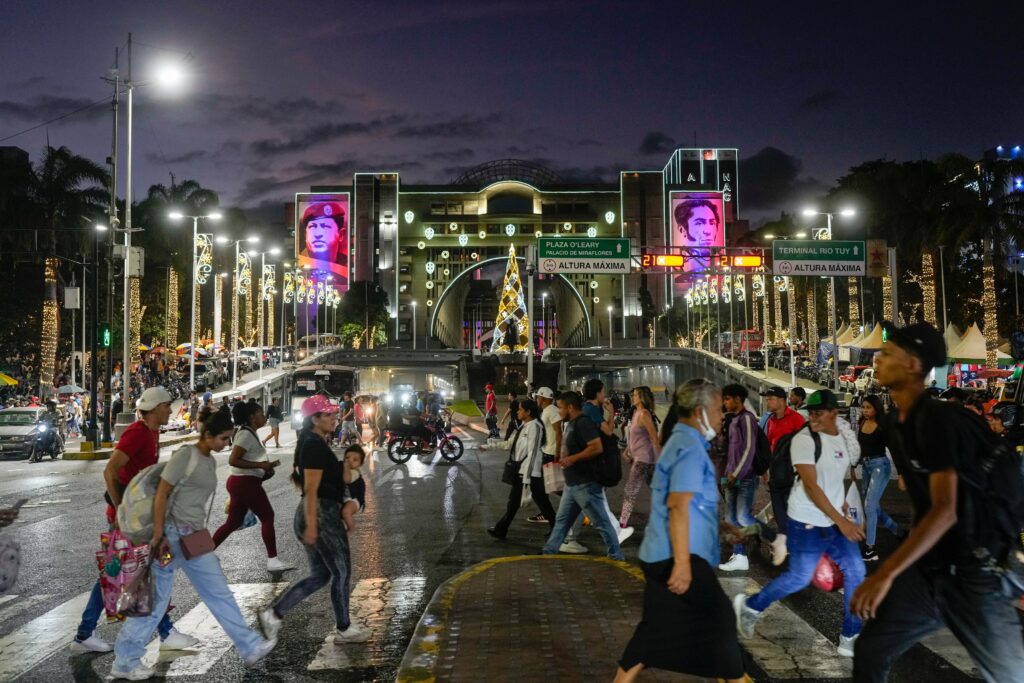
CARACAS, Venezuela — As U.S. forces mass off Venezuela, launch attacks on alleged drug traffickers and seize oil tankers, authorities here are mobilizing the army, calling on allies for support and appealing to the United Nations.
They’re also taking advantage of U.S. threats to crack down on internal dissent, local and international monitors say.
The government of President Nicolás Maduro “has used U.S. pressure as an excuse to deploy the military, label critics as ‘traitors’ and arrest dozens of dissidents,” said Martina Rapido Ragozzino, North Andes researcher for Human Rights Watch. The New York-based rights group said in September it had documented 19 cases in which prisoners were held incommunicado.
Opposition politician Alfredo Díaz, a former governor of Nueva Esparta state, died this month in El Helicoide, the Caracas headquarters of the intelligence agency SEBIN, a year after he was arrested while trying to flee the country. His family says he was denied needed medical care.
And the National Assembly on Tuesday passed legislation imposing up to 20 years in prison for anyone who “promotes, instigates, requests, invokes, favors, facilitates, supports, finances or participates” in the U.S. campaign to seize ships carrying Venezuelan oil, sponsor Giuseppe Alessandrello said.
“The crackdown on civic space has intensified, suffocating people’s freedoms,” Volker Türk, the U.N. high commissioner for human rights, told the U.N. Human Rights Council this month. “Journalists, human rights defenders, opposition figures, and even humanitarian workers continue to face threats, harassment, and the risk of arbitrary detention — simply for doing their jobs.”
(Human Rights Watch and Türk have also criticized the U.S. military strikes on alleged drug traffickers off Central and South America. Human Rights Watch has called them illegal extrajudicial killings; Türk has said they violate international human rights law.)
The developments are unsurprising, Tulane University sociologist David Smilde said. “When you have this very real threat of military operation, of course it’s going to be used as an excuse.”
The crackdown has intensified a campaign of repression launched by Maduro last year. The authoritarian socialist claimed victory in Venezuela’s July 2024 presidential election despite ballot audits by The Washington Post and other independent observers that showed he lost the vote to opposition candidate Edmundo González by a 2-1 margin. When Venezuelans took to the streets in protest, authorities arrested thousands. The independent prison monitor Foro Penal said this month that the government was holding 905 political prisoners.
The United States has considered Maduro illegitimate going back to Venezuela’s previous presidential election, a 2018 vote that was also widely seen as fraudulent. The Trump administration has accused his government of trafficking drugs to the United States. Maduro and several senior Venezuelan officials have been indicted in U.S. federal court on charges of narco-terrorism; the Justice and State departments this year increased the reward for information leading to his arrest or conviction to $50 million.
The administration began deploying warships to the Caribbean in August. U.S. forces have launched strikes against at least 29 boats off South and Central America, killing at least 105 people, since the start of September. The Coast Guard has seized two tankers this month and attempted to capture a third.
The administration says it’s fighting drug trafficking. But President Donald Trump has said repeatedly that Maduro’s “days are numbered”; he told reporters this week that he would be “smart” to step down.
The Venezuelan government has tried to respond through diplomacy while avoiding a military confrontation. Maduro has described the tanker seizures as acts of piracy aimed at stealing Venezuela’s natural resources. On Monday, he sent a formal appeal to all 193 U.N. member states warning of a U.S. “escalation of extremely serious aggression.”
“Venezuela has not committed any act that justifies this military intimidation,” Maduro wrote. He described the U.S. approach as “the lethal use of force outside any international legal framework.”
In an emergency meeting of the U.N. Security Council on Tuesday requested by Venezuela, Samuel Moncada, the country’s representative, accused the United States of “the greatest extortion known in our history.”
U.S. representative Mike Waltz responded that Maduro was “a fugitive from American justice and the head of the Foreign Terrorist Organization Cartel de Los Soles.”
On Wednesday, 35-year-old Johany Méndez headed a prison in the state of Lara with a small bag of food and hygiene products for her nephew. During the hour-long drive, she prayed: “I just ask God to hear our clamor and get my boy back.”
Gabriel José Rodríguez was 16 in January when he was arrested at a hospital in Lara. He’d gone for treatment with a fever. It was the day before Maduro’s inauguration, his aunt said, and he was taken “because they said he looked like a troublemaker.”
Over the past year, he has celebrated his 17th birthday and completed high school behind bars. He was also charged with terrorism, convicted, and, this month, sentenced to 10 years in prison. He’s one of at least five teens imprisoned by the government.
“His father is destroyed, as we all are,” his aunt said. “He loves Christmas — in that way, he is still a kid. Now, without him, it feels empty.”
Jorgen Watne Frydnes, the chairman of the Norwegian Nobel Committee, spoke of Díaz’s death this month in Oslo, where Venezuelan opposition leader María Corina Machado was honored with the 2025 Nobel Peace Prize.
“Alfredo Díaz, an opposition leader and former mayor, was pulled from a bus last November and thrown into the depths of El Helicoide, Latin America’s largest torture chamber,” Frydnes said. “One more political prisoner, in a long line of others. This week came the news of his death. Another life gone. Another victim of the regime.”
In the past year, the government has imprisoned not only political leaders and activists but also regular citizens. Marggie Orozco, a 65-year-old physician, shared a WhatsApp message complaining about Venezuela’s political crisis. She was arrested, charged and convicted of treason, instigating hate and conspiracy. In November, she was sentenced to 30 years in prison.
Also in November, the Committee for the Freedom of Political Prisoners said, a group of men, some in the uniforms of security forces, some not, “violently broke into” a Caracas home and arrested Samanta Sofía Hernández Castillo, 16. Forty-eight hours later, her family learned of the arrest of her sister, Aranza Hernández Castillo, 19, in Maracaibo, their mother, Ambar Castillo, told CNN. Sofía and Aranza are sisters of the former Venezuelan Army Lt. Cristian Hernández, accused of treason and living in exile.
Outside El Helicoide on Tuesday, one prisoner’s small family dressed in white for their visit. “This is the closest thing I have to hell,” the prisoner’s wife said. She spoke on the condition of anonymity out of concern, she said, for retaliation such as the cancellation of her visitation rights or her own arrest.
The woman and her two young children brought a couple of gifts, examined first by guards, and hallacas — pastries of corn dough stuffed with meat and other ingredients and folded in plantain leaves — a traditional Christmas dish here. “We gave him a little bit of our home flavors,” she said. “My kids gave him a nutcracker, to protect him from the evil inside.”
Her son, 8, has asked Santa this year for only one gift: his father’s release.
“He believes he will wake up to his dad,” the woman said.
She reads the same books as her husband as a way to connect with him, and the family planned to eat the same dinner and breakfast as he will. But she didn’t know whether the guards would let him keep the food, or allow further visits. In August, Human Rights Watch reported, El Helicoide limited family deliveries to Fridays, “ending daily food and multiple weekly drop-offs.”
“In other cases,” the rights group said, “prison authorities allowed visits for a period of time and then arbitrarily denied them for weeks or months.”
“Honestly,” the prisoner’s wife said, “sometimes I see Madam Justice with her eyes covered and I think, if there could be a way to uncover them and help her see.”
Brown reported from Washington.
The post Venezuela’s Maduro using U.S. military threat to crack down on dissent appeared first on Washington Post.