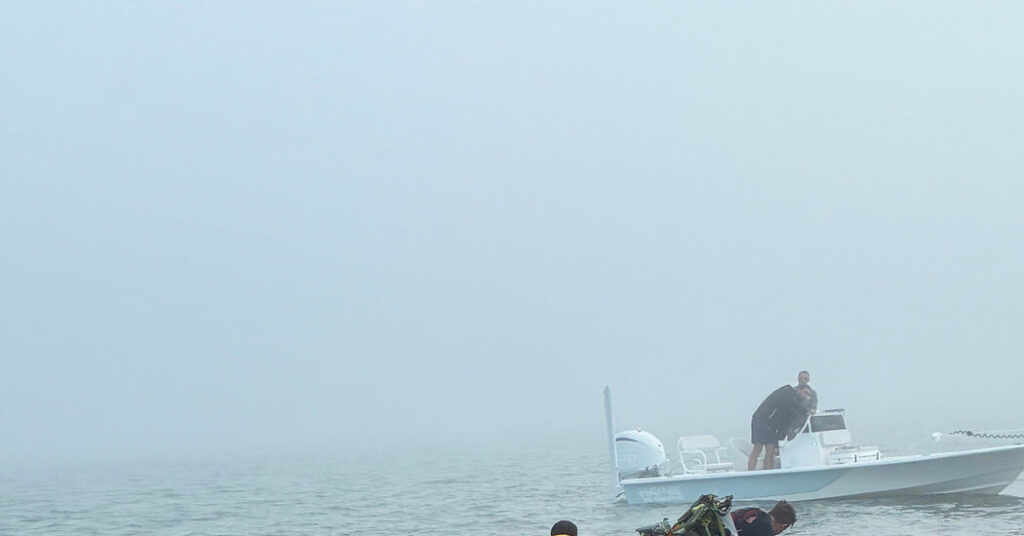
Todd Donaldson was fishing with family on Monday near Galveston, Texas, when he caught a glimpse of a plane — flying too low, he thought — before it vanished back into the dense fog that had enveloped the bay. A few seconds later came sounds he would not forget: a sharp, concussive crack followed by the heavy slap of water. It did not echo. The fog swallowed it.
“It was dead silence,” he said. “We couldn’t hear the motor anymore, nor the propellers.”
He did not see the crash, but with an airport just across the bay, he followed the sound and the path of the jet he had caught only a peek of.
As Mr. Donaldson, a 57-year-old resident of Cypress, Texas, steered his boat toward it, debris began to appear. Strips of metal and insulation drifting like torn cotton. Then the strong and unmistakable smell of jet fuel.
By the time the fog began to thin, the facts started to come into focus. A Mexican Navy King Air medical transport plane had crashed into Galveston Bay, killing six people and leaving two survivors. Among the dead was a 2-year-old burn patient being flown from Mexico for treatment. The aircraft had four crew members and four civilians, on a humanitarian mission meant to save a life. Federal officials, along with the authorities in Texas, are investigating the crash.
Mr. Donaldson and his group were the first people to reach the wreckage. As they crept through the fog, they heard a woman screaming. A possible survivor, they thought.
A 27-year-old care flight nurse was alive in the middle of twisted metal and floating wreckage just breaking the surface of the bay. Mr. Donaldson gave the woman his hand to get her safely aboard as they combed through the wreckage. Her neck, chest and legs hurt, he said.
“If we hadn’t found the young woman alive first, before we found the wreckage, I would have never thought that anybody would have survived that,” Mr. Donaldson said.
The woman had been thrown from the fuselage, roughly 50 yards from them, he said.
The plane was almost completely submerged. The fuselage was torn open, metal peeled back and twisted. It looked less like an aircraft than a crushed aluminum can.
Sky Decker, a boat captain from Galveston, Texas, who lives about a mile from the crash site, assumed that no one could still be alive inside. He was about to dock his boat when a neighbor told him about the crash, so he rushed back out.
Then came a shout.
Inside the plane, a woman was trapped high in the cabin. Only inches of air remained between her and the waterline. She was holding herself up so her mouth stayed above water as waves rolled through the broken fuselage, Mr. Decker said. Each passing boat wake briefly erased that space, forcing her to hold her breath and wait for the water to recede.
The interior of the plane had collapsed into chaos. Seats had broken loose and piled together. Wall panels floated and snagged. There was no clear path to her. Mr. Decker, 58, could see her but could not reach her.
A yacht captain comfortable in the water, he dove in.
“I didn’t even notice it being cold,” he said. “I was on a mission.”
Mr. Decker pulled the seats and debris free one by one. Time stretched. But eventually, their eyes met. He spoke to her in Spanish, telling her to hold on and that he would get her out, five minutes seeming like an eternity, measured in breath and effort.
He does not dwell on the details of her injuries, saying only that she was in terrible shape.
“Seeing her mangled legs when we got her out of the water, oh my goodness,” Mr. Decker said.
Once she was free, the path inside the plane opened enough for him to go back in. There was a man in front of where she had been. Mr. Decker worked by feel now, reaching where sight failed. The man had been underwater longer. When he pulled him free, there was no response.
“I’m pretty sure he was already deceased,” Mr. Decker said later. “I tried to reach the pilot and co-pilot but there was no way I could get in there.”
Mr. Decker knew it would have been too dangerous to retrieve them.
The woman survived. The authorities later said she was responsive and talking.
Six others did not.
Among them was the 2-year-old burn patient being flown for treatment. Mr. Donaldson recalled seeing bottles of Pedialyte and a small child’s jacket floating in the water.
For Mr. Decker, the experience stirred memories he thought he had put behind him. When he was 10 years old, his father had crashed a small plane. No one died, but the trauma lingered. For years, Mr. Decker dreamed of planes crashing, of being inside them as they fell. Those dreams followed him well into adulthood before finally fading.
“I’m done with small planes,” he said.
Mr. Donaldson returned home carrying images he could not easily set aside. He spoke of the emotional toll, of the silence afterward, of trying to explain to others what it feels like to be first on scene when something goes terribly wrong.
“That was the worst feeling in the world. I cried quite a bit about that last night, after I got home,” Mr. Donaldson said late on Tuesday.
As the fog lifted and the toll became clear, the weight of it all settled on the two good Samaritans and their community. “When the moment came, people didn’t ask whose job it was they simply acted,” the Galveston police chief, Doug Balli, wrote in a social media post. “Galveston showed its heart, and I’m grateful beyond words.”
Sheelagh McNeill contributed research.
Mark Walker is a Times reporter who covers breaking news and culture.
The post After a Plane Crashed in the Texas Fog, 2 Stories of Rescue appeared first on New York Times.