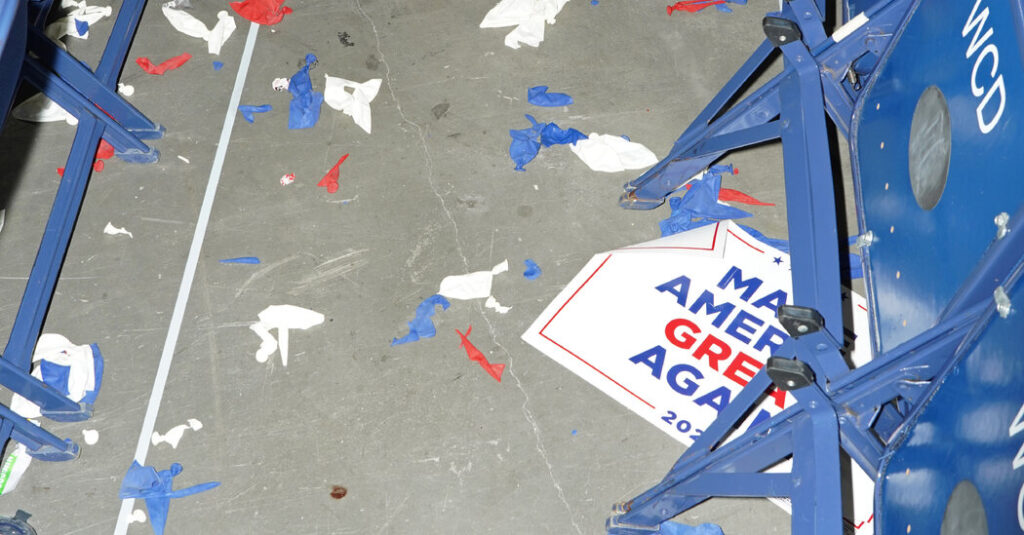
In 1935, the English journalist George Dangerfield published a book-length political obituary for the British Liberal Party, which only a few decades earlier had found itself “flushed with one of the greatest victories of all time” after winning a commanding parliamentary majority and passing a series of long-sought reforms. “From that victory,” Mr. Dangerfield wrote, “they never recovered.”
Nearly a century after its publication, “The Strange Death of Liberal England” still makes for instructive reading — especially after the recent annual gathering of Turning Point USA, where conservative infighting seemed to threaten President Trump’s remarkable political movement. Mr. Dangerfield thought that the Liberals, who by the mid-1930s were an all but spent force electorally and intellectually, had been victims of their own success. They ended up with a political coalition that was not only divided internally but also increasingly aloof from the concerns of ordinary voters.
Though parts of Mr. Dangerfield’s narrative have been criticized by academic historians, his central argument remains persuasive: Coalitions organized around symbolic enmities and ideological absolutes rather than shared material interests are prone to sudden collapse. The analogy with today’s G.O.P. should not be pressed too hard, but his main insight will travel a bit.
Not long ago, the Make America Great Again movement was ostensibly a right-leaning response to neoliberalism. Its bugbears were free trade, immigration, postindustrial decline, institutional inertia and the cultural condescension of an elite managerial class. Its greatest strength was its breadth. Former Tea Party voters, paleoconservatives, Christian culture warriors, foreign policy realists and a small but decisive number of disaffected Democrats in the Midwest: All could be part of MAGA because its enemies (the establishment, the swamp, the media, globalism) were external and vaguely defined. These antagonists provided MAGA with a raison d’être and, after 2016, an excuse for every perceived failure or delay.
This state of affairs was always bound to be temporary. A year into Mr. Trump’s second term in office, MAGA’s internal contradictions can no longer be ignored. The movement that had promised an end to foreign adventurism has found itself torn between an alliance of ideological noninterventionists and realists and a hawkish national security establishment. Trumpism promised a revival of domestic manufacturing, yet neither the president nor his advisers have decided whether this means tariffs, industrial policy, reviving organized labor, environmental deregulation or mere nostalgia. MAGA also promised immigration reform but has oscillated between showboating deportations and a deference to pro-visa allies in Big Tech and corporate agriculture. At the same time, American support for Israel has become a contested issue on the right for the first time in decades. Some opponents have been accused of antisemitism; others simply announce it.
The result of a decade of these upheavals has not been consolidation of the Trumpist position but a series of existential questions to which no one seems capable of providing a definitive answer.
Yet sooner or later, someone must answer them. Tucker Carlson and Ben Shapiro, who publicly clashed at the Turning Point USA gathering, cannot represent the same broad political tendency. But it is hard to see how the necessary anathemas will be issued. At present there is no incentive for any major figure or group to excommunicate anyone from the movement except in the most extreme cases. Resolution would require sacrifice: the narrowing of appeal, the loss of audience and donor support, the abandonment of ideological and rhetorical flexibility.
MAGA’s internal culture has always rewarded theatrical confrontation over achievement. Boorishness commands attention, and boors mistake attention for leverage. Pseudo-martyrdom becomes an end in itself. Loyalty tests proliferate. Those who counsel de-escalation find themselves subject to denunciation; prudential disagreement is allowed to provide cover for rank bigotry. Partisans celebrate one another for exacerbating tensions even when exacerbation forecloses coalition building.
There is also a related problem: The Trumpist movement has generated a lunatic array of semiautonomous online subcultures that are largely indifferent to strategic considerations and immune from political consequences while still exercising influence over actors whose decisions are not so immune. The disappearance of the informal gate-keeping function once performed by conservative luminaries such as William F. Buckley Jr. is probably permanent. In the absence of such authority, informed argument exists alongside phony outrage, profiteering, self-aggrandizement and saying things for the hell of it. The result is not merely the radicalization that Mr. Buckley feared but a kind of omnidirectional incoherence.
This problem extends to Mr. Trump himself. No postwar political movement has been more closely bound up in the fortunes of its founder than MAGA is. Yet during the recent controversies, Mr. Trump’s own views have been neither heeded nor even earnestly solicited. Slowly, almost imperceptibly, he has begun to recede from the movement he created. The Republican Party has been remade not exactly in his image but in a looser, more chaotic approximation of his style, without the singular personal authority that once held its factions together.
Whether we are about to witness a “strange death” of Trumpism remains an open question. But Mr. Dangerfield was an astute pathologist, and the symptoms he cataloged nearly a century ago are now unmistakable. They may also prove terminal.
The Times is committed to publishing a diversity of letters to the editor. We’d like to hear what you think about this or any of our articles. Here are some tips. And here’s our email: [email protected].
Follow the New York Times Opinion section on Facebook, Instagram, TikTok, Bluesky, WhatsApp and Threads.
The post The Strange Death of Make America Great Again appeared first on New York Times.