This is an edition of The Atlantic Daily, a newsletter that guides you through the biggest stories of the day, helps you discover new ideas, and recommends the best in culture. Sign up for it here.
Christmas has always made me nostalgic, but I have come to realize, with something of a jolt— perhaps because I just turned 65—that my sense of nostalgia is not what it used to be. When I was younger, I happily got all wistful when hearing Johnny Mathis or Perry Como because I would think of my parents and the Christmases I knew as a little kid. My folks were still around, and it didn’t seem all that long ago that I was hoping to find new accessories for my beloved Captain Action doll under the tree.
When you’re very young, you’re enveloped in the memories and traditions of the adults around you. But my parents have been gone for many years, and the house I grew up in, where my mother would lovingly tape every Christmas card to the walls, has changed hands at least twice since their passing. So I now find myself comforted less by the songs of my childhood and more by the music I came to love as a teen and young adult—just like my parents did in the 1960s, when they were dreaming about the 1940s. I now want to remember my contemporaries, not those of my parents. Perhaps that’s how time and memory work; I still have fond recollections of my childhood, but I also have a kind of newer nostalgia.
So yes, when I hear Vince Guaraldi, I still think of being bundled up in my pajamas with a mug of hot chocolate and A Charlie Brown Christmas. But if you look at my Spotify list of Christmas songs, you’ll see that these days I am truly nostalgic not for Percy Faith but for … Billy Joel and the Alarm. I will always love Judy Garland’s “Have Yourself a Merry Little Christmas,” but think of this: In 2025, we are now as far away from the Waitresses’ “Christmas Wrapping” as we were from Meet Me in St. Louis when I was in college back in the early 1980s.
My list does not include a hundred versions of “Last Christmas” and the earworm known as “All I Want for Christmas Is You.” Allow me to offer something a little more, ah, idiosyncratic.
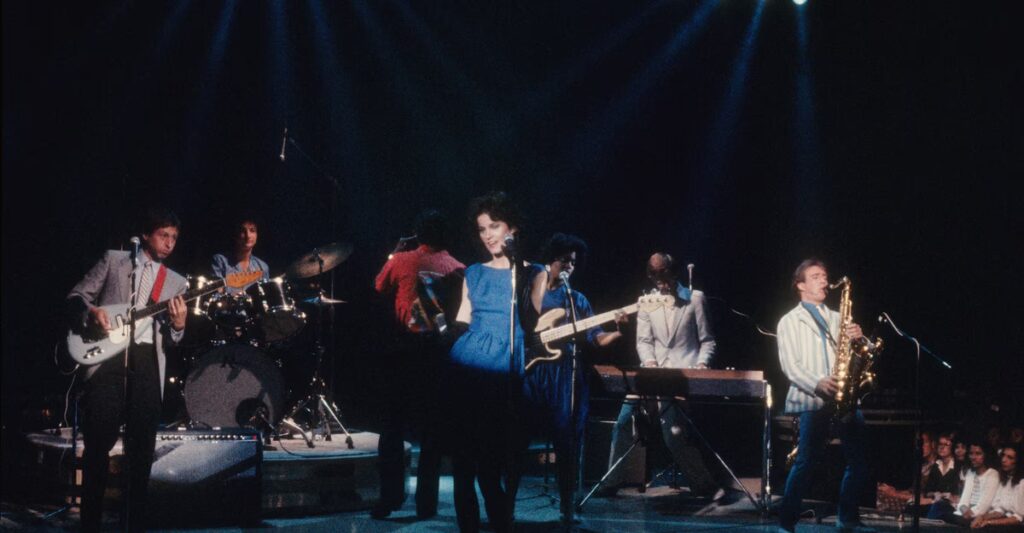
“Christmas Wrapping,” released in 1981, has become a charmingly offbeat holiday mainstay for decades. It shouldn’t work at all as a holiday song. It’s a tale of harried urban singledom—with an admittedly happy ending—half-sung and half-rapped by the late Patty Donahue in her trademark flat-affect voice. When I was in college, the first jingle-jingles of “Christmas Wrapping” on Boston’s FM stations meant that school was done, and that I was going to go home to see my family. The song has always marked, for me, the beginning of the season.
The rest of my list, however, isn’t very upbeat. (Notable exception: “Christmas Won’t Be the Same Without You,” a great 2008 sing-along by the Plain White T’s and proof that I listen to a few things from this century.) In fact, most of these songs are rather melancholy. Perhaps the theme among them is something I try to remember at Christmas: “There but for the grace of God go I.”
Greg Lake, of the group Emerson, Lake & Palmer, didn’t really mean to write a Christmas song when he released “I Believe in Father Christmas” in 1975. Lake’s song, composed with lyricist Peter Sinfield, laments the loss of his childhood wonder at the holiday; he describes feeling betrayed because “they said there’ll be snow at Christmas … / But instead it just kept on raining.” I get that feeling; I am a man of faith who nonetheless knows that Christ was not born on December 25, who no longer believes in Santa Claus, and who feels mournful when it rains on Christmas.
“Circle of Steel,” a 1974 song by Gordon Lightfoot, is also lovely but depressing. Lightfoot tells three stories of inner-city Christmas despair, as reminders that life is a roulette wheel—a circle of steel—where many lose, and the rest of us should count our blessings. More than a decade later, Sir Bob Geldof, co-writer Midge Ure, and a bevy of top British and Irish artists collectively recording as the group Band Aid would do the same with a song titled “Do They Know It’s Christmas?”
Ironically, the people who made “Do They Know It’s Christmas?” aren’t crazy about it, despite the song’s success in raising money at the time for famine-stricken Ethiopia. “It’s not a great song,” Ure said in 2014. “Had we known it would end up side-by-side with ‘Silent Night’ and ‘White Christmas’ we’d have tried to write a better track.” Geldof said in 2010 that it was one of the “worst songs in history,” but he has since softened his view, noting a “guileless innocence” that resulted in something that is “so English, spotty, scruffy.”
Geldof, Ure, and Band Aid created a brutal, if melodic, reminder that in some places, Christmas bells are the “clanging chimes of doom,” and not everyone is choosing between turkey and ham while drinking good wine and exchanging expensive gifts. “Tonight,” the Irish singer Bono, of U2, howls, “thank God it’s them instead of you.”
I have a special affection for the song because I bought it as a 12-inch-vinyl single in 1985 and discovered a gem on the other side: A long version with all of the stars wishing you (as the British say) a happy Christmas, including a gentle remonstration about world hunger from David Bowie. Sure, I have some quibbles with it: For one thing, Ethiopia, the epicenter of the 1984 famine, is a nation with a large population of my fellow Orthodox Christians, so yes, they did in fact know it was the Christmas season. But even I am not enough of a curmudgeon to dislike a Christmas song that wraps a classic Brit-pop sound and the instantly recognizable drumming of Phil Collins around bushels of real sincerity.
Other songs on my list, I admit, make for oddball listening. “Snoopy’s Christmas” was a goofy but adorable—and extremely catchy—novelty hit by the Royal Guardsmen in 1967, in which our canine pal encounters the “Red Baron” in combat on Christmas Eve, and instead of fighting, they enjoy a chivalrous truce.
The thing is, such truces did happen in World War I, so after you smile at Snoopy, listen to “Christmas in the Trenches,” a 1984 song by the American folk singer John McCutcheon. McCutcheon’s gentle ballad opens with British and German troops hearing each other as they sing carols in their trenches while celebrating Christmas. Soon—as actually happened in some places during the Great War—they tentatively venture out into no-man’s-land to shake hands, “share some secret brandy,” and play soccer by flare-light. As morning comes and the war resumes, the men return to their trenches but wonder: “Whose family have I fixed within my sights?”
You might notice that my list includes some real clunkers. Why did I include “Wonderful Christmastime,” by Paul McCartney? (Because it was released during my first year of college; that’s why. I know it’s terrible. Shut up.) The sticky gunk from Neil Diamond and Faith Hill is there because I’m old enough that even the 1990s can trigger nostalgia. And I have to listen to the boys from South Park do “Merry F**king Christmas” as a kind of palate cleanser now and then, despite my wife’s exasperated sighs.
I hope that whatever your faith or tradition, this season you find some joy, and that you take a moment—as the young people in Band Aid sang so long ago—to “pray for the other ones” and remember our common responsibility to them. I know this has been a tough year, but remember, as Judy Garland promised us in 1942: “Let your heart be light,” and hope, as we always do, that “next year, all our troubles will be out of sight.”
Merry Christmas.
Related:
- The most haunting—and most inspiring—moment in A Christmas Carol
- The most beloved Christmas specials are (almost) all terrible.
Evening Read

What I Lost When I Gave Up My Catholicism
By Xochitl Gonzalez
Few experiences in modern life are as wondrous as a really good Christmas Vigil Mass. It’s a full sensory encounter: the sight of the chapel, decked out for the holidays; the smell of the incense; the sound of the choir singing “Adeste Fideles” or “Hark! The Herald Angels Sing”; the taste of the Communion wafer; the heavy feel of the chalice when you sip your Communion wine. The message, every year, is that no matter the state of the world, goodness can be born anew.
I don’t remember the last time that I let myself experience this.
More From The Atlantic
- Thomas Chatterton Williams: The other way the “super woke” left discriminates
- ChatGPT needs more cowbell.
- The writer fueled by life’s randomness
Culture Break

Examine. Why did we ever watch To Catch a Predator? A new documentary (streaming on Paramount+) probes the influential Dateline series—and the titillating nature of true crime itself, Sophie Gilbert writes.
Listen. Growing up, Anna Holmes’s holidays were profoundly shaped by the sound of a Charlie Brown Christmas.
Stephanie Bai contributed to this newsletter.
When you buy a book using a link in this newsletter, we receive a commission. Thank you for supporting The Atlantic.
The post An Idiosyncratic Christmas Playlist appeared first on The Atlantic.